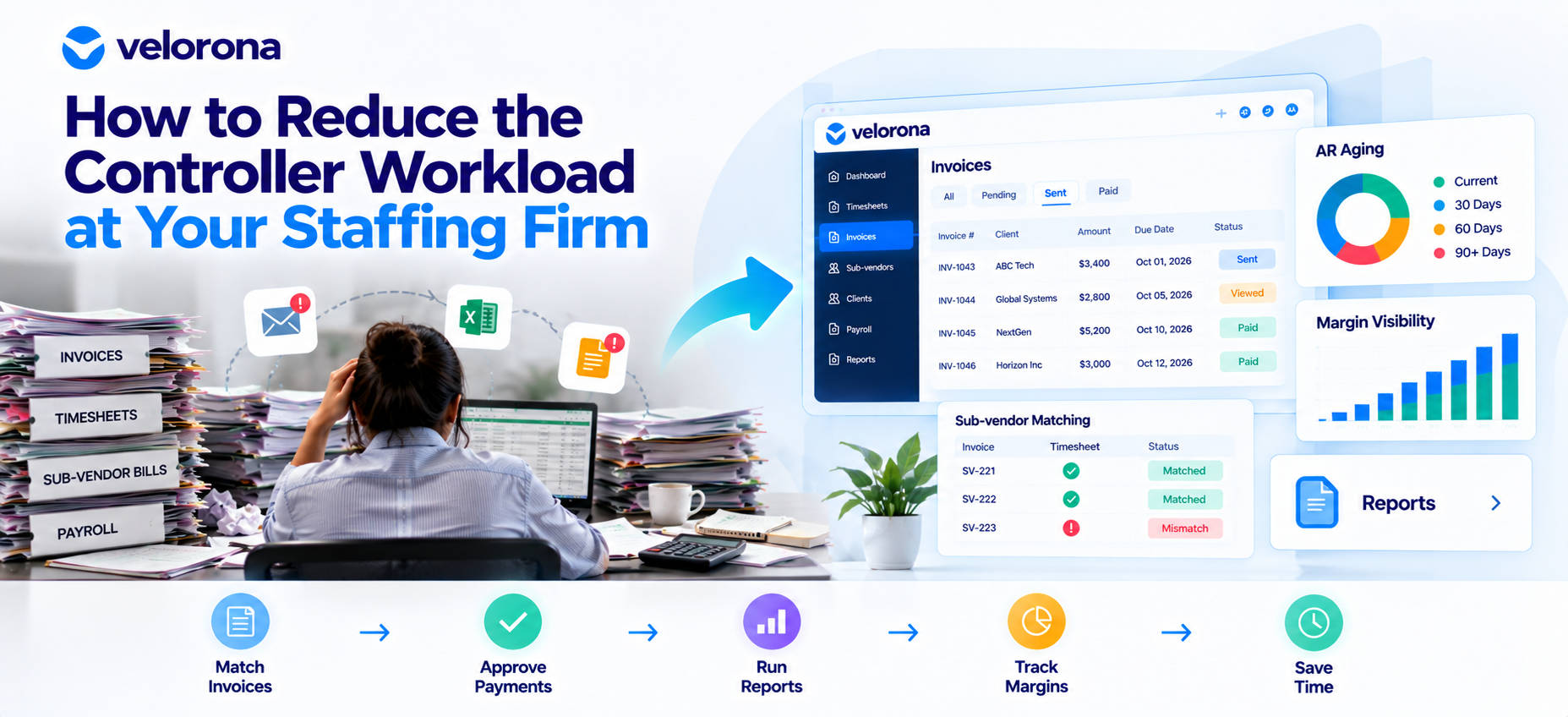
What Does a Staffing Firm Controller Actually Do and What Should She Do?
On paper: manage AR and AP, reconcile sub-vendor invoices against timesheets, prepare payroll data, produce margin and client P&L reports, and keep the books audit-ready. However, in practice at most firms running on spreadsheets and email, the bulk of that time goes to the first two items matching invoices to hours by hand because nothing does it automatically.
As a result, the reporting and analysis work the part that actually needs a controller’s judgment gets squeezed into whatever time remains. Usually the controller completes it in a rush at month-end instead of continuously. That’s the core staffing firm controller workload problem: the role’s highest-value work consistently loses priority to its lowest-value task.
Why Does Manual Reconciliation Consume So Much Controller Time?
Because it’s fundamentally a data-matching problem that a human performs instead of a system. Here’s what happens every pay period:
The Line-by-Line Matching Process
A sub-vendor invoice arrives. The controller then finds the matching timesheet, compares hours line by line, checks the rate against the contract, and flags anything that doesn’t line up. She repeats that for every sub-vendor, every pay period. Consequently, multiply that across 10, 20, or 40 sub-vendors and it adds up fast.
This is the same root cause we cover in How Sub-Vendor Invoice Errors Cost Your Staffing Firm $12,000 to $25,000 Every Year: a 3-5% error rate on sub-vendor spend that manual matching rarely catches completely.
Why This Work Doesn’t Need a Controller’s Expertise
None of this requires a controller’s judgment. It requires patience and time which is exactly why it’s expensive labor doing cheap work. In other words, every hour your controller spends matching invoice line items against timesheet entries is an hour she doesn’t spend on margin analysis, AR follow-up, or client profitability reporting.
How Does the Staffing Firm Controller Workload Break Down?
The following table shows how reconciliation dominates the controller’s time and what changes when the system handles the matching:
| Dimension | Manual Reconciliation | Automated Matching |
|---|---|---|
| Monthly time on invoice-timesheet matching | 12+ hours | ~90 minutes |
| Work type | Data entry and manual comparison | Exception review and judgment calls |
| Time left for analysis and reporting | Whatever remains after reconciliation | Most of the role |
| Margin and AR visibility | Produced in a rush at month-end | Available on demand from the invoices dashboard |
| Sub-vendor error detection | Catches some errors misses others under time pressure | System flags every mismatch before payment |
| Risk if controller leaves | Institutional knowledge walks out the door | Process lives in the system, not in her head |
That last row matters more than it looks. When reconciliation lives in a controller’s head and habits, her departure doesn’t just create a hiring problem. It triggers a 2-4 week operational crisis while whoever remains tries to reconstruct how things worked. We cover that scenario in detail in Staffing Back Office Automation: One Platform.
What Does This Misapplied Controller Time Actually Cost?
The direct labor cost is real but it’s the smaller number. Here’s where the true cost sits:
The reconciliation hours themselves. At 12+ hours per month, your controller dedicates roughly 150 hours per year to a task that automated matching handles in about 18 hours total. That’s 130+ hours of skilled labor redirected to data entry time your firm pays for but doesn’t benefit from.
The sub-vendor errors that slip through. Manual matching carries a 3-5% error rate. At $500K to $1M in annual sub-vendor spend, that’s $12,000-$25,000 per year in overpayments that nobody catches because the controller runs out of time to verify every line. We document this in the sub-vendor invoice errors deep dive.
The margin analysis that never happens. If your controller can’t tell you which clients actually generate profit without a two-day spreadsheet exercise, you make business decisions without current data. The margin visibility problem exists specifically because the person who should produce those numbers spends her time on reconciliation instead.
The DSO that creeps up. When your controller spends her week matching invoices, she has no capacity for proactive AR follow-up. Consequently, slow-paying clients stay slow because nobody sends consistent follow-up. We cover that connection in how to reduce DSO at a staffing firm.
The year-end fire drill. If reconciliation data stays messy all year, January becomes a multi-week scramble to prepare 1099-NECs and year-end filings an emergency that clean year-round data prevents entirely.
How Do You Fix the Staffing Firm Controller Workload Without Replacing Her?
The goal isn’t replacing your controller. It’s removing the manual matching work so her time goes toward analysis, exceptions, and judgment calls the parts of the role that actually need a person.
Step 1: Move the reconciliation process out of her head and into the system. If sub-vendor invoices automatically match against timesheet data, the process doesn’t depend on one person remembering how it works. Velorona’s bidirectional reconciliation does this: client invoices going out matched against sub-vendor invoices coming in, with mismatches flagged before payment.
Step 2: Document what remains as judgment calls. Once matching runs automatically, what stays is genuinely a judgment call approving a flagged exception, deciding on a disputed rate. That’s a much smaller, more teachable list than “how do you reconcile everything.” Furthermore, every decision gets timestamped and logged in the audit trail, so the next person can see the history.
Step 3: Make margin and AR reporting self-serve. If margin per client and AR aging sit available on demand instead of something only the controller knows how to pull, a new hire or a temporary gap doesn’t leave you blind. In Velorona, the client dashboard shows this without a separate report.
Step 4: Consider payroll outsourcing for execution, not data. Once reconciliation runs automatically, some firms outsource remaining payroll execution to a partner. Velorona focuses on clean pay tracking and data — payroll details that feed your payroll provider not filing payroll taxes or issuing paychecks directly. Payroll execution via Gusto Embedded targets Q4 2026 on Velorona’s roadmap.
What Happens When You Stop Asking a Controller to Do This Manually?
Note: This is a representative scenario based on typical staffing-firm workflows, not a named customer case study.
Consider a hypothetical IT staffing firm where the controller’s week runs 12+ hours on reconciliation alone. After the firm automates invoice-to-timesheet matching, that reconciliation workload drops to about 90 minutes of exception review the same metric Velorona documents for firms that move from manual to automated matching.
Where the Freed Time Goes
The time that opens up doesn’t disappear. Instead, it shifts to the margin analysis and client reporting the role should have covered all along. Specifically:
Month-end close compresses. Instead of a multi-day reconciliation sprint, the controller reviews exceptions and exports clean data. The heavy lifting already happened automatically throughout the month.
Margin problems surface earlier. A client that quietly went negative because a sub-vendor rate crept up without anyone noticing gets caught in the current billing cycle instead of at year-end renewal.
AR follow-up becomes proactive. With reconciliation off her plate, the controller has capacity to watch the AR aging report weekly and follow up on slow-paying clients before they cross into the 60-day bucket. That’s the same DSO improvement we cover in Cut Your Staffing Firm’s DSO.
The core shift: the staffing firm controller workload moves from data entry to data analysis. The role doesn’t change the work inside it does.
What Should You Honestly Expect From Velorona and What Isn’t Ready Yet?
Velorona handles timesheets, sub-vendor invoicing with bidirectional reconciliation, client portal auto-delivery with read receipts, multi-currency invoicing (USD/INR with FX lock), expense tracking, time-off, schedules, payroll details, bulk timesheet approval, and audit logs with 2FA.
The Team plan costs $10/month per user ($7/month on annual billing), with no setup fees and no implementation cost. As a result, firms typically go live in 5 to 14 days. Compare that to CEIPAL ($30K–$50K/year, 12 weeks implementation) or Bullhorn ($50K+/year). Full plan details sit on the pricing page.
What Isn’t Available Today
However, Velorona does not do the following today: QuickBooks Online integration targets Q3 2026 (until then, you export clean matched data via CSV). Similarly, Stripe Connect for online invoice payment targets Q3 2026. The team currently builds SSO. In addition, Public API + Zapier targets Q3 2026. Payroll execution via Gusto Embedded targets Q4 2026. Finally, 1099-NEC auto-generation also targets Q4 2026. The FAQ page covers additional details.
If you need in-platform payroll execution or QuickBooks sync today, the honest answer is to wait or evaluate alternatives. On the other hand, if your core pain is the staffing firm controller workload consumed by manual reconciliation, Velorona addresses that today.
One month free trial. No credit card required.
Frequently Asked Questions About Staffing Firm Controller Workload
My controller just quit what do I do first?
Figure out what the system actually reconciles versus what lived as tribal knowledge in her head. If invoice-matching and timesheet approval run through an automated system rather than manual spreadsheets, a temp or a new hire can step into the judgment-call work in days not weeks. If everything ran manually, start by identifying the three or four sub-vendors with the largest spend and reconstruct their reconciliation first, since that’s where the biggest dollar errors hide. The one-platform approach prevents this exact crisis.
Does 12 or more hours a month of reconciliation really count as typical?
Yes, for firms with 10-plus sub-vendors running manual matching. Firms with fewer sub-vendors or already-automated matching see meaningfully less. However, the American Staffing Association context helps here: at industry net margins of 3-7%, every hour your controller spends on data entry instead of margin analysis directly affects your ability to spot profitability problems.
Should I hire a second controller instead of automating?
A second hire solves the time problem but not the institutional-knowledge risk. Furthermore, it adds significant salary cost without addressing the root cause: manual matching that a system handles in a fraction of the time. Automating the matching work first often means you don’t need the second hire at all.
Does Velorona replace my controller?
No. It removes the manual matching and data-entry work so your controller’s time goes toward analysis, exceptions, and judgment calls the parts of the role that actually need a person. The staffing firm controller workload shifts from low-value tasks to high-value tasks. The role stays.
What about outsourced payroll providers do they solve this?
They can execute payroll well. However, most don’t touch sub-vendor invoice reconciliation or margin reporting, which is where the bulk of the wasted controller time actually sits. In other words, outsourcing payroll execution and automating reconciliation solve different problems and most firms need both. Velorona handles the reconciliation and data side. Payroll execution via Gusto Embedded targets Q4 2026.
How does controller workload connect to year-end 1099 prep?
Directly. If your controller spends all year on manual reconciliation, the sub-vendor payment data stays messy. Consequently, January becomes a fire drill to untangle twelve months of scattered records before filing 1099-NECs. We cover the fix in January Is Coming: Get Your 1099 Data Ready Now.
Get Your Controller’s Time Back
If your controller spends her week buried in reconciliation instead of running the reports that actually protect your margin, that’s a fixable gap not a hiring problem.
Book a personalized demo and we’ll walk through what currently eats her month and show you what automated matching looks like against your actual sub-vendor and timesheet data. Alternatively, Claim 2 Months 100% FREE Premium Plan, no credit card required.
Related reading:
- How Sub-Vendor Invoice Errors Cost Your Staffing Firm $12,000 to $25,000 Every Year
- Staffing Firm Margin: Where It Actually Disappears
- The Friday Night Reconciliation Ritual: What It Actually Costs
- Cut Your Staffing Firm’s DSO Without Chasing Clients
- January Is Coming: Get Your 1099 Data Ready Now
- Closing the Staffing Cash Gap
- Staffing Back Office Automation: One Platform
- The Complete Guide to Staffing Agency Back Office Software