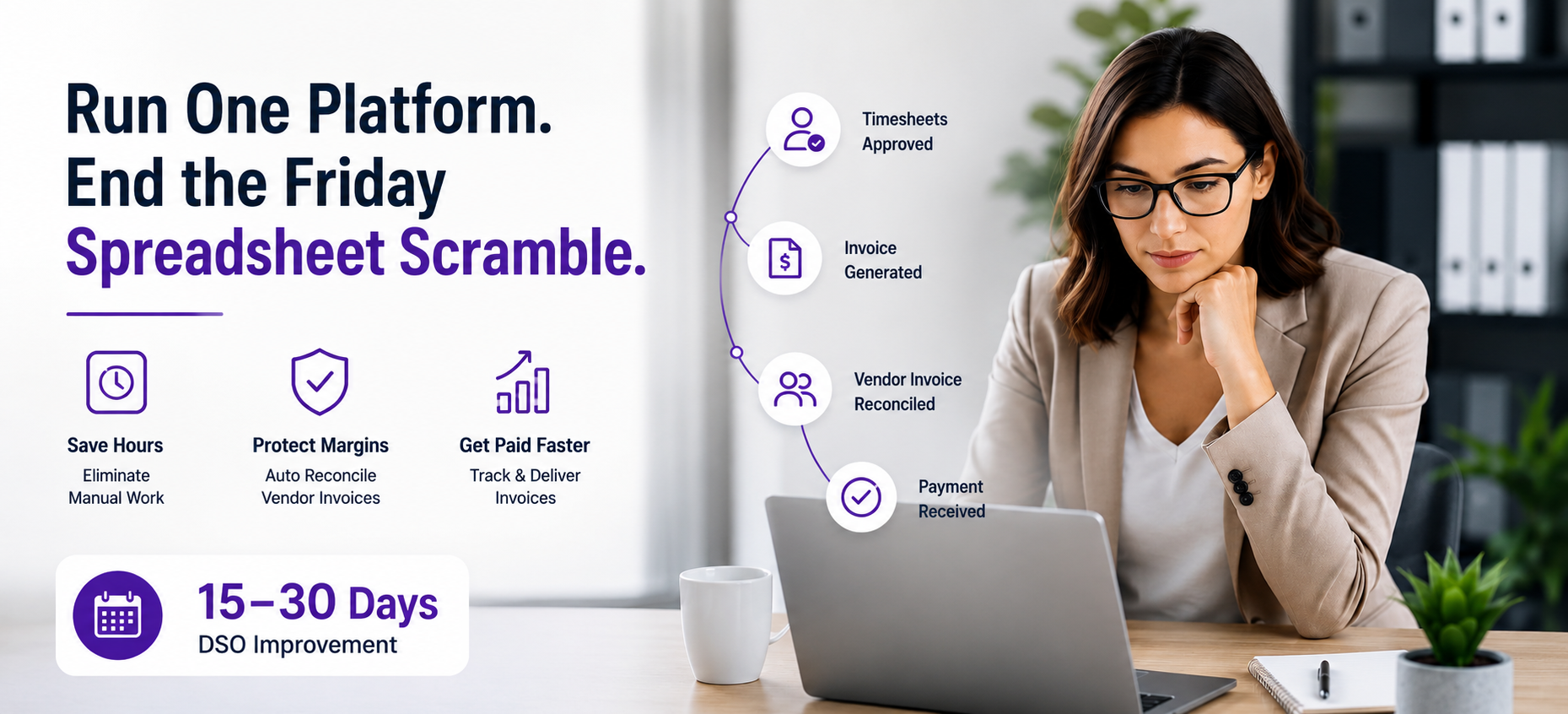
Staffing Back Office Automation: Run One Platform and End the Friday Spreadsheet Scramble
Quick answer: Staffing back-office automation replaces the Friday spreadsheet scramble by running timesheets, invoices, and sub-vendor billing on one platform with zero re-entry. When approved hours generate both the client invoice and the sub-vendor invoice automatically, reconciliation stops being manual, errors get caught before payment, and your controller gets their evenings back.
Why Does Staffing Back Office Automation Become Essential Around 50 to 60 Consultants?
How the Spreadsheet System Holds – Until It Doesn’t
For the first 30 consultants, one organised person can hold the whole back office together in QuickBooks, Excel, and email. However, past roughly 50 to 60 placements, the seams split. The same data gets keyed three times – once into a timesheet, once into a client invoice, once into a sub-vendor record – and every re-entry is a place an error can hide.
Raj’s Firm at the Breaking Point
This is Raj’s firm. Five internal staff, 80 consultants on assignment, half of them placed through sub-vendors. Raj cannot say, on demand, what his margin is per consultant per client. His controller, Priya, spends Friday nights chasing approvals. Furthermore, nobody is certain whether last quarter’s sub-vendor invoices billed for hours the consultants actually worked.
Velorona is built for exactly this firm: the small US IT staffing shop with 30 to 300 consultants that the enterprise platforms ignore. As the American Staffing Association regularly highlights, firms in this range carry the most operational risk precisely because enterprise tools price them out and generic tools were never built for their workflows.
What Does Staffing Back Office Automation on One Platform Actually Mean?
It means a consultant enters hours once and those hours flow through the whole cycle without re-entry:
- A consultant submits a timesheet or clocks in and out via timelogs, with geolocation captured on clock-in for site-based work.
- An approver signs off – in bulk, up to 50 timesheets in a single click – from web or mobile.
- Those approved hours generate the outbound client invoice and reconcile the inbound sub-vendor invoice from the same numbers.
If you are still exporting a CSV from your time tracker to paste into accounting, you have not automated – you have digitised the manual work. Instead, real efficiency comes from time tracking being natively linked to payroll and billing in one connected system.
How Does Velorona Stop You Paying for Hours That Did Not Happen?
Bidirectional Invoice Reconciliation: The Primary Moat
This is Velorona’s primary moat. Most staffing firms leak 3 to 5% of their sub-vendor spend to invoice errors. On $500K of annual sub-vendor spend, that is $12,000 to $25,000 a year leaving the business invisibly.
How the Three-Direction Check Works
Velorona reconciles both directions automatically:
- Client invoices going out, generated from approved timesheets.
- Sub-vendor invoices coming in, matched against the consultant hours you actually approved.
- Mismatches flagged before payment, not discovered in December.
As a result, the sub-vendor logs into their own portal to approve their consultants’ hours, so the owner stops being the person chasing six vendors at 7 p.m. on a Friday.
How Do Invoices Stop Getting Lost?
Velorona’s second moat is client-portal auto-delivery. Instead of composing an email with an attachment that a client later claims never arrived, the invoice lands in a client portal automatically. You see when the client opened it, viewed it, and approved it.
Consequently, the “I never received your invoice” dispute – the one that quietly resets your payment clock by weeks – becomes impossible. Staffing firms typically see a 15 to 30 day improvement in Days Sales Outstanding within the first quarter once the lost-invoice cycle stops.
Does It Handle Three-Party C2C Chains and Multiple Currencies?
Yes and this is where generic tools fall down. Most invoicing tools assume two parties: client and vendor. However, IT staffing routinely runs three: your end-client pays you, you pay a sub-vendor, and the sub-vendor pays the consultant. Velorona’s third moat is multi-tier sub-vendor support, built for those three-plus-party chains natively.
For firms billing US clients in USD while paying sub-vendors in INR, multi-currency rate cards and FX lock are built in no manual conversion, no spreadsheet workaround.
Where Does Staffing Back Office Automation Break Down?
| Pitfall | What it looks like | What to do instead |
|---|---|---|
| Fragmented tools | Time in one app, invoicing in another, reconciliation by hand | Choose end-to-end flow: time → approval → invoice → reconciliation in one system |
| Desktop-only “mobile” | Contractors pinch-and-zoom to submit time | Mobile-first submission and approval |
| No audit trail | “Who changed this timesheet?” goes unanswered | Action history with timestamps on every record |
| Weak security | Password-only access to financial data | Audit log plus two-factor authentication |
When a wage claim or disputed-hours question arises, an audit log with 2FA lets you resolve it in minutes because every approval carries a timestamp.
What Should an Owner Honestly Expect – and Not Expect – Today?
Velorona is back-office software, not a payroll bureau or an ATS. It does not run payroll, file employment taxes, or replace your recruiting system. Several frequently requested items are on the 2026 roadmap rather than shipped today: QuickBooks Online sync, Stripe Connect payments in the portal, SSO, a public API and Zapier, payroll execution, automated 1099-NEC generation, and kiosk attendance. Until QuickBooks sync ships, historical data imports cleanly via CSV.
What is live today is the part that stops the bleeding: staffing back office automation covering timesheets, invoices, and sub-vendor reconciliation, with no setup fees and a go-live measured in days.
How Fast Can a Firm Actually Get Running?
Velorona goes live in 5 to 14 days with no setup fee. In contrast, CEIPAL or Bullhorn typically require 6 to 12 weeks and $8,000 to $15,000 in implementation cost. Pricing is $6/user/month on the Starter plan and $10/user/month on the Team plan, with 30 to 33% off on annual billing and a one-month free trial that requires no credit card.
For further reading on the full back-office workflow, see:
- What Back-Office Automation Actually Fixes for Staffing Firms in 2026
- Staffing Payroll Prep: How to Get Payroll-Ready in Minutes Instead of Days
- Automated Invoicing for Staffing Firms: How to Cut DSO by 15 to 30 Days
- Staffing Back Office Software: 7 Questions to Ask Before You Buy in 2026
FAQ: Staffing Back Office Automation in 2026
How does one platform improve invoice accuracy?
Billing rates are configured once and invoices generate from the same approved hours that drive reconciliation. Specifically, the manual re-keying step where last month’s rate or a missed calculation slips in – no longer exists.
How does Velorona handle Corp-to-Corp C2C arrangements?
You set the invoice rate (what you bill the client) and the payout rate (what you pay the sub-vendor). Approved hours then produce the outbound client invoice and the inbound sub-vendor invoice from one source, and the sub-vendor approves their consultants’ hours in their own portal before payment.
Can the team work from their phones?
Yes. Consultants can clock in and out, fill timesheets, and submit expenses from mobile. Additionally, approvers can review and approve from mobile too.
What is the typical timeline to value?
Firms generally see time savings inside the first month from eliminating manual invoice creation and reconciliation, and DSO improvement within the first quarter.
Ready to End the Friday Scramble?
The firms that get ahead in 2026 are not chasing trends – they are running staffing back office automation on one connected system for timesheets, invoices, and sub-vendor billing. Pick your biggest manual bottleneck and let us show you the fix.
Book a personalized demo: velorona.com/demo