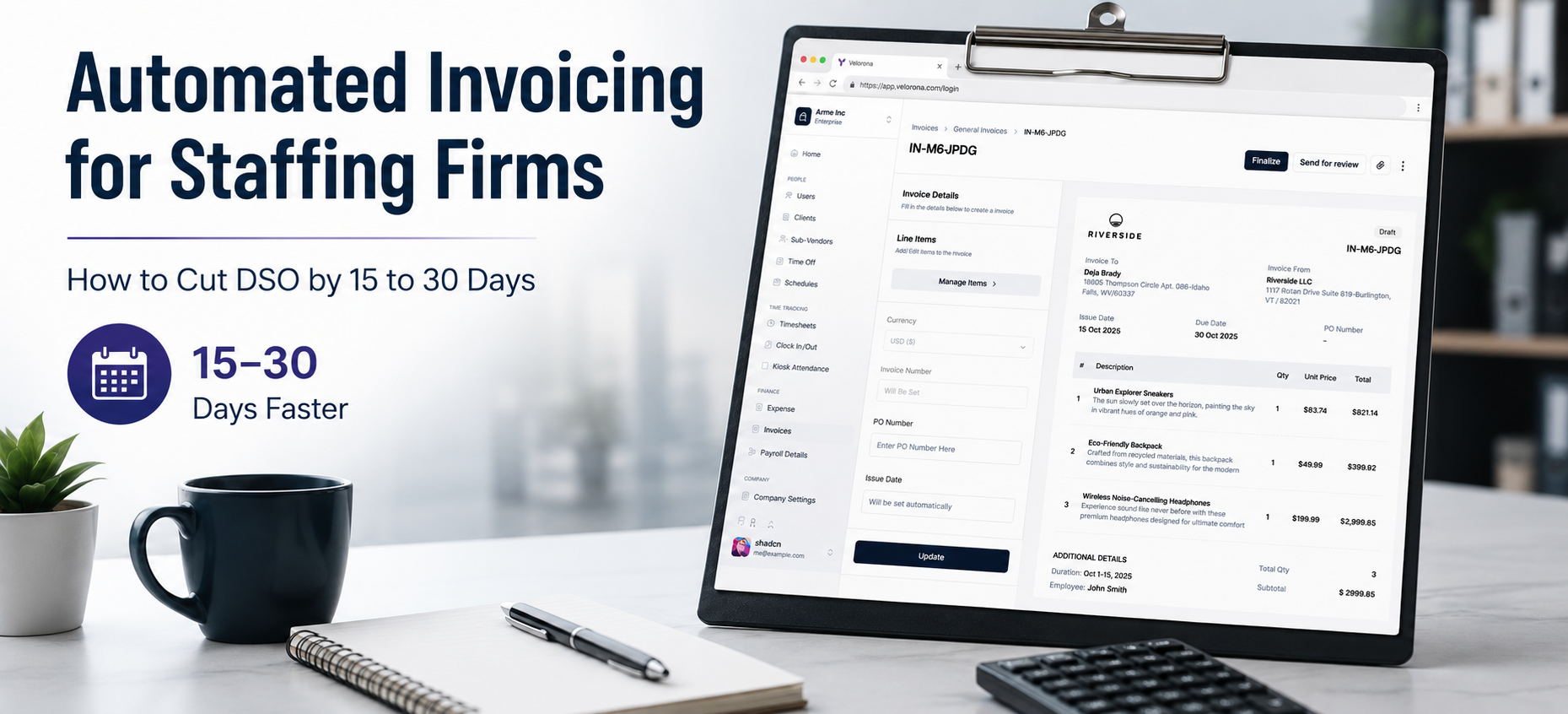
Automated Invoicing for Staffing Firms: How to Cut DSO by 15 to 30 Days
Quick answer: Automated invoicing for staffing firms closes the gap between paying your workforce weekly and collecting from clients in 30 to 60 days. By generating invoices from approved hours the moment work is signed off and delivering them to a tracked client portal, you remove the pre-send lag, the lost-email dispute, and the correction loop that quietly drain cash. Firms typically see Days Sales Outstanding fall by 15 to 30 days within the first quarter.
Why Does Growing Faster Make Cash Tighter?
It’s the staffing paradox: the more talent you place, the more capital you burn. You pay W-2 and 1099 contractors weekly or bi-weekly, while enterprise clients stretch terms to Net-30, Net-45, even Net-60. As a result, every new placement adds to the payroll you’re carrying before the matching cash arrives. Grow quickly enough and a profitable firm can still hit a liquidity wall.
Therefore, automated invoicing for staffing firms is the lever that widens the cash pipe without adding back-office headcount. The result shows up as a measurable DSO reduction of 15 to 30 days in the first quarter.
Where Does the Cash Cycle Actually Leak?
In fact, most owners measure DSO from the day the invoice is sent. However, the real damage happens earlier and in three places.
The Hidden Lag Before the Invoice Even Goes Out
If your work week ends Sunday but the invoice doesn’t leave until Thursday, that’s a structural delay built into the process before the client has done anything. Generating invoices directly from approved time removes it entirely.
The Approval Wait
For example, in IT and healthcare placements an invoice can need multiple sign-offs. Consequently, a “lost” email here means days of revenue delay.
The Correction Loop
A small error on a large invoice often freezes the entire payment and resets the clock. Therefore, the fix is to make sure the invoice is right the first time, because it was generated from the same approved hours you already reconciled.
How Does Automated Invoicing for Staffing Compress Each Cash Cycle Stage?
The principle is to move from “batch-and-queue” to “flow.”
- Generated from approved time, not re-typed. When a client approves a time entry in Velorona, the invoice is created from those exact hours at the contracted rate. No CSV export, no transcription step where errors enter.
- Delivered to a client portal, not buried in email. The invoice lands in a portal where you can see it opened, viewed, and approved. The “we never received it” dispute that quietly resets the payment clock can’t happen.
- Reconciled in both directions. Outbound client invoices and inbound sub-vendor invoices are matched against the same approved hours, with mismatches flagged before payment so corrections don’t blow up your cycle later.
What Does the Before-and-After Look Like?
| Cash-cycle stage | Manual process | With Velorona |
| Time entry to invoice | Re-keyed days later | Generated from approved hours |
| Delivery | Email + attachment | Auto-delivered to client portal |
| Visibility | “Did they get it?” | Opened / viewed / approved tracking |
| Sub-vendor reconciliation | Manual, end-of-quarter | Auto-matched, flagged pre-payment |
The cumulative effect of removing the pre-send lag, the delivery uncertainty, and the correction loop is the 15 to 30 day DSO improvement Velorona firms see in their first quarter.
Does This Free Up the Finance Team Too?
Yes, and it changes the role. When the controller is no longer a high-paid data-entry clerk re-keying invoices and chasing receipts, the same person can instead do the analysis that actually grows the firm: which clients pay slowly, which carry the highest cost to serve, and where margin is thin. Ultimately, the work moves from production to judgment.
Can You Scale Without Adding Back-Office Headcount?
That’s the strategic case. The old model added a back-office person for every few million in billings. With one connected workflow handling timesheets, invoicing, and sub-vendor reconciliation, a firm can take on more consultants without expanding the payroll department protecting margin as you grow.
Furthermore, the same workflow that makes automated invoicing for staffing more efficient also gives leadership real visibility into which clients are most profitable, without opening Excel.
What’s Honest About the Limits Today?
Velorona auto-generates and delivers invoices and reconciles them in both directions now. However, online client payment from the portal (Stripe Connect) and QuickBooks Online sync are on the 2026 roadmap. Until then, accounting data moves via CSV. Velorona is back-office software it accelerates the billing side of cash flow; it does not provide financing or run payroll.
What Does It Cost and How Fast Is Go-Live?
$6/user/month (Starter) or $10/user/month (Team), 30 to 33% off annually, one-month free trial, no credit card, no setup fee, live in 5 to 14 days. In contrast, enterprise staffing platforms run $20,000 to $50,000 or more a year with 6 to 12 week implementations.
Related Reading
If you’re evaluating your full back-office workflow, these articles connect the same topics:
- How to Run Your Staffing Back Office on One Platform in 2026
- What Back-Office Automation Actually Fixes for Staffing Firms in 2026
- Staffing Payroll Prep: How to Get Payroll-Ready in Minutes Instead of Days
- 7 Questions to Ask Before Buying Staffing Software in 2026
FAQ: Automated Invoicing for Staffing Firms
How exactly does automation reduce DSO?
It attacks the front of the cycle the lag before an invoice is sent and the rejections that reset the clock. Specifically, invoices go out days earlier and, because they’re built from already-approved hours, the rejection rate drops sharply.
How does portal delivery help client relationships?
Clients get predictable, professional delivery with full documentation in one place. Additionally, you both see exactly when the invoice was opened and approved resulting in fewer “where’s my payment / where’s my invoice” calls.
What is the “staffing growth trap”?
Paying contractors weekly while collecting from clients in 30 to 60 days means every new placement increases the payroll you carry. Consequently, without fast invoicing to recoup cash, even a profitable firm can run short of money.
Do clients pay through the portal today?
Portal payment via Stripe Connect is on the 2026 roadmap. Today, however, the portal handles delivery, viewing, and approval.
Turn Trapped Receivables Into Working Capital
Cutting DSO by 15 to 30 days puts cash back in the business the cash you reinvest in recruiters, marketing, and talent. See automated invoicing for staffing run against your own cycle.
Book a personalized demo: velorona.com/demo