Where Do Back-Office Hours Actually Go in a Staffing Firm?
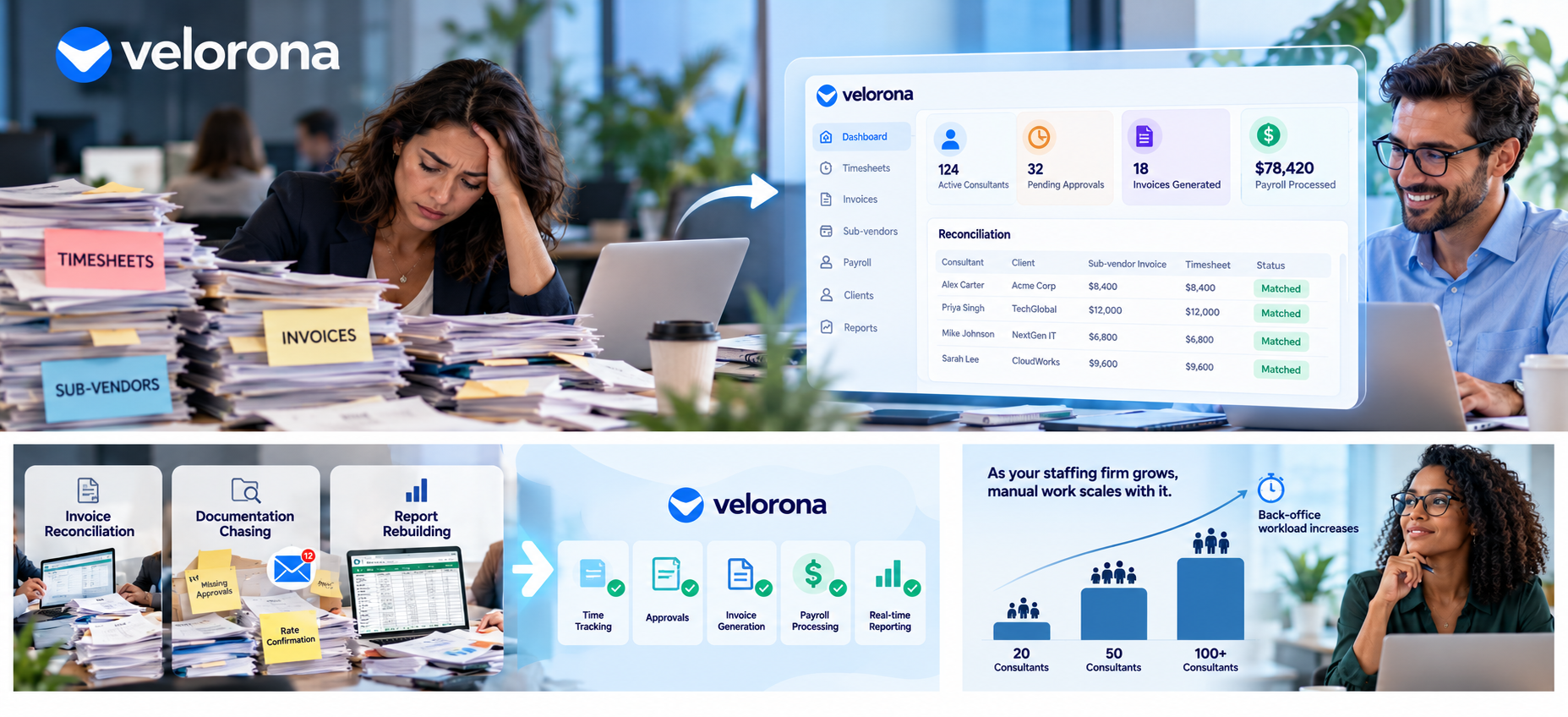
At most firms running on spreadsheets, QuickBooks, and email, back-office time goes to three things:
Invoice-to-Timesheet Reconciliation
Your controller manually matches every sub-vendor invoice against approved timesheet hours line by line, consultant by consultant, sub-vendor by sub-vendor. This alone consumes 12 or more hours per month. Furthermore, manual matching carries a 3-5% error rate that costs $12,000-$25,000 per year in undetected overpayments. We document the full cost in How Sub-Vendor Invoice Errors Cost Your Staffing Firm $12,000 to $25,000 Every Year.
Documentation Chasing
W-9s that nobody collected at onboarding, missing approvals buried in email threads, unclear rates that require a phone call to the sub-vendor. None of this work requires expertise it requires patience and time. As a result, your controller spends hours on administrative retrieval instead of financial analysis.
Report Rebuilding
Margin-per-client reports, AR aging, year-end reconciliation all of these require manual reconstruction when the underlying data lives in three or four disconnected systems. Your controller builds these reports from scratch instead of reviewing reports that the system generates automatically. We cover why this matters in Staffing Firm Margin: Where It Actually Disappears.
None of that ranks as high-value work. However, all of it stays necessary when nothing runs automatically.
Why Does the Back-Office Bottleneck Get Worse Past 50-100 Consultants?
Because manual reconciliation scales roughly linearly with the number of sub-vendors and consultants, while your back-office headcount usually doesn’t grow at the same rate. Specifically:
A firm that manages reconciliation by hand at 20 consultants starts to strain at 50. By 100 consultants, the reconciliation workload often becomes the actual ceiling on growth not your sales pipeline, not your recruiting capacity, but your controller’s available hours.
This is the same bottleneck we cover in The High Cost of Operational Fragmentation. The firm can win more clients and place more consultants, but the back office can’t process the invoices and timesheets fast enough to keep up. Consequently, invoices go out late (adding days to DSO), sub-vendor errors slip through (adding thousands to annual leakage), and your controller burns out.
In other words, the growth ceiling isn’t a sales problem. It’s a reconciliation problem. And you can’t hire your way past it you can only automate your way through it.
What’s the Difference Between Adding Headcount and Removing the Work?
This distinction matters because most firms default to hiring when the real answer involves automation:
Adding a second controller addresses the symptom more capacity to perform the manual matching. However, it doesn’t address the cause: that the matching happens manually at all. Furthermore, it adds significant annual salary cost for work that a connected system handles automatically.
Automating the reconciliation addresses the cause the manual matching step disappears. Your existing controller’s time shifts from data entry to exception handling, analysis, and judgment calls. We cover this shift in detail in Your Controller Is Doing $200 Work Worth $50.
How Does Adding Headcount Compare to Automating Reconciliation?
The following table shows why automation reduces back-office hours in staffing more effectively than hiring:
| Dimension | Adding Back-Office Headcount | Automating the Reconciliation |
|---|---|---|
| Annual cost | Significant salary per hire | $10/month per user ($7 annual) Team plan |
| Solves the root cause | No more people doing the same manual work | Yes — removes the manual matching step entirely |
| Scales with consultant count | Requires proportional headcount growth | Scales without adding people |
| Time to value | Weeks to hire and onboard | 5–14 days to go live, $0 setup |
| Sub-vendor error detection | Same 3-5% miss rate, just processed faster | System flags every mismatch before payment |
| What remains for your team | Same manual work, spread across more people | Exception handling and analysis |
| Key-person risk | Now two people hold tribal knowledge instead of one | Process lives in the system any authorized user can see status |
| Controller reconciliation time | 12+ hours/month per controller | ~90 minutes/month (exception review) |
How Do You Actually Reduce Back-Office Hours for 50–100+ Consultants?
Here’s the step-by-step approach, in order of impact:
Step 1: Automate the invoice-to-timesheet match first. This is where the most hours go. In Velorona, approved timesheets automatically generate client invoices billing rate applied, PO pulled from client setup, billing schedule respected. Simultaneously, the system matches incoming sub-vendor invoices against those same approved hours and flags mismatches before payment. This is bidirectional reconciliation, and it’s the single largest source of freed-up back-office hours. We cover the mechanics in How Sub-Vendor Invoice Errors Cost Your Staffing Firm $12,000 to $25,000 Every Year.
Step 2: Centralize vendor documentation instead of chasing it. Velorona stores W-9s, MSAs, and COIs with the sub-vendor’s record — not in an email archive somebody has to search. Consequently, when January arrives and 1099-NECs come due, the documentation already sits on file instead of triggering a three-week chase.
Step 3: Make reporting a byproduct of clean data, not a separate project. If margin per client and AR aging pull automatically from reconciled invoice and timesheet data, nobody manually rebuilds those reports every month. The system produces them on demand because the underlying data stays clean year-round.
Step 4: Deliver invoices through a portal, not email. Velorona’s client portal delivers invoices directly you see when the client opened, viewed, and approved them. As a result, the “I never received it” dispute cycle disappears, and DSO typically improves by 15–30 days within the first quarter. That’s fewer hours chasing overdue invoices and more hours on proactive AR management.
Step 5: Redirect the freed-up hours toward what actually needs a person. Exception handling, client relationship management, growth planning the work that doesn’t scale by adding more manual labor. The Friday Night Reconciliation Ritual documents how that 12-hour weekly reconciliation workload drops to 90 minutes freeing up exactly the hours your back office needs for higher-value work.
What Happens When You Remove the Manual Work Instead of Adding Headcount?
Firms that automate invoice-to-timesheet matching and centralize vendor documentation typically find their existing back-office team can handle meaningfully more consultants without new hires. Specifically, three things change:
The controller’s role transforms. Instead of spending 12+ hours per month on data matching, she spends about 90 minutes reviewing exceptions and redirects the remaining time to margin analysis, AR follow-up, and the judgment calls the role should actually cover.
The growth ceiling lifts. A firm that hit capacity at 50 consultants with a manual process can typically handle 100+ with the same back-office team once reconciliation runs automatically. The ceiling moves from “how many invoices can one person match” to “how many exceptions need human review.”
Year-end becomes an export, not a fire drill. When sub-vendor payment data stays reconciled all year, 1099 prep drops from a multi-week scramble to a few hours of review before export. The same clean data feeds the margin-per-client report your bank wants for credit line renewal.
In other words, reducing back-office hours in staffing and scaling past the growth ceiling turn out to be the same project. You fix them together by removing the manual reconciliation not by hiring more people to do it.
What Should You Honestly Expect From Velorona and What Isn’t Ready Yet?
Velorona handles timesheets with multi-level approval and time locking, clock-in/clock-out with GPS, sub-vendor invoicing with bidirectional reconciliation, client portal auto-delivery with read receipts, multi-currency invoicing (USD/INR with FX lock), expense tracking, time-off, schedules, payroll details, bulk timesheet approval, and audit logs with 2FA.
The Team plan costs $10/month per user ($7/month on annual billing), with no setup fees and no implementation cost. Firms typically go live in 5 to 14 days. Compare that to CEIPAL ($30K–$50K/year, 12 weeks implementation) or Bullhorn ($50K+/year). Full plan details sit on the pricing page.
What Isn’t Available Today
However, Velorona does not do the following today: QuickBooks Online integration targets Q3 2026 (until then, you export clean matched data via CSV). Similarly, Stripe Connect for online invoice payment through the client portal targets Q3 2026. The team currently builds SSO. In addition, Public API + Zapier targets Q3 2026. Payroll execution via Gusto Embedded targets Q4 2026. Finally, 1099-NEC auto-generation also targets Q4 2026. The FAQ page covers additional details.
One month free trial. No credit card required.
Frequently Asked Questions About How to Reduce Back-Office Hours in Staffing
How many back-office hours does a typical 50-consultant firm spend on reconciliation?
At firms running manual matching, 12 or more hours per month of controller time on invoice-to-timesheet reconciliation alone ranks as common on top of whatever time goes to chasing documentation and rebuilding reports. With automated matching, that drops to about 90 minutes of exception review. We document this metric in the Friday Night Reconciliation Ritual.
Should I hire more back-office staff as I grow past 100 consultants?
Possibly, but automate the reconciliation work first. Adding headcount to perform more manual matching costs significant salary annually and doesn’t remove the underlying bottleneck. It just adds more people managing it. Automation removes the bottleneck, and your existing team often handles the increased volume without new hires.
Where should I start if I want to reduce back-office hours fastest?
Sub-vendor invoice reconciliation. That’s usually where the most hours go, and the system can automate it most directly because it’s a well-defined matching problem between two data sets you already have (timesheets and sub-vendor invoices). Start there, and the downstream effects faster invoicing, better margin visibility, cleaner year-end data follow automatically.
Does automating reconciliation eliminate the need for a controller?
No. It removes the manual matching so your controller’s time goes toward exceptions, analysis, and judgment calls the parts of the role that actually need a person. The role stays. The work inside it shifts from data entry to data analysis. We cover that shift in Your Controller Is Doing $200 Work Worth $50.
How does this differ from hiring an operations coordinator?
An operations coordinator can help manage the process. However, if the underlying reconciliation stays manual, you’ve added a person to do the same work not removed the work itself. The hours you save come from automating the matching, not from adding hands to do it faster.
How fast can I go live compared to hiring and onboarding a new back-office hire?
Velorona typically goes live in 5 to 14 days with no setup fees. Hiring a controller or ops coordinator takes weeks of recruiting, interviewing, and onboarding plus $50K-$80K+ in annual salary. Furthermore, a new hire still performs the same manual reconciliation. Automation removes it. The Complete Guide to Staffing Agency Back Office Software walks through the full evaluation framework.
Free Up Your Back Office Without Adding Headcount
If your back-office team runs at capacity and the answer feels like “hire another controller,” the real question is whether manual reconciliation eats the hours that automation could remove instead. Reducing back-office hours in staffing starts with removing the matching not adding more people to do it.
Book a personalized demo and we’ll walk through where your back-office hours actually go and show you what automated reconciliation looks like against your actual sub-vendor and timesheet data. Alternatively, Claim 2 Months 100% FREE Premium Plan, no credit card required.
Related reading:
- How Sub-Vendor Invoice Errors Cost Your Staffing Firm $12,000 to $25,000 Every Year
- Your Controller Is Doing $200 Work Worth $50
- The High Cost of Operational Fragmentation
- Staffing Firm Margin: Where It Actually Disappears
- The Friday Night Reconciliation Ritual: What It Actually Costs
- Cut Your Staffing Firm’s DSO Without Chasing Clients
- January Is Coming: Get Your 1099 Data Ready Now
- The Complete Guide to Staffing Agency Back Office Software