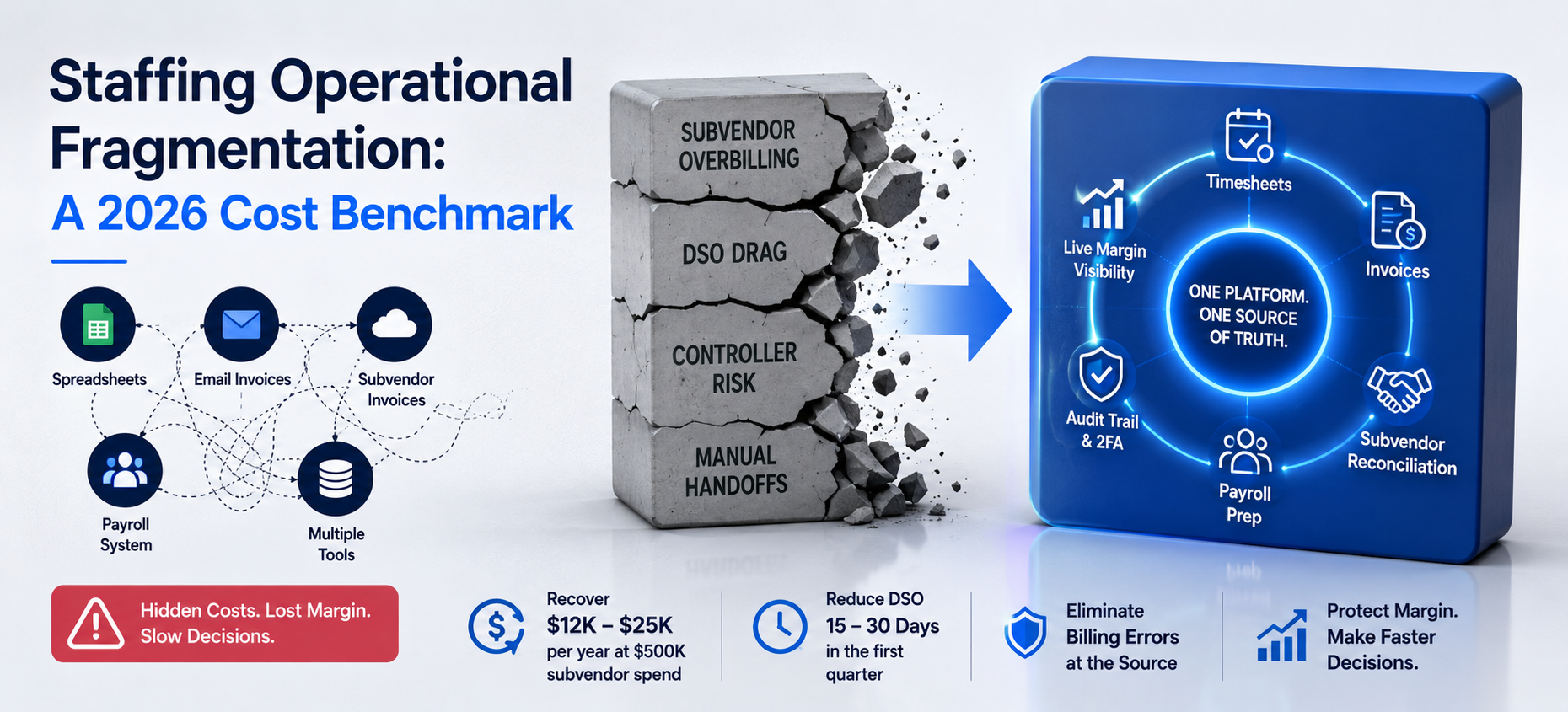
Staffing Operational Fragmentation: A 2026 Cost Benchmark
Quick answer: Staffing operational fragmentation costs firms real margin across four models: spreadsheet only, tools plus spreadsheets, siloed tools, and integrated platform. Each model leaks in a different place, from subvendor overbilling to DSO drag to controller key person risk. This benchmark names the cost by model and shows what the connected state looks like.
What Does This Benchmark Measure?
This benchmark examines the operational cost of staffing operational fragmentation across four firm profiles. Where industry context appears, it draws on published research from Staffing Industry Analysts and Bullhorn’s State of Staffing. Where a figure comes from Velorona’s own onboarding data, it is marked as such. Ultimately, the goal is a clear-eyed look at where the costs live before any platform is evaluated.
How Do the Three Operational Models Compare?
The table below contrasts the three main models across the metrics that matter most to margin. Afterward, each model is explained in turn.
| Dimension | Spreadsheets Only | Siloed Tools | Integrated Platform (Velorona) |
| Subvendor reconciliation | None | Manual | Auto-matched before payment |
| Client invoice delivery | Manual export | Tracked portal | |
| Margin visibility | Two-day Excel build | Multi-tool pull | Live from approved hours |
| Audit trail | None | Partial | Full, timestamped with 2FA |
| Payroll prep | Manual rebuild | Separate system | From approved hours |
What Does Spreadsheet-Only Fragmentation Cost?
The spreadsheet-only firm carries the most hidden risk. Notably, there is no audit trail, formulas break silently, and one person holds the institutional memory. So when that person leaves, the firm spends months reconstructing the logic, and billing errors slip through in the meantime. In short, this is staffing operational fragmentation in its purest form.
Hidden cost: Controller key-person risk – $80–100K annually in hidden work hours if that person leaves unexpectedly.
What Does the Tools-Plus-Spreadsheets Model Cost?
This firm has tools that do not connect, so spreadsheets live between them. Consequently, each manual transfer is a chance for an error that reaches a client invoice or a paycheck. Reconciliation also becomes painful, because verifying a disputed invoice means cross-referencing several systems.
Hidden cost: Data leakage between systems – Estimated 2–4% of invoiced hours are either double-counted, missed, or misattributed across systems before someone catches it (if they catch it at all).
What Does the Siloed Tools Model Cost?
This firm bought purpose-built tools separately, so it now has five logins and five data sets. As a result, margin visibility per client requires a manual spreadsheet pull. Unfortunately, that delays decisions until it is often too late to reprice an engagement.
Hidden cost: DSO drag and repricing blindness – Most firms in this model don’t see margin gaps until 30–60 days after invoice (or sometimes never). Repricing a client is impossible mid-contract if you don’t know you’re losing money.
What Does the Connected State Look Like?
The integrated model removes the handoffs entirely. Approved timesheets drive the client invoice, the subvendor reconciliation, and the payroll data from one source. As a result, margin is visible immediately, leakage is caught before payment, and the system runs without depending on one person.
What this means in practice:
- Subvendor invoice errors caught before payment (average recovery: $12–25K annually on $500K spend)
- Margin visibility within 24 hours of timesheet approval (not 2 days later)
- Client invoices tracked in portal (not lost in email threads)
- Payroll data flows directly from approved hours (no manual reconciliation)
- Full audit trail with timestamps (you can show auditors exactly who approved what, when, and why)
Frequently Asked Questions:
Which model is most expensive?
The spreadsheet-only model usually carries the highest hidden cost, because it has no audit trail and depends on one person.
How fast can a firm consolidate?
Velorona goes live in 5 to 14 days with no setup fees. Historical data imports via CSV.
Does Velorona replace QuickBooks?
No. Instead, it feeds QuickBooks. QuickBooks Online native sync ships Q3 2026, and CSV export covers it until then.
What is the single biggest fragmentation cost?
For most firms, it is the subvendor leak: $12,000 to $25,000 annually on $500K of spend.
Book a Demo
See your missed margin in 20 minutes: Schedule a personalized demo
Related Reading:
- The Staffing Cash Gap
- Seven Questions to Ask Before Buying Staffing Software