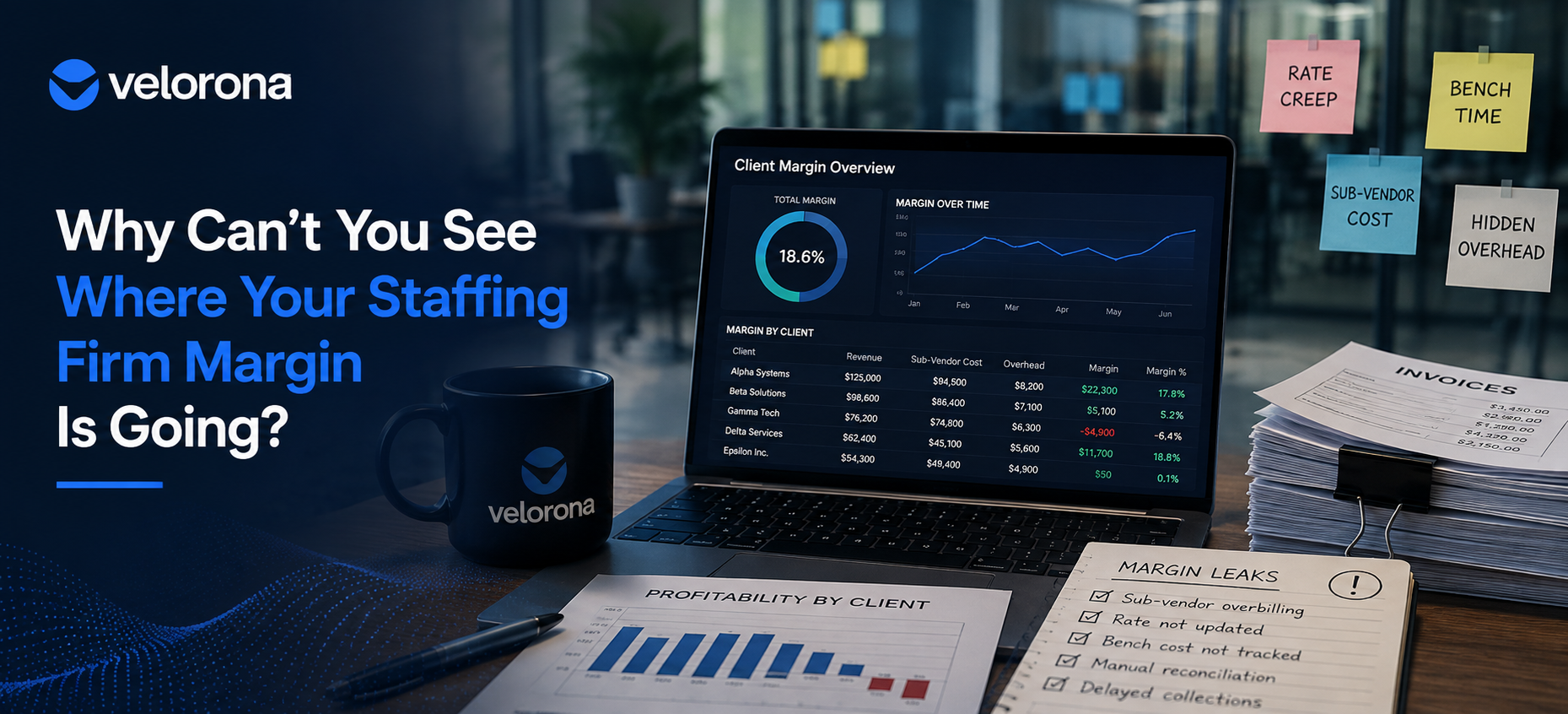
Why Can’t You See Where Your Staffing Firm Margin Is Going?
Margin per client depends on three moving numbers: what you bill the client, what you pay the sub-vendor or consultant, and the overhead sitting in between (benefits, insurance, admin time). Most firms track these in three different places: an invoicing tool, a timesheet spreadsheet, and QuickBooks. In other words, none of them talk to each other.
So calculating true staffing firm margin means somebody manually pulls all three, lines them up by client, and does the subtraction. That’s a half-day to two-day job for a controller, and it’s usually only done at quarter-end or year-end not week to week. In the meantime, a client that looked profitable in January can quietly go negative by March. For example, an extra sub-vendor markup here, a rate that didn’t get renegotiated there, and nobody notices until the annual review.
Where Does Staffing Firm Margin Actually Disappear?
It rarely disappears all at once. Instead, it leaks in small amounts across a few predictable spots:
Sub-Vendor Invoice Errors
A 3-5% mismatch rate between invoiced hours and actual timesheet hours is common when reconciliation is manual. At $500K to $1M in annual sub-vendor spend, that’s $12,000-$25,000 per year in invisible overpayments. We cover the full mechanics of this in How Sub-Vendor Invoice Errors Cost Your Staffing Firm $12,000 to $25,000 Every Year.
Rate Creep That Never Gets Caught
A sub-vendor rate goes up, or a client rate stays flat, and the margin compression isn’t visible until someone runs the full P&L. Consequently, by the time the controller spots it, two or three billing cycles of compressed margin have already gone out the door.
Bench Time Nobody’s Pricing In
Consultants between assignments still cost you money. If you’re not tracking days on bench against your margin model, that cost is invisible until cash flow tightens. For broader context, the American Staffing Association reports industry net margins of 3-7% which means even a few weeks of untracked bench time per consultant can eat a meaningful share of your annual profit.
Controller Time Spent Reconciling Instead of Analyzing
The hours that should go toward spotting a bleeding account instead go toward basic data entry and invoice reconciliation. This is a problem we walk through in The Real Cost of Manual Payroll Prep. As a result, the person best positioned to find margin problems is too busy creating margin problems.
How Do You Calculate Margin Per Consultant in a Staffing Firm?
The formula itself is simple:
Margin per consultant = (Client bill rate × hours worked) – (Consultant or sub-vendor pay rate × hours worked) – allocated overhead
However, the hard part isn’t the formula. It’s getting accurate, matched hours and rates for every consultant, every pay period, without re-keying data three times. In other words, the actual bottleneck is data reconciliation, not math. The U.S. Department of Labor’s FLSA recordkeeping requirements add another reason to get this right: inaccurate hour records aren’t just a margin problem — they’re a compliance exposure.
How Does Manual Margin Tracking Compare to Live Reporting?
The following table shows why quarterly margin reviews miss problems that live reporting catches:
| Dimension | Manual Margin Calculation | Live Margin Reporting |
|---|---|---|
| Frequency | Quarterly or annual | Daily |
| Time to produce a client P&L | 4-16 hours of controller time | Instant, on demand |
| When you catch a negative-margin client | At renewal, after the damage is done | Within the first billing cycle |
| Data sources | 3 separate systems, manually reconciled | One system – timesheet to invoice to margin |
| Owner visibility | Depends on controller pulling a report | Self-serve, any day |
| Staffing firm margin accuracy | Depends on reconciliation quality | Matched automatically from approved hours |
Why Doesn’t Your Current System Show Staffing Firm Margin in Real Time?
Because timesheets, invoices, and sub-vendor bills usually live in three unconnected tools. Specifically, a consultant logs hours in one system. Then someone manually turns that into a client invoice in another. Meanwhile, a sub-vendor bill arrives by email and gets keyed into QuickBooks separately.
Margin is what’s left after all three are reconciled. Therefore, if that reconciliation only happens once a quarter, margin visibility only happens once a quarter too.
Furthermore, this is the same fragmentation that caps growth for a lot of firms. Once you’re past 50-60 consultants, a controller manually stitching together margin reports for that many client relationships stops being realistic. This is the ceiling we cover in The High Cost of Operational Fragmentation, and it’s the same bottleneck we address in Staffing Back Office Automation: One Platform.
How Do You Track Margin Per Consultant Without a Finance Team?
This is the core of what Velorona does. Here’s the step-by-step process:
Step 1: Connect timesheets directly to invoicing. If a consultant’s approved hours automatically become the client invoice, you’ve removed one manual re-entry point and one source of error. In Velorona, approved timesheets generate invoice line items automatically billing rate applied, billing schedule respected, no re-keying.
Step 2: Match sub-vendor invoices against the same timesheet data. This is the other half of the equation, covered in detail in How Sub-Vendor Invoice Errors Cost Your Staffing Firm $12,000 to $25,000 Every Year. Once both sides pull from the same source of truth, margin per consultant becomes a subtraction problem not a reconciliation project. Velorona’s bidirectional reconciliation does this automatically: client invoices going out matched against sub-vendor invoices coming in, with mismatches flagged before payment.
Step 3: Report margin by client, not just in aggregate. Aggregate margin can look healthy while two or three specific clients are quietly negative. As a result, a client-level view surfaces that instead of hiding it in an average.
Step 4: Check it weekly, not annually. Once the data flows automatically, there’s no reason to wait for year-end. Consequently, a five-minute weekly check catches a slipping account while there’s still time to fix the rate or the staffing mix. For firms with C2C and multi-currency relationships, this is especially important because FX fluctuations can erode margin between billing cycles.
What Happens When You Track Staffing Firm Margin in Real Time?
Note: This is a representative scenario based on typical staffing-firm workflows, not a named customer case study.
Consider a hypothetical IT staffing firm that had never been able to answer “which clients are actually profitable” without a full week of controller time each quarter. After moving to a system where timesheets, invoices, and sub-vendor bills pull from the same approved hours, margin per consultant and per client becomes visible daily instead of quarterly.
In this scenario, the controller’s reconciliation workload drops from 12 hours per week to about 90 minutes of exception review the same metric Velorona documents for firms that move from manual to automated reconciliation.
However, the bigger shift is catching problems earlier. For example, a client that had been quietly running negative margin for two quarters because a sub-vendor rate had crept up without anyone noticing gets caught and renegotiated in the first billing cycle after switching to live reporting, instead of at the annual review.
That’s the difference between losing $15,000 before you notice and losing $1,200 before you fix it.
What Should You Honestly Expect From Velorona and What Isn’t Ready Yet?
Velorona handles timesheets, sub-vendor invoicing with bidirectional reconciliation, client portal auto-delivery, multi-currency invoicing (USD/INR with FX lock), expense tracking, time-off, schedules, payroll details, bulk timesheet approval, and audit logs with 2FA.
The Team plan costs $10/month per user ($7/month on annual billing), with no setup fees and no implementation cost. As a result, firms typically go live in 5 to 14 days. Compare that to CEIPAL ($30K–$50K/year, 12 weeks implementation) or Bullhorn ($50K+/year). Full plan details are on the pricing page.
What Isn’t Available Today
However, Velorona does not do the following today: QuickBooks Online integration is targeted for Q3 2026 (until then, export clean matched data via CSV). Similarly, Stripe Connect for online invoice payment is targeted for Q3 2026. SSO is currently in progress. In addition, Public API + Zapier is targeted for Q3 2026. Payroll execution via Gusto Embedded is targeted for Q4 2026. Finally, 1099-NEC auto-generation is also targeted for Q4 2026.
If QuickBooks integration or payroll execution is an immediate requirement, the honest answer is to wait or evaluate alternatives. On the other hand, if your core pain is invisible staffing firm margin and the reconciliation-to-visibility workflow, Velorona addresses that today.
One month free trial. No credit card required.
Frequently Asked Questions About Staffing Firm Margin
How often should I check margin per client?
Weekly, if it’s automatic. If you’re pulling it manually, monthly is the realistic minimum. However, quarterly or annual reviews are how margin bleeds silently for months before anyone notices. The goal is catching a slipping account while there’s still time to renegotiate the rate.
What’s a normal margin range for a staffing firm?
It varies widely by vertical and contract type C2C, 1099, or W-2 all carry different overhead. The American Staffing Association reports industry net margins of 3-7%, but the range within a single firm’s client portfolio can be much wider. In other words, the point of live tracking isn’t hitting a universal benchmark it’s knowing your own number per client, in real time, so you can act on it.
Can I calculate staffing firm margin in QuickBooks?
QuickBooks can hold the numbers once they’re entered, but it doesn’t automatically connect timesheets to invoices to sub-vendor bills. As a result, you’d still be doing the matching manually. QuickBooks Online integration is on Velorona’s roadmap for Q3 2026. Until then, clean matched data exports via CSV. See the FAQ page for details on how Velorona connects to your existing QuickBooks setup.
How is this different from just tracking revenue by client?
Revenue by client tells you what you billed. Margin by client, on the other hand, tells you what you kept — after sub-vendor pay, consultant pay, and overhead. For example, a client can be your biggest revenue source and your worst margin performer at the same time, and revenue-only reporting won’t show you that.
Does bench time affect margin per consultant?
Yes, directly. A consultant sitting on the bench between assignments still costs you money with no offsetting revenue. Therefore, if bench time isn’t factored into your margin model, your per-consultant numbers will look better than your actual cash position. Tracking bench days alongside active billing is part of accurate staffing firm margin visibility.
How does DSO affect margin visibility?
Slow-paying clients compress your working capital even when the billing rate looks healthy. Specifically, if a client takes 60 days to pay on NET 30 terms, your cash position drops even though the margin on paper looks fine. We cover the DSO problem and how portal-based invoice delivery improves it by 15-30 days in Cut Your Staffing Firm’s DSO with Automated Invoicing.
See Your Real Staffing Firm Margin — Not Your Quarterly Estimate
If you can’t tell me, right now, which of your clients are actually profitable, you’re not alone. And you’re not going to find out by working harder in Excel. Instead, you need the timesheet, the invoice, and the sub-vendor bill to already agree with each other before you ask the question.
We’ll show you what live margin-per-client reporting looks like against your actual data in about 15 minutes.
Book a personalized demo and see your margin per client and per consultant in real time with your actual data, not a generic walkthrough. Alternatively, Claim 2 Months 100% FREE Premium Plan, no credit card required.
Related reading:
- How Sub-Vendor Invoice Errors Cost Your Staffing Firm $12,000 to $25,000 Every Year
- The Friday Night Reconciliation Ritual: What It Actually Costs
- The Real Cost of Manual Payroll Prep
- The High Cost of Operational Fragmentation
- Cut Your Staffing Firm’s DSO with Automated Invoicing
- Closing the Staffing Cash Gap
- The Complete Guide to Staffing Agency Back Office Software