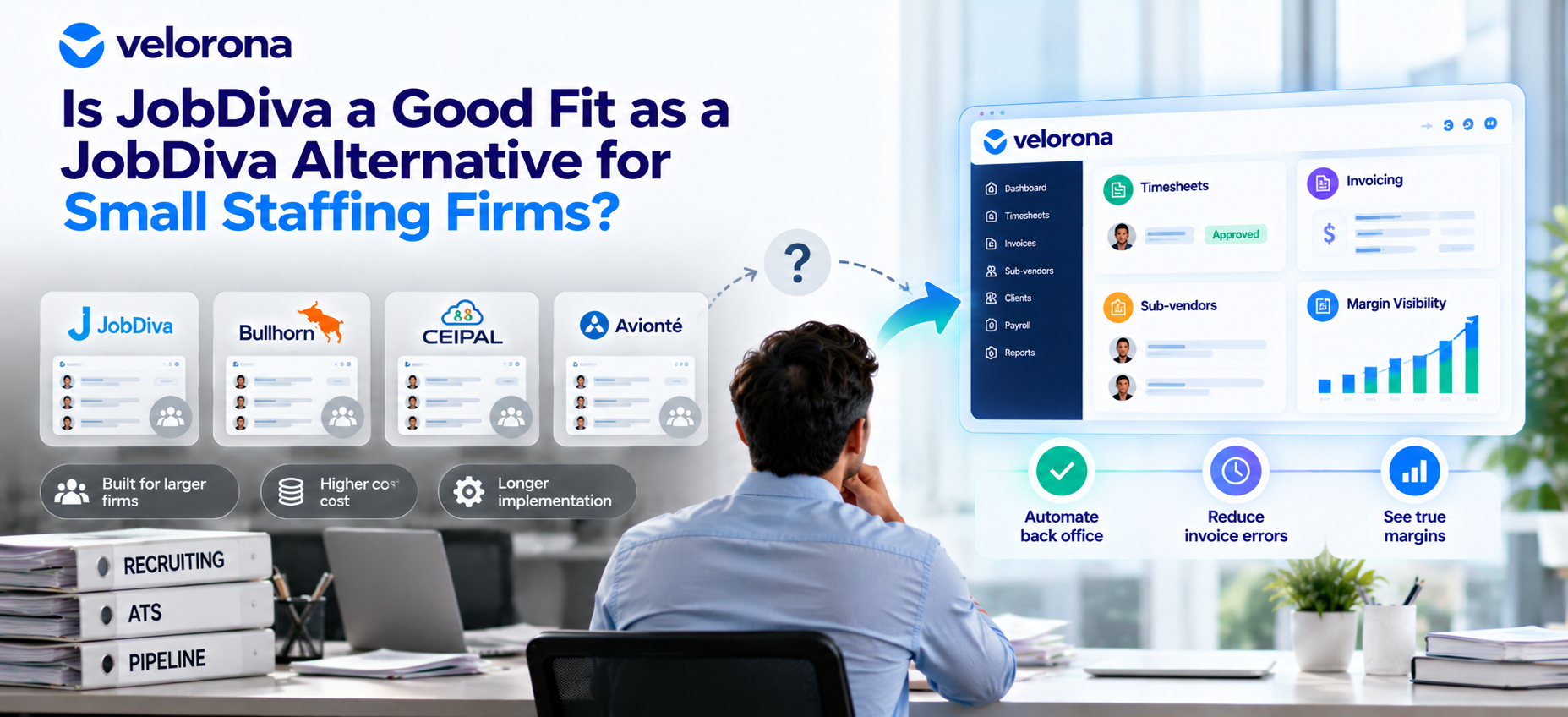
Is JobDiva a Good Fit as a JobDiva Alternative for Small Staffing Firms?
That question sounds circular, but it’s the right one to ask. JobDiva ranks as a capable applicant tracking system built primarily around recruiting workflows sourcing, pipeline management, submittals. Invoicing and sub-vendor billing function as add-ons, not the core of the product. Furthermore, pricing typically exceeds $25K per year, reflecting enterprise deployment.
If your firm runs 5-50 employees and your biggest pain involves sub-vendor invoice errors or margin visibility rather than recruiting pipeline management, JobDiva solves a different problem than the one costing you money. In other words, searching for a JobDiva alternative when your actual pain sits in the back office means comparing against the wrong category entirely.
What About Bullhorn or CEIPAL as an Alternative?
Same story, different flavor.
Bullhorn
Bullhorn ranks as a strong, established ATS and CRM. However, it targets firms well past 50 employees, and its pricing reflects that typically $50K+ per year. For a 5-50 employee firm, that’s more platform and more cost than the actual back-office problem requires.
CEIPAL
CEIPAL similarly targets enterprise deployment, with pricing that typically runs $30K-$50K per year. If you’re a 5-50 employee firm evaluating either Bullhorn or CEIPAL, you’re likely looking at 12 weeks of implementation plus $8,000-$15,000 in setup costs on top of the annual license. Compare that to Velorona’s 5-14 day go-live with zero setup fees.
Is Avionté a Closer JobDiva Alternative?
Closer, yes. Avionté targets staffing specifically and overlaps more directly with back-office and billing functionality. It also typically costs $20K+ per year. If sub-vendor invoice reconciliation and margin visibility represent your core pain, Avionté deserves a fair head-to-head comparison specifically on the invoicing and reconciliation workflow, not just the ATS features.
However, none of these platforms – JobDiva, Bullhorn, CEIPAL, or Avionté handle bidirectional sub-vendor invoice reconciliation (matching client invoices going out against sub-vendor invoices coming in, line by line, against approved timesheet hours) at the depth Velorona does. That’s the moat that matters for a staffing firm leaking $12,000–$25,000 per year to sub-vendor invoice errors.
What’s the Real Alternative Most Small Staffing Firms Actually Use?
Spreadsheets, QuickBooks, and email. It costs nothing to start, which is exactly why it becomes the default. However, it rarely stays free.
Specifically, consider what the spreadsheet stack actually costs a firm with $500K to $1M in annual sub-vendor spend:
The reconciliation labor. Your controller spends 12 or more hours a month manually matching sub-vendor invoices against timesheets work that drops to about 90 minutes with automated matching. That’s 130+ hours per year of skilled labor redirected to data entry.
The sub-vendor errors that slip through. Manual matching carries a 3-5% error rate. At $500K in sub-vendor spend, that’s $12,000–$25,000 per year in overpayments nobody catches. We document this in How Sub-Vendor Invoice Errors Cost Your Staffing Firm $12,000 to $25,000 Every Year.
The margin blindness. You can’t answer “which clients are actually profitable?” without days of Excel work. That question stays unanswered until year-end by which time the margin already disappeared. We cover that in Staffing Firm Margin: Where It Actually Disappears.
In other words, the “free” spreadsheet stack carries real annual costs in labor and errors costs that often exceed what a purpose-built back-office tool charges per year.
How Does Every JobDiva Alternative Actually Compare?
The following table compares the options on the dimensions that matter for a 5-50 employee staffing firm not feature lists, but what actually costs you money:
| Dimension | JobDiva / Bullhorn / CEIPAL | Avionté | Spreadsheets + QB + Email | Velorona |
|---|---|---|---|---|
| Built for firm size | Enterprise, 100+ employees | Mid-market staffing | Any size, by default | 5-50 employees, 30-300 consultants |
| Annual cost | $25K-$100K+ | $20K+ | “Free” but real costs in labor + errors | $48-$120/year per user |
| Implementation | 12 weeks + $8K-$15K setup | Weeks + setup fees | Immediate | 5-14 days, $0 setup |
| Core strength | Recruiting, ATS, pipeline | Staffing-specific ops | Whatever you build | Sub-vendor reconciliation, C2C invoicing, margin |
| Sub-vendor invoice reconciliation | Bolt-on at best | Present, less specialized | Fully manual | Bidirectional client out matched against sub-vendor in |
| Client portal delivery | Portal with read receipts “I never received it” eliminated | |||
| Multi-currency (USD/INR) | Basic | Limited | Manual FX conversion | Built in currency locks at setup |
| Multi-tier C2C support | Basic (2 parties) | Limited | Manual tracking | Native 3+ party chains |
| Audit trail | Varies | Present | Email threads | Every approval timestamped and logged with 2FA |
How Do You Replace a Spreadsheet Stack Without a Six-Figure Contract?
Here’s the step-by-step approach:
Step 1: Get honest about what actually costs you money. If your pain sits in recruiting pipeline management, an ATS like JobDiva or Bullhorn may genuinely fit sized correctly for your firm. However, if your pain involves sub-vendor invoice errors, margin blindness, or a controller drowning in reconciliation, that’s a back-office problem, not a recruiting problem. It doesn’t need a $30K ATS to solve it.
Step 2: Start with sub-vendor invoice matching and timesheet-to-invoice automation. This is where the spreadsheet stack usually leaks the most money. In Velorona, approved timesheets generate client invoices automatically billing rate applied, PO pulled from client setup. Simultaneously, the system matches incoming sub-vendor invoices against those same approved hours and flags mismatches before payment.
Step 3: Add margin and AR visibility on top. Once invoicing and reconciliation run automatically, margin per client reporting and AR aging become byproducts of clean data not a separate quarterly project. DSO typically improves by 15-30 days within the first quarter because invoices go out the same day hours receive approval, and the client portal eliminates lost-invoice disputes.
Step 4: Keep your existing ATS if it works. You don’t need to replace your recruiting tools to fix your back office. Specifically, a platform built for 5–50 employee firms’ invoicing and reconciliation sits alongside whatever ATS you already use. Velorona doesn’t touch recruiting, sourcing, or pipeline management and doesn’t pretend to.
What Should You Honestly Expect From Velorona and What Isn’t Ready Yet?
Velorona handles timesheets, clock-in/clock-out with GPS, sub-vendor invoicing with bidirectional reconciliation, client portal auto-delivery with read receipts, multi-currency invoicing (USD/INR with FX lock), expense tracking, time-off, schedules, payroll details, bulk timesheet approval, and audit logs with 2FA.
The Team plan costs $10/month per user ($7/month on annual billing), with no setup fees and no implementation cost. Firms typically go live in 5 to 14 days. Full plan details sit on the pricing page.
What Isn’t Available Today
However, Velorona does not do the following today: QuickBooks Online integration targets Q3 2026 (until then, you export clean matched data via CSV). Similarly, Stripe Connect for online invoice payment through the client portal targets Q3 2026. The team currently builds SSO. In addition, Public API + Zapier targets Q3 2026. Payroll execution via Gusto Embedded targets Q4 2026. Finally, 1099-NEC auto-generation also targets Q4 2026. The FAQ page covers additional details.
And one thing Velorona does not do at all: recruiting, sourcing, ATS, or pipeline management. If that’s your primary need, JobDiva, Bullhorn, or CEIPAL may genuinely fit. Velorona focuses exclusively on the back-office workflow timesheets, invoicing, sub-vendor reconciliation, and margin visibility that those platforms treat as secondary.
One month free trial. No credit card required.
Frequently Asked Questions About JobDiva Alternatives for Small Staffing Firms
Does Velorona compete directly with JobDiva or Bullhorn?
Not directly. Velorona focuses on time tracking, invoicing, sub-vendor reconciliation, and margin visibility for 5–50 employee staffing firms. If your primary need involves a full recruiting ATS, JobDiva or Bullhorn may still fit they just target a bigger firm than the back-office problem this post addresses. In other words, they’re recruiting platforms with invoicing bolted on. Velorona handles invoicing and reconciliation natively, with no recruiting features.
What size firm does Avionté actually fit?
Avionté tends to serve mid-market staffing firms well, and its pricing reflects that. For firms specifically in the 5–50 employee range where sub-vendor invoice accuracy and margin visibility represent the main pain, compare directly on those capabilities not just the overall feature list.
Can I keep my current ATS and still fix my back-office problems?
Yes. Recruiting and pipeline management operate as a separate workflow from invoicing, sub-vendor reconciliation, and margin reporting. Consequently, you don’t need to rip out your ATS to fix the back office. Velorona sits alongside your existing recruiting tools.
How much does the “free” spreadsheet-and-email stack actually cost?
For a firm with $500K to $1M in annual sub-vendor spend, the real cost includes 130+ hours per year of controller labor on manual reconciliation, plus $12,000–$25,000 in undetected invoice errors from a 3–5% mismatch rate. That’s a real annual cost that typically exceeds what a purpose-built back-office tool charges. We document the math in How Sub-Vendor Invoice Errors Cost Your Staffing Firm $12,000 to $25,000 Every Year.
What if I’ve outgrown spreadsheets but I’m not ready for a $20K+ platform?
That’s the gap most 5–50 employee firms occupy too big for spreadsheets to stay safe, too small for enterprise ATS pricing to make sense. Specifically, Velorona’s Team plan at $10/month per user ($7 annual) targets exactly this gap. A 5-person internal team pays $420/year on the annual plan. Compare that to $25K–$50K for JobDiva or CEIPAL.
How fast can I go live compared to JobDiva or Bullhorn?
Velorona typically goes live in 5 to 14 days with no setup fees. JobDiva, Bullhorn, and CEIPAL typically require 12 weeks of implementation plus $8,000–$15,000 in setup costs. Furthermore, Velorona requires no custom implementation the configuration handles client billing rates, sub-vendor rates, pay periods, and multi-currency settings during onboarding.
See What Actually Fits Your Firm’s Size
If you’re comparing JobDiva, Bullhorn, or Avionté against your spreadsheet stack, the honest question isn’t which tool offers more features. It’s which one matches your firm’s size, solves the problem actually costing you money, and doesn’t require a six-figure commitment to find out.
Book a personalized demo and we’ll walk through what your back-office workflow would look like with your actual client and sub-vendor structure, at your firm’s actual size. Alternatively, Claim 2 Months 100% FREE Premium Plan, no credit card required.
Related reading:
- How Sub-Vendor Invoice Errors Cost Your Staffing Firm $12,000 to $25,000 Every Year
- Staffing Firm Margin: Where It Actually Disappears
- C2C Invoicing Software Built for How Staffing Firms Actually Bill
- Time Tracking for IT Consultants: Why Generic Tools Fall Short
- The Friday Night Reconciliation Ritual: What It Actually Costs
- Your Controller Is Doing $200 Work Worth $50
- Cut Your Staffing Firm’s DSO Without Chasing Clients
- The Complete Guide to Staffing Agency Back Office Software