The $18,000 Leak Most IT Staffing Firms Don’t Find Until It’s Too Late
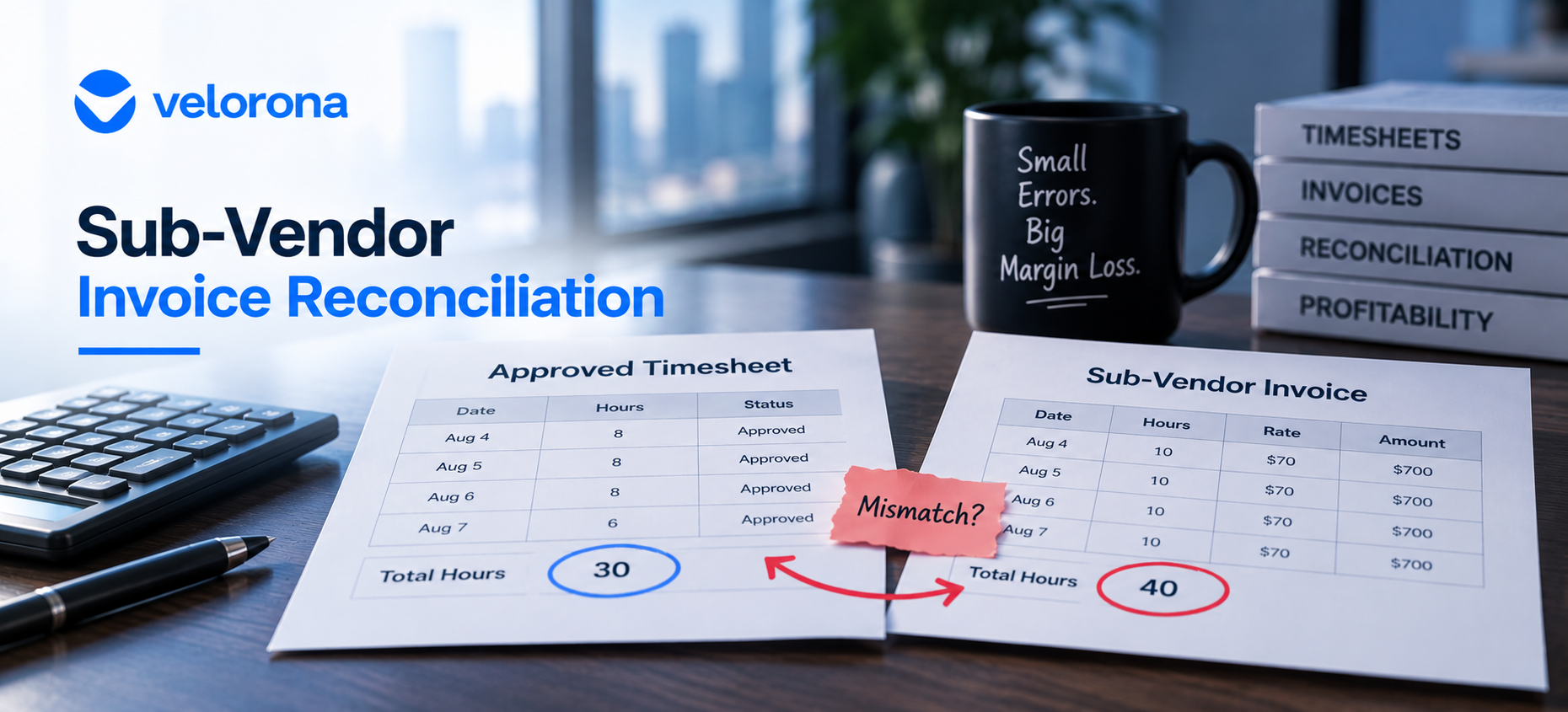
Most IT staffing firms with 30–300 consultants leak $12,000–$25,000 a year to sub-vendor invoice reconciliation gaps not fraud, just drift between approved hours and billed hours that nobody checks line by line. This guide walks through what that drift actually looks like, why it happens even at well-run firms, and how automatic matching catches it before payment goes out.
His firm was doing fine. That’s what he would have told you, if you’d asked him in March. Revenue was up. He had 68 consultants placed across nine clients. Payroll went out on time. Nobody was complaining.
Then his accountant asked a simple question during a tax planning call: “What’s your actual margin on the sub-vendor consultants specifically not blended across everyone, just the sub-vendor placements?”
He didn’t know. He knew the blended number. However, he didn’t know the sub-vendor number because that meant pulling every sub-vendor invoice from the past year, matching it against the timesheets his own team had approved, and checking whether the hours lined up. Nobody had done that in eleven months. His controller had tried once, gave up after two days, and went back to running the business.
So he set aside a weekend. He pulled the sub-vendor invoices. He pulled the approved timesheets. And he started matching them, one by one.
What he found came to just over $18,000.
Why Didn’t a Profitable, Growing Firm Know Its Own Margin?
Because sub-vendor invoice reconciliation at most staffing firms isn’t a continuous process. It’s a periodic scramble that happens once a year or not at all because doing it properly means someone sitting down and cross-referencing two separate documents by hand for every invoice, every pay period.
The Structural Gap
The problem isn’t incompetence. It’s architecture. A sub-vendor invoice arrives by email. The approved timesheet lives in a spreadsheet. Nothing connects them automatically. Consequently, checking whether the invoice matches the timesheet requires someone to open both, compare them manually, and do that for every sub-vendor, every billing cycle.
At three sub-vendors, that’s manageable. At twelve, it stops being realistic. So it gets skipped, or done loosely, and the gap between “hours worked” and “hours billed” quietly grows.
Why This Happens at Well-Run Firms
This isn’t a story about a badly run staffing firm. It’s the opposite. This firm was profitable, growing, and by every visible measure, healthy. The leak existed precisely because everything else ran smoothly enough that nobody had a reason to go looking.
Sub-vendor invoice errors are one of the most common and most invisible bleeds in IT staffing. Per Velorona’s analysis of staffing firm workflows during onboarding, most firms in the 30–300 consultant range leak somewhere between $12,000 and $25,000 a year to exactly this pattern. This firm’s $18,000 sat right in the middle of that range not an outlier, just typical. The American Staffing Association reports industry net margins of 3–7%, which means a leak of that size represents a material share of annual profit for a firm doing $2M–$5M in revenue.
What Does Sub-Vendor Invoice Drift Actually Look Like?
Nobody at the sub-vendor was stealing from him not deliberately. What he found was smaller and more mundane than that, which somehow made it worse:
| Type of Drift | Example | Why It’s Easy to Miss |
|---|---|---|
| Hour mismatch | Sub-vendor billed 42 hours; approved timesheet shows 38 | Nobody cross-checks invoice against timesheet line by line |
| Rate drift | Invoice rate is $2/hour higher than the agreed rate in the vendor hub | Rate was adjusted months ago and never re-verified at billing |
| Duplicate billing | Same week billed twice — invoices arrived two weeks apart | Controller approved both because each looked correct in isolation |
| Missing timesheet | Invoice approved with no matching timesheet on file | Approved anyway because it “looked right” to the controller |
None of it was large on its own. All of it, added up across a year and across three sub-vendors, came to $18,000.
That’s not a rounding error for a firm this size. That’s most of a hire.
Is This Just a Bookkeeping Issue or Something More Serious?
Both. The margin impact is the immediate problem. However, there’s a compliance dimension worth naming directly.
The Margin Problem
When hours billed don’t match hours actually worked and approved, the gap represents money paid out for work that didn’t happen. At a 3–5% error rate on $500K in annual sub-vendor spend, that’s $12,000–$25,000 per year. We cover the full cost breakdown in How Sub-Vendor Invoice Errors Cost Your Staffing Firm $12,000 to $25,000 Every Year.
The Compliance Problem
When hours billed don’t match hours actually worked and approved, that gap isn’t just a margin problem it’s a documentation gap that can matter if a wage dispute or audit arises. The U.S. Department of Labor’s FLSA recordkeeping requirements require accurate records of hours worked. A sub-vendor invoice reconciliation process that catches mismatches at the point of invoicing does double duty: protecting margin and keeping the underlying hour records defensible.
Furthermore, when those records need to support year-end 1099-NEC filing, accurate sub-vendor payment records ones that reflect what was actually approved, not what was billed matter for tax accuracy too.
How Does Manual Reconciliation Compare to Automated Invoice Matching?
The following table shows the difference between checking sub-vendor invoices by hand versus automatic matching at the moment of arrival:
| Dimension | Manual Sub-Vendor Reconciliation | Automated Invoice Matching (Velorona) |
|---|---|---|
| When the check happens | Periodically quarterly, annually, or never | At invoice arrival before payment goes out |
| Who performs the check | Controller manually compares two documents | System matches invoice against approved timesheet hours |
| Time per billing cycle | 8–12+ hours/month across all sub-vendors | ~90 minutes/month (exception review only) |
| Error detection rate | Catches some misses the cumulative drift | Flags every mismatch before payment |
| When errors surface | Months later, after payment has cleared | Same day the invoice arrives |
| Recovery after error | Phone calls, credit memos, strained relationships | Nothing to recover error caught pre-payment |
| Audit trail | Email threads and memory | Every match and every mismatch timestamped and logged |
| Rate verification | Only if controller remembers to check | System compares invoice rate against the agreed rate in the vendor hub |
What’s the Actual Fix a Bigger Team or a Different Process?
He didn’t need to hire someone to check invoices more carefully. He needed the checking to happen automatically, the moment a sub-vendor invoice came in — matched against the approved timesheet immediately, with any mismatch flagged before payment went out.
That’s the mechanism: every client invoice generates from approved hours, every sub-vendor invoice coming in gets checked against those same approved hours, and any gap surfaces automatically rather than requiring someone to go looking for it.
The reconciliation he did manually over a weekend once, a year late happens on every invoice, every time, without anyone opening a spreadsheet. This is Velorona’s bidirectional reconciliation: client invoices going out matched against sub-vendor invoices coming in, through the vendor hub, with mismatches flagged before payment.
How This Connects to the Rest of the Back Office
Sub-vendor invoice reconciliation doesn’t exist in isolation. When it runs automatically, three other things improve as a direct result:
Margin per client becomes accurate. If sub-vendor costs stay verified against approved hours in real time, the gap between what you billed and what you paid reflects reality not a number that drifts 3–5% per year before anyone notices.
Controller workload drops. The 12+ hours per month spent on manual matching drops to about 90 minutes of exception review because the system handles the matching and flags only the cases that need a human decision. We cover this in detail in Automate Timesheet Reconciliation: Cut 12 Hours to 90 Minutes.
Client invoice delivery becomes cleaner. The same approved hours that verify the sub-vendor invoice also generate the client invoice pulling the correct rate from the current client configuration, delivering through the client portal with read receipts, and triggering automated reminders at 7, 14, and 30 days past due.
What Should You Honestly Expect and What Isn’t Ready Yet?
Velorona handles timesheets with multi-level approval and time locking, sub-vendor invoicing with bidirectional reconciliation via the vendor hub, client portal auto-delivery with read receipts, multi-currency invoicing (USD/INR with FX lock), expense tracking, time-off, schedules, payroll details, bulk timesheet approval, and audit logs with 2FA.
The Team plan costs $10/month per user ($7/month on annual billing), with no setup fees and no implementation cost. Firms typically go live in 5 to 14 days. Full plan details sit on the pricing page.
What Isn’t Available Today
However, Velorona does not do the following today: QuickBooks Online integration targets Q3 2026 (until then, export clean matched data via CSV). Similarly, Stripe Connect for online invoice payment targets Q3 2026. The team currently builds SSO. In addition, Public API + Zapier targets Q3 2026. Payroll execution via Gusto Embedded targets Q4 2026. Finally, 1099-NEC auto-generation also targets Q4 2026. The FAQ page covers additional details.
One month free trial. No credit card required.
Frequently Asked Questions About Sub-Vendor Invoice Reconciliation
How common is sub-vendor invoice drift, really?
Very common in firms without automated matching. Per Velorona’s analysis of staffing firm invoice data during onboarding, most staffing firms in the 30-300 consultant range carry a 3–5% error rate on sub-vendor invoices when reconciliation runs manually. At $500K in annual sub-vendor spend, that’s $12,000–$25,000 per year. The firms that don’t find it aren’t firms that don’t have it they’re firms that haven’t checked.
Is this usually intentional fraud on the sub-vendor’s side?
Rarely. It’s more often small, cumulative drift a rate adjustment that didn’t get re-verified in the vendor hub, an invoice approved without a matching timesheet on file rather than deliberate overbilling. The fix is a process that checks automatically, not suspicion of your sub-vendors.
How often should a firm reconcile sub-vendor invoices manually if they don’t have automated matching?
At minimum, quarterly waiting a full year, as in this scenario, means the drift has already compounded well past the point of easy correction. However, the right answer is to check every invoice at arrival rather than batch-reconciling periodically. Manual batch reconciliation will always miss some errors under time pressure.
Does reconciliation slow down the invoice-to-payment process?
Automated matching happens at the moment the invoice arrives, so it doesn’t add a manual step. Mismatches get flagged immediately rather than requiring a separate audit process. Invoices that match clear the same day. In practice, accurate invoices get paid faster not slower because there’s no “let me check and get back to you” delay.
What’s the first thing to check if you suspect drift but haven’t reconciled in a while?
Start with your largest sub-vendor by dollar volume. Even a spot check of three or four recent invoices against approved timesheets often reveals whether the pattern exists before committing to a full historical review. Check hours billed against approved timesheet hours and compare the invoice rate against the rate agreement in your records.
How does sub-vendor reconciliation connect to the staffing firm audit trail?
Every match, every mismatch, and every resolution should get timestamped and logged not just the final payment. In Velorona, the audit trail records who submitted the invoice, which timesheet it matched against, whether the system cleared or flagged it, and who resolved any mismatch. That record matters for wage disputes, tax audits, and the annual 1099 reconciliation.
The Weekend He Spent Matching Invoices Shouldn’t Happen to You
He spent two days of his own time finding $18,000 his firm had already paid out. He couldn’t recover most of it the sub-vendor invoices were twelve months old, the money was spent, and asking for credits on year-old overpayments strains relationships. What he could do was make sure it didn’t happen again.
That’s the only rational response to finding a leak: close it. Sub-vendor invoice reconciliation that happens automatically at invoice arrival, before payment, every time is how it stays closed.
Start your free trial of Velorona and get automatic invoice reconciliation from day one no more finding out what you leaked a year after it happened. Start free trial →
Or book a 15-minute demo to see the matching workflow with your actual sub-vendor structure.
Related reading:
- How Sub-Vendor Invoice Errors Cost Your Staffing Firm $12,000 to $25,000 Every Year
- How to Verify Sub-Vendor Invoices Before You Pay for Hours No One Worked
- Staffing Firm Margin: Where It Actually Disappears
- Automate Timesheet Reconciliation: Cut 12 Hours to 90 Minutes
- Your Client Said They Never Got the Invoice. Again.
- January Is Coming: Get Your 1099 Data Ready Now
- The Complete Guide to Staffing Agency Back Office Software