Why Doesn’t Generic Invoicing Software Work for C2C Staffing?
Corp-to-corp billing means you invoice a client for hours a consultant worked, while separately paying that consultant’s own company (or a sub-vendor employing them) for the same hours often at a different rate. A generic tool built for freelancer-to-client billing has no concept of that second leg.
As a result, most firms track the client side in one system and the sub-vendor side in a spreadsheet or email thread. Then someone manually makes sure the two agree. This is a process we cover in detail in How Sub-Vendor Invoice Errors Cost Your Staffing Firm $12,000 to $25,000 Every Year and it carries a 3-5% error rate that costs $12,000-$25,000 annually for firms with $500K to $1M in sub-vendor spend.
The Three-Party Gap That Creates the Errors
Specifically, here’s where the gap sits. In a typical C2C staffing arrangement:
Party 1 – Your client. You invoice them for the consultant’s hours at the client billing rate.
Party 2 – The sub-vendor or consultant’s corp. You pay them for the same hours at the sub-vendor rate (lower than the client rate the difference is your margin).
Party 3 – Sometimes an MSP or VMS. A vendor management system sits between you and the client, dictating the invoice format, PO requirements, and approval workflow.
Generic invoicing software sees Party 1 and ignores Parties 2 and 3. Consequently, your controller fills the gap manually and that’s where hours get mis-keyed, rates get mismatched, and margin quietly disappears.
What Should C2C Invoicing Software Actually Do?
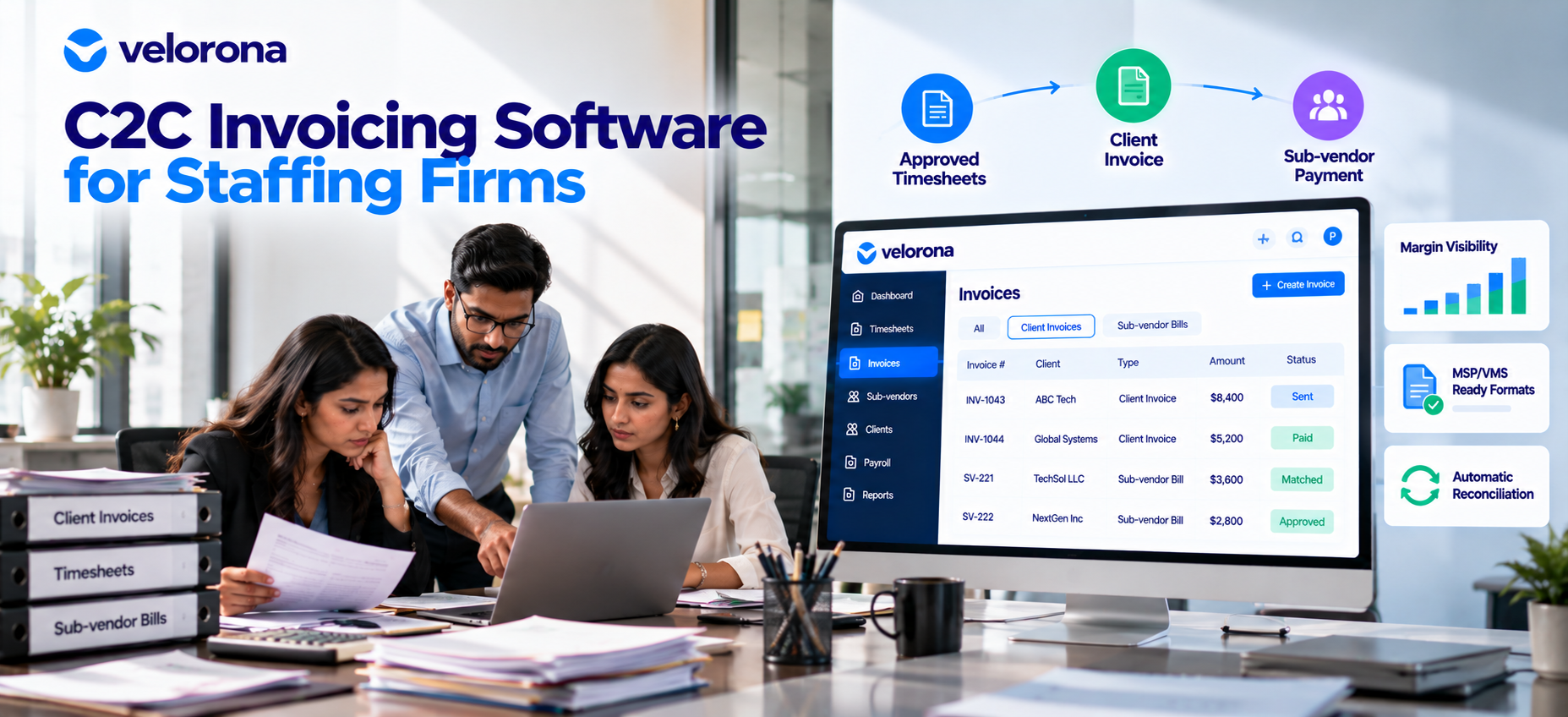
Purpose-built c2c invoicing software should handle three things from one set of approved hours:
First, generate the client invoice directly from approved timesheet hours. No manual re-entry. The system applies the client billing rate, respects the billing schedule, and creates the invoice line item automatically.
Second, handle the sub-vendor side of the same transaction. The hours you bill the client and the hours you pay the sub-vendor come from the same source of truth. When the numbers agree, the sub-vendor invoice clears. When they don’t, the system flags the mismatch before payment which is Velorona’s bidirectional reconciliation at work.
Third, support the invoice formats that MSPs and VMS platforms require. A rejected invoice format can delay payment as long as a billing error. The system should match the client’s expected format automatically, not require manual reformatting every cycle.
How Does Generic Invoicing Compare to Purpose-Built C2C Invoicing Software?
The following table shows the gap between tools built for two-party billing and tools built for the three-party reality staffing firms actually run:
| Dimension | Generic Invoicing (QuickBooks, freelancer tools) | Purpose-Built C2C Invoicing |
|---|---|---|
| Party structure | Two-party (you and client) | Three-plus party (client, sub-vendor, sometimes MSP/VMS) |
| Sub-vendor billing | Not supported your controller tracks it separately | Native the system matches against the same approved hours |
| Source of invoice data | Manually entered | The system pulls directly from approved timesheets |
| Rate structure | Single rate per client | Client rate and sub-vendor rate tracked separately, same transaction |
| Multi-currency | Manual FX conversion | Built in currency locks at setup, margin calculated in USD |
| MSP/VMS compatibility | Requires manual reformatting each cycle | The system matches common formats automatically |
| Invoice delivery | Email with PDF no read receipt | Client portal you see when the client opens, views, and approves |
| Sub-vendor error detection | None errors hide until month-end | System flags mismatches before payment (3-5% error rate caught) |
| Margin visibility | Requires separate spreadsheet reconstruction | Subtraction from the same approved hours available on demand |
How Do You Invoice an MSP or VMS Without the Invoice Getting Rejected?
MSPs and VMS platforms (vendor management systems that large clients use to manage staffing spend) often require a specific invoice format: PO number in a specific field, timesheet backup attached, rate breakdowns shown a certain way. Get any of that wrong and the invoice bounces back, adding days or weeks before you receive payment.
This ranks as one of the quieter contributors to a stretched DSO something we cover in Cut Your Staffing Firm’s DSO Without Chasing Clients. Specifically, a rejected invoice can add two to three weeks to an already-long payment cycle.
The fix: build invoice templates per client that match what the MSP or VMS expects. The system generates the invoice automatically in the right format every cycle nobody reformats anything by hand. Furthermore, Velorona’s client portal delivers the invoice directly, so you can see when the client opened it, viewed it, and approved it. The “I never received it” dispute which typically adds 7 to 15 days to DSO disappears entirely.
How Do You Set Up C2C Invoicing That Actually Matches Your Sub-Vendor Bills?
Here are the steps, in order:
Step 1: Pull the client invoice from approved consultant hours. When a consultant’s timesheet receives approval, the system generates the client invoice line item automatically billing rate applied, PO number pulled from client setup. No separate spreadsheet. No re-typing.
Step 2: Pull the sub-vendor bill from the same hours, at the sub-vendor’s rate. Since both invoices reference the same underlying timesheet record, the system catches a mismatch between what you bill and what you pay immediately not at month-end. This is bidirectional reconciliation: client invoices going out matched against sub-vendor invoices coming in.
Step 3: Match your invoice template to the client’s requirements. If the client uses an MSP or VMS, configure the template once to their format. Every future invoice goes out correctly the first time no reformatting.
Step 4: Track invoice status end-to-end. Know whether someone sent, viewed, or paid an invoice rather than discovering it never arrived when the client hits 45 days overdue. Velorona’s client portal shows this in real time.
Step 5: Lock multi-currency rates at invoicing. If you bill US clients in USD and pay Indian sub-vendors in INR, the system locks the FX rate at setup. No retroactive adjustments, no spreadsheet workarounds. This matters particularly for Indian-American staffing firms concentrated in NJ, Dallas-Fort Worth, and Atlanta.
What Changes When Your Invoicing System Handles Three-Party Billing?
Firms that move off the spreadsheet-plus-QuickBooks approach for their C2C billing typically see three immediate changes:
Double entry stops. The client invoice and the sub-vendor bill share one source of approved hours. Nobody re-keys the same data into two systems. As a result, that alone removes most of the manual matching work your controller currently performs.
The 3-5% error rate drops. When the system matches every sub-vendor invoice against approved timesheet hours before payment, the $12,000-$25,000 per year in overpayments that manual eyeballing misses gets caught at the source. We document this in the sub-vendor invoice errors deep dive.
Margin becomes a lookup, not a project. Once client and sub-vendor invoices share the same hours, the gap between what you billed and what you paid becomes a simple subtraction not a reconciliation project. That’s the foundation of the live margin reporting we cover in Staffing Firm Margin: Where It Actually Disappears.
Furthermore, your controller’s workload shifts from data matching to exception review. The Friday Night Reconciliation Ritual documents how that 12-hour weekly reconciliation workload drops to 90 minutes and the controller workload piece explains where that freed time goes.
What Should You Honestly Expect From Velorona and What Isn’t Ready Yet?
Velorona handles timesheets, sub-vendor invoicing with bidirectional reconciliation, client portal auto-delivery with read receipts, multi-currency invoicing (USD/INR with FX lock), expense tracking, time-off, schedules, payroll details, bulk timesheet approval, and audit logs with 2FA.
The Team plan costs $10/month per user ($7/month on annual billing), with no setup fees and no implementation cost. Firms typically go live in 5 to 14 days. Compare that to CEIPAL ($30K–$50K/year, 12 weeks implementation) or Bullhorn ($50K+/year). Full plan details sit on the pricing page.
What Isn’t Available Today
However, Velorona does not do the following today: QuickBooks Online integration targets Q3 2026 (until then, you export clean matched data via CSV). Similarly, Stripe Connect for online invoice payment through the client portal targets Q3 2026. The team currently builds SSO. In addition, Public API + Zapier targets Q3 2026. Payroll execution via Gusto Embedded targets Q4 2026. Finally, 1099-NEC auto-generation also targets Q4 2026. The FAQ page covers additional details.
If you need QuickBooks sync or payroll execution today, the honest answer is to wait or evaluate alternatives. On the other hand, if your core pain is C2C invoicing matching client invoices to sub-vendor bills from one set of hours, with multi-currency and MSP/VMS format support Velorona addresses that today.
One month free trial. No credit card required.
Frequently Asked Questions About C2C Invoicing Software
What exactly makes C2C invoicing different from regular invoicing?
Regular invoicing bills a client for work done one rate, one party, one transaction. C2C invoicing does that and separately pays a consultant’s corporation or a sub-vendor for the same work, at a different rate, within the same billing cycle. In other words, c2c invoicing software needs to handle both legs of the transaction from one set of approved hours. Software that only handles the first leg forces your controller to manage the second leg manually which is where invoice errors and margin leakage originate.
Can I use QuickBooks for the client side and something else for sub-vendors?
You can. However, that means the two sides never get checked against each other automatically which is exactly where the 3-5% error rate and $12,000-$25,000 in annual overpayments originate. We cover what that gap actually costs in How Sub-Vendor Invoice Errors Cost Your Staffing Firm $12,000 to $25,000 Every Year.
Does Velorona support the invoice formats MSPs and VMS platforms require?
Yes. Custom invoice templates per client currently ship as a standard feature. You configure each template to match what a given client, MSP, or VMS expects PO placement, rate breakdowns, timesheet backup attachment so invoices don’t bounce back for formatting reasons.
What if I bill in multiple currencies?
Velorona supports multi-currency invoicing natively. Specifically, the system locks the FX rate at the time of invoicing so nobody makes retroactive adjustments. This matters especially for Indian-American staffing firms that bill US clients in USD and pay Indian sub-vendors in INR the currency locks at setup, and margin calculates in USD automatically.
How does c2c invoicing software connect to margin visibility?
Once client and sub-vendor invoices share the same approved hours, the gap between what you billed and what you paid becomes a simple subtraction instead of a reconciliation project. That’s the foundation of live margin-per-client reporting, which we cover in Staffing Firm Margin: Where It Actually Disappears. In other words, accurate C2C invoicing is the prerequisite for accurate margin visibility.
Does Velorona integrate with QuickBooks?
QuickBooks Online integration targets Q3 2026 on Velorona’s roadmap. Until then, you export clean, reconciled data via CSV so whatever enters QuickBooks is already accurate. Velorona handles the pre-accounting workflow (timesheets, invoicing, reconciliation, payroll details) and feeds your accounting system, rather than replacing it.
Stop Re-Keying the Same Hours Into Two Systems
If your client invoice and your sub-vendor bill come from two different spreadsheets that someone manually keeps in sync, that’s where both the errors and the wasted hours live. The right c2c invoicing software pulls both sides from the same approved timesheet and catches mismatches before you pay.
Book a personalized demo and we’ll show you what three-party invoicing looks like with your actual client and sub-vendor structure. Alternatively, Claim 2 Months 100% FREE Premium Plan, no credit card required.
Related reading:
- How Sub-Vendor Invoice Errors Cost Your Staffing Firm $12,000 to $25,000 Every Year
- Staffing Firm Margin: Where It Actually Disappears
- The Friday Night Reconciliation Ritual: What It Actually Costs
- Cut Your Staffing Firm’s DSO Without Chasing Clients
- Your Controller Is Doing $200 Work Worth $50
- Closing the Staffing Cash Gap
- The Complete Guide to Staffing Agency Back Office Software