Staffing Agency Rate Cards: How Outdated Rates Kill Margin
A staffing firm’s staffing agency rate cards determine the revenue and cost behind every hour billed and they go stale in ways that most firms don’t notice until month-end, if they notice at all. Your timesheets can be completely accurate. Your invoice can still be wrong. Here’s where rates drift, what it costs, and how to build a process that catches it before billing.
A consultant works 160 hours in a month. The timesheet goes through the approval chain without issue. The account manager signs off. The invoice goes out with the correct hour count.
Nobody disputes the hours. The client pays without a question.
However, the client contract was renewed in January at $120/hour. The billing system still shows $115/hour from the previous contract term because the rate was updated in the contract but never changed in the invoicing tool.
Consider this hypothetical: 160 hours × $5/hour difference = $800 in revenue left on the table. For one consultant. In one month.
Now run that same arithmetic across ten consultants with the same rate lag. That’s $8,000 per month. $96,000 per year. Not because anyone made a mistake on a timesheet. Because the rate behind the hours was wrong, and nobody caught it.
This is the rate drift problem. And it’s more common than most staffing firm owners want to admit.
What Is a Staffing Agency Rate Card?
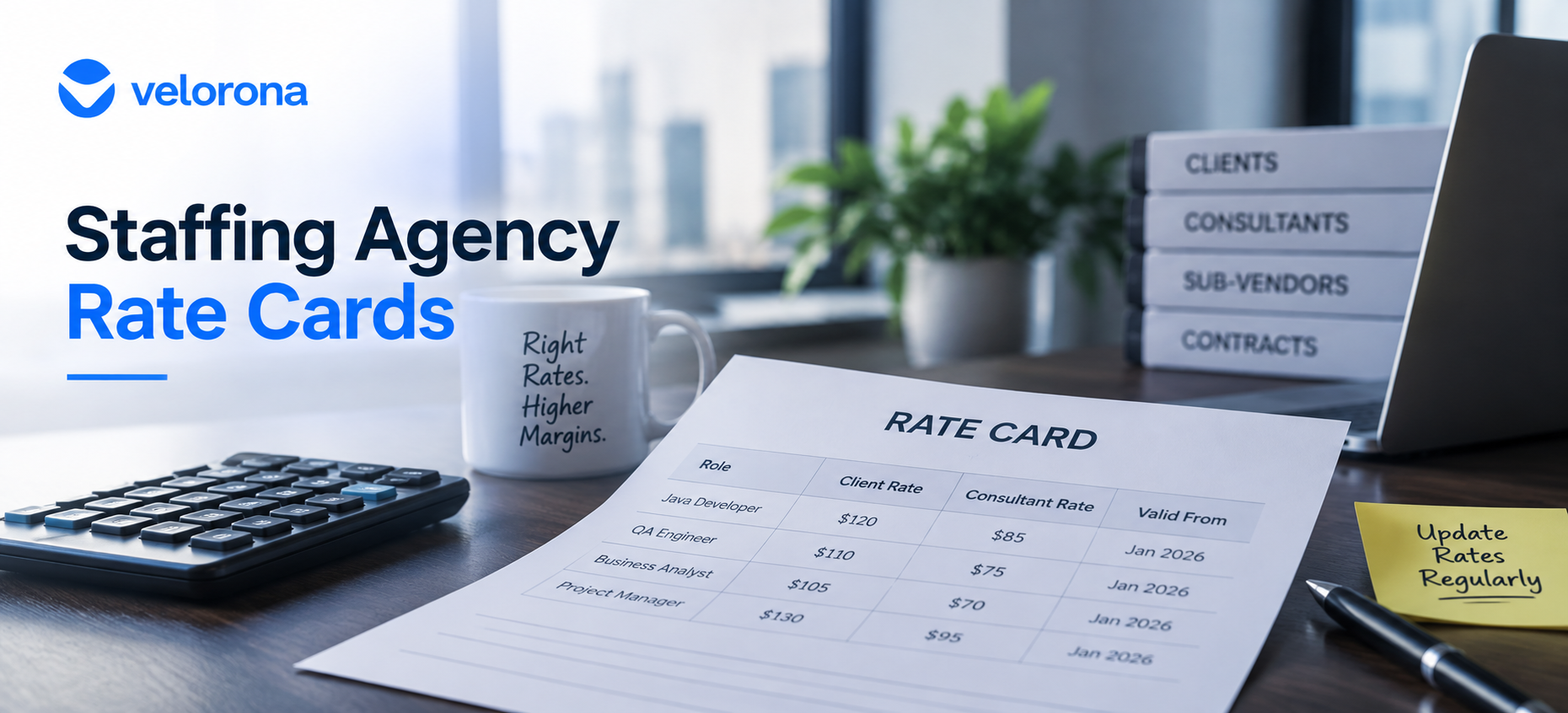
A staffing agency rate card is the structured record of the rates that govern every billing and payment transaction in a consultant engagement. It’s not a single number it’s a set of numbers, each tied to a specific relationship and a specific time period.
A complete rate card for a single consultant engagement typically includes:
Client bill rate. The hourly rate you invoice the end client. This is the top-line revenue figure for the engagement. It should reflect the current contract terms not the rate from the previous renewal, not the original onboarding rate, not a default rate that nobody updated.
Consultant pay rate. The hourly rate you pay the consultant directly (for W-2 or 1099 arrangements). This is your direct cost for the engagement.
Sub-vendor rate. If the consultant works through a sub-vendor under a C2C arrangement, this is the hourly rate you pay the sub-vendor. It differs from the consultant pay rate because you’re paying the sub-vendor’s company, not the individual.
Effective dates. Every rate should have a start date and, where applicable, an end date. A rate without an effective date is a rate waiting to cause a billing error.
Currency. For cross-border arrangements common in IT staffing firms working with Indian sub-vendors rates may apply in different currencies. USD for the client invoice, INR for the sub-vendor payment.
Project or client-specific variations. Many staffing firms have a default billing rate for a client, with exceptions for specific projects, roles, or locations. Those exceptions need their own rate records not a note in the account manager’s email.
Overtime and blended rates. Where applicable, the rate card should specify whether overtime applies and at what multiplier.
The rate card is the source of truth that every invoice and every payment should trace back to. When it’s accurate, billing is accurate. When it drifts which it does, quietly, through contract renewals, pay adjustments, and manual workarounds the financial consequences compound before anyone notices.
Why Rate Errors Are More Dangerous Than They Look
The reason rate drift is harder to catch than hour errors is that invoices look right. The hour count matches the timesheet. The math checks out. The invoice is technically correct based on the data in the system.
The problem is that the data in the system is wrong.
Consider a hypothetical scenario:
| Item | Correct | Incorrect (in system) |
|---|---|---|
| Client bill rate | $120/hour | $115/hour |
| Hours billed | 160/month | 160/month |
| Invoice total | $19,200 | $18,400 |
| Revenue shortfall | – | $800/month |
One consultant, one rate lag of $5/hour, one month: $800 shortfall.
Now consider the same issue from the other direction a sub-vendor rate that was supposed to decrease after a contract amendment but didn’t. In that case, the firm overpays rather than under-invoices. The financial impact is the same; the direction is different.
The compounding effect is what makes rate errors genuinely dangerous. A $5/hour rate lag on one consultant is a rounding error. The same lag on fifteen consultants across three clients, running for six months before anyone audits it, is a meaningful financial problem and by the time someone catches it, the margin is already gone. We cover where staffing firm margin disappears in more depth in Staffing Firm Margin: Where It Actually Disappears.
Where Staffing Agencies Lose Control of Their Rates
Rate drift doesn’t usually happen because someone made a deliberate error. It happens through a series of small operational gaps, each of which seems manageable on its own:
Contract Renewal Changes the Bill Rate
The client renews for another year at a negotiated rate increase. The rate gets updated in the contract document and in the account manager’s notes. It doesn’t get updated in the invoicing tool. The next billing cycle goes out at the old rate.
A Consultant Receives a Pay Adjustment
The consultant gets a raise deserved, agreed to, documented in email. The pay rate gets updated in the payroll system. It doesn’t propagate to the rate card that drives sub-vendor billing or the margin calculation. The firm continues showing the old cost rate in its margin reporting.
A Client Has a Project-Specific Rate
The standard rate for Client X is $115/hour. However, Project Y at the same client has a $125/hour rate because it requires a senior architect. When a new consultant goes onto Project Y, the default client rate applies in the billing system because whoever set up the engagement didn’t know there was a project-specific override.
A Sub-Vendor Changes Their Rate
The sub-vendor renegotiates their rate mid-engagement. The staffing firm accepts via email. The new rate gets documented nowhere in the billing system. The sub-vendor invoices at the new rate. The staffing firm’s rate card still shows the old rate. The invoice reconciliation flags a mismatch or doesn’t, if the reconciliation is manual. We cover the invoice matching side of this in How to Verify Sub-Vendor Invoices Before You Pay.
Effective Dates Get Ignored
A rate change goes into effect on the 15th of the month. The billing cycle runs from the 1st. Nobody configures the effective date correctly. The entire month bills at the pre-change rate or the post-change rate applied retroactively to weeks when it shouldn’t have.
Someone Updates One Spreadsheet and Not Another
The rate lives in three places: the invoicing spreadsheet, the payroll spreadsheet, and the margin tracking spreadsheet. Someone updates the invoicing spreadsheet after a contract amendment. The other two continue showing the old rate. The margin calculation uses the wrong cost rate for the next three months.
Currency Creates Another Layer
A US client pays in USD. The sub-vendor invoices in INR. The exchange rate used in the billing system was set six months ago and hasn’t been updated. The margin calculation reflects a currency assumption that no longer matches reality. We cover the multi-currency dimension specifically in Bill in USD, Pay Sub-Vendors in INR.
Client Bill Rate vs. Consultant Pay Rate vs. Sub-Vendor Rate
These three numbers are distinct, and conflating them is where a lot of rate management problems start.
The client bill rate is what the end client pays the staffing firm. This is revenue. It should be tied to the client contract, the specific role or project, and the effective date range.
The consultant pay rate is what the staffing firm pays the individual consultant directly applicable in W-2 or 1099 arrangements. This is a direct cost.
The sub-vendor rate is what the staffing firm pays the sub-vendor company in a C2C arrangement. The sub-vendor then pays the consultant from their own funds. This is also a direct cost but it’s a different number from the consultant pay rate, and it exists in a different contractual relationship.
Hypothetical example:
| Transaction | Rate |
|---|---|
| Client pays staffing firm | $120/hour |
| Staffing firm pays sub-vendor | $85/hour |
| Difference before other costs | $35/hour |
That $35/hour difference is not automatically gross margin. The staffing firm carries additional costs employer taxes on any W-2 staff, workers’ comp, insurance, administrative overhead that reduce the effective margin further. However, the $35/hour spread is the starting point for understanding whether an engagement is financially viable.
The problem is that most staffing firms can’t answer “what is our current spread on Consultant X?” in real time because the client rate, the sub-vendor rate, and the approved hours sit in three different places that nobody reconciles continuously.
Why C2C Staffing Makes Rate Cards Harder
In a direct placement staffing firm pays consultant the rate structure has two parties: client bill rate and consultant pay rate. One spread. One margin calculation.
In a C2C arrangement, there’s an additional party: the sub-vendor. That adds another rate, another contractual relationship, another invoice, and another potential point where the rate can drift independently of the other two.
In some IT staffing arrangements, particularly where sub-vendors source consultants through their own networks, the chain goes deeper:
End Client → Staffing Firm → Sub-Vendor → Sub-Sub-Vendor → Consultant
Each layer has its own rate. Each rate has its own effective dates. Each rate can drift independently. And the staffing firm sitting in the middle is responsible for ensuring that every layer invoices at the agreed rate while also ensuring its own margin on the full chain remains what it expected.
We cover the operational complexity of multi-tier chains in detail in Multi-Tier Staffing Vendor Management. The rate management challenge is a core part of that complexity not every staffing firm runs multi-tier arrangements, but those that do face a compounded version of the rate drift problem.
The Multi-Currency Rate Card Problem
For US IT staffing firms with Indian sub-vendors a common structure in markets like NJ, Dallas-Fort Worth, and Atlanta the rate card spans two currencies.
Consider a hypothetical:
| Transaction | Currency | Rate |
|---|---|---|
| Client invoice | USD | $120/hour |
| Sub-vendor payment | INR | ₹7,000/hour |
The staffing firm’s margin calculation requires converting one to the other. If that conversion uses a fixed exchange rate from six months ago, the margin calculation may look healthy even as the actual INR cost has changed relative to USD.
Manual currency conversion looking up the rate at billing time, entering it into a spreadsheet, hoping it gets applied consistently creates the same drift problem as any other manual rate entry. The rate is only as accurate as whoever last looked it up, and there’s no audit trail showing which rate applied to which invoice.
Velorona supports multi-currency rate cards and invoicing, including the ability to lock an exchange rate at the time of invoicing so the record stays consistent and auditable. This doesn’t solve every currency management challenge, but it removes the manual lookup-and-entry step where inconsistency most commonly enters the process.
How to Build a Reliable Staffing Rate Card Process
The following applies regardless of which tool you use. A reliable rate management process needs:
One source of truth for every rate. Not a spreadsheet, a contract document, and an invoicing tool one place where the authoritative rate lives and where any change gets made. Every invoice and every payment should trace back to that record.
Client-specific rate records with effective dates. Each client gets their own rate configuration. Each rate has a start date. Contract renewals create new rate records they don’t overwrite the old ones, which you need for historical accuracy.
Consultant and sub-vendor rate records with effective dates. Same principle on the cost side. Pay adjustments and sub-vendor rate changes create dated records they don’t replace the prior rate without trace.
Rate verification before billing. Before any invoice goes out, someone or something should confirm that the rate applied matches the current contract. This doesn’t need to be manual but it needs to happen.
Rate verification before payment. Before any sub-vendor invoice gets approved, the rate on that invoice should get checked against the agreed sub-vendor rate in the rate card. We cover the invoice matching side of this in How to Verify Sub-Vendor Invoices Before You Pay.
Clear ownership of rate changes. Someone should be responsible for updating rate records when contracts change. That process should be documented, not informal. When a contract amendment lands in the account manager’s email, there should be a defined path to getting that rate updated in the system.
Periodic rate audits. At minimum quarterly, someone should compare the rates in the billing system against the current contracts for every active engagement. This catches drift before it compounds.
An audit trail on every rate change. Who changed the rate, when, and from what to what. This matters when a dispute arises or when the controller needs to explain a billing discrepancy.
What Rate Management Software Should Actually Check
If you’re evaluating tools or assessing your current one here’s what rate verification functionality should actually cover:
Is the current rate being used? Not the rate that was entered at onboarding. Not the default rate for this client. The rate that applies to this consultant, on this project, in this billing period.
Is the rate tied to the correct client and project? A client with multiple projects at different rates needs project-level rate records not just a single client rate.
Is the effective date correct? If a rate changed on the 15th, the first half of the month should bill at the old rate and the second half at the new rate. Does the system handle that, or does it apply one rate to the entire billing period?
Is the billing currency correct? For multi-currency arrangements, is the invoice going out in the right currency at the right rate?
Is the sub-vendor rate correct? Does the sub-vendor invoice match the rate stored in the vendor record or is there a discrepancy that needs to be caught before payment?
Has any rate changed since the last billing cycle? If a rate changed between billing cycles, does something flag it so a human can verify the change was intentional and correctly applied?
Can the rate history be traced? If a dispute arises over a billing discrepancy, can you show the full rate history what rate applied, when, and why?
Velorona’s vendor hub stores sub-vendor rates, effective dates, and rate agreements alongside W-9s and MSAs. When a sub-vendor invoice arrives, the bidirectional reconciliation checks the invoice rate against the rate stored in the vendor hub flagging mismatches before payment rather than discovering them at month-end. Combined with timesheet-to-invoice automation, approved hours pull the rate from the current client configuration rather than from a manually entered field which removes one of the most common paths for rate drift to enter the billing process.
This doesn’t claim to prevent every possible rate error. However, it does address the most common operational gaps: rates stored separately from invoicing, sub-vendor rates not checked at billing time, and rate changes that propagate to contracts but not to the billing system.
The Rate Card Audit You Should Run This Month
Before the next billing cycle, check five things on your three largest active engagements:
1. Pull the current client contract. What rate is in the contract for the current term? Compare it to the rate in your billing system. Do they match?
2. Pull the current sub-vendor agreement. What rate did you agree to pay the sub-vendor? Compare it to the rate in your invoicing tool. Do they match?
3. Check the effective dates. Did any rate change take effect since the last billing cycle? If so, was it applied to the correct period not the entire month?
4. Check the currency configuration. For any cross-border arrangement, what exchange rate is your billing system using? When was it last updated?
5. Check the rate history. Can you see every rate change for these engagements over the past six months, including who made the change and when?
If any of those five checks reveals a discrepancy or if you can’t answer them without opening multiple spreadsheets and email threads that’s where your rate management process has a gap.
Staffing Agency Rate Cards: The Problem That Hides in Plain Sight
The reason rate drift persists in most staffing firms is that it’s invisible. Invoices go out. Clients pay them. The numbers look right. Nothing flags.
The only signal that something is wrong is a margin calculation that doesn’t quite match what you expected and most staffing firms only produce that calculation quarterly, by which point several billing cycles of rate drift have already settled into the books.
Staffing agency rate cards don’t fail dramatically. They drift slowly, one overlooked contract amendment and one unupdated spreadsheet at a time. The answer isn’t more careful data entry. It’s a process where the rate is verified against the contract before every invoice goes out not reconstructed from memory when someone finally notices the discrepancy.
Want to see how Velorona handles staffing rates, invoices, and contractor workflows in one back office? Explore Velorona →
Related reading:
- How to Verify Sub-Vendor Invoices Before You Pay for Hours No One Worked
- How Sub-Vendor Invoice Errors Cost Your Staffing Firm $12,000 to $25,000 Every Year
- Staffing Firm Margin: Where It Actually Disappears
- Multi-Tier Staffing Vendor Management: How to Control C2C Chains
- Bill in USD, Pay Sub-Vendors in INR: Multi-Currency Without the Spreadsheet
- C2C Invoicing Software Built for How Staffing Firms Actually Bill
- The Complete Guide to Staffing Agency Back Office Software