Multi-Tier Staffing Vendor Management: How to Control C2C Chains and Protect Margin
When a C2C staffing chain runs four parties deep end client, staffing firm, sub-vendor, sub-sub-vendor multi-tier staffing vendor management stops being an administrative task and becomes an operational risk. Every additional layer introduces another invoice, another rate, another approval point, and another opportunity for margin to disappear before anyone notices. Here’s where the chains break, what they cost, and what a firm needs to manage them properly.
Liam’s firm placed a Java developer at a financial services client in New Jersey. The client billing rate is $120 per hour. The developer works through a sub-vendor a small staffing firm in Dallas who pays the developer through their own sub-contractor arrangement. The developer works 40 hours in a given week.
Four parties. Four sets of records. Four potential discrepancy points.
Liam’s controller can tell him the client invoice total. However, she can’t immediately tell him what the developer actually cost because the sub-vendor’s invoice hasn’t arrived yet, the sub-sub-vendor arrangement isn’t formally tracked in any system, and the rate at the bottom of the chain was agreed verbally three months ago.
The developer worked 40 hours. Nobody made a mistake. And yet Liam still can’t answer the one question that matters most: how much did this consultant actually cost us?
That’s the multi-tier staffing vendor management problem. It’s not a billing error. It’s a structural gap between how staffing workflows actually run and what most software was built to handle.
Why Is a Staffing Transaction Not Always Two-Party?
Most invoicing tools model a simple relationship: you bill a client, you pay a vendor or employee. Two parties. One margin calculation. Straightforward.
However, IT staffing firms particularly those operating with C2C workflows frequently run a very different structure:
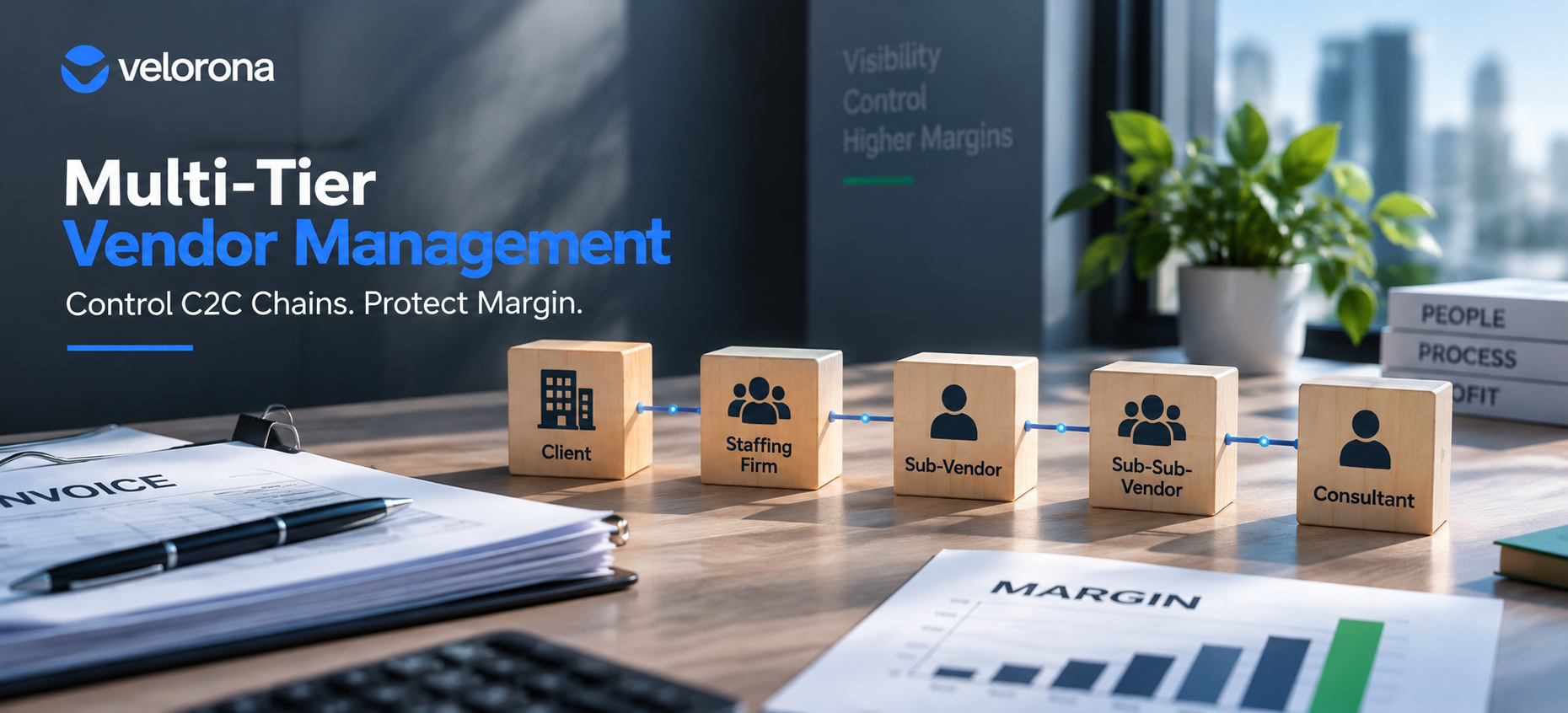
End Client → Staffing Firm → Sub-vendor → Sub-sub-vendor → Consultant
This isn’t unusual. It’s common in markets like NJ/NYC, Dallas-Fort Worth, and Atlanta, where Indian-American staffing firms source through layered C2C arrangements. The staffing firm invoices the client. The sub-vendor invoices the staffing firm. And in some cases, the sub-vendor sources the consultant through their own sub-contractor relationship creating a fourth or even fifth party in the chain.
Most generic tools assume two parties. Consequently, every layer beyond that gets managed in spreadsheets, email, and someone’s working memory which works until it doesn’t.
What Happens When Your Vendor Chain Gets Deeper?
Each additional layer in the chain multiplies the reconciliation work. Specifically, here’s what each new party adds:
Another set of hours to verify. The consultant submits hours. The sub-vendor submits hours. The sub-sub-vendor may submit their own. None of these automatically agree with each other someone has to check.
Another rate to track. The client rate, the sub-vendor rate, and the sub-sub-vendor rate are all different. If any of those rates changes mid-engagement, every downstream calculation changes too.
Another invoice to process. Each party in the chain generates their own invoice on their own schedule. The staffing firm sits in the middle, receiving invoices from below while generating invoices above.
Another approval point. Who approved the sub-vendor’s hours? Who confirmed the sub-sub-vendor’s rate? If those approvals happen verbally or over email, they leave no audit trail which matters when a dispute comes up later.
Another potential currency. US clients pay in USD. Sub-vendors based in India invoice in INR. Multi-tier chains can span multiple currencies at multiple layers each requiring accurate conversion to calculate true margin.
As a result, the staffing firm’s margin the actual difference between what it bills and what it pays across the entire chain becomes harder to calculate with every party added. In other words, growth creates opacity, not clarity.
What Is the Hidden Margin Problem in Multi-Tier Staffing?
Most staffing firm owners know their client bill rate. However, knowing the client rate isn’t the same as knowing the margin.
In a two-party arrangement, margin is simple: client rate minus consultant cost, multiplied by hours. In a multi-tier arrangement, the calculation requires:
- The client bill rate (what you invoice the end client)
- Every vendor rate in the chain below you (what each party charges the party above them)
- Accurate, approved hours at every level
- Correct currency conversion if any party invoices in a different currency
- Confirmation that no duplicate or inflated invoices entered the chain at any layer
Furthermore, margin can look healthy at the top of the chain while a rate mismatch at the bottom quietly erodes it. A sub-vendor who increased their rate by $5/hour three months ago and whose invoice your controller approved without line-by-line verification has already cost your firm thousands before anyone noticed.
The American Staffing Association reports industry net margins of 3–7%. At those margins, a rate discrepancy of even 2–3% applied across dozens of consultants over twelve months isn’t a rounding error it’s the difference between a profitable year and a breakeven one.
What Does a Single-Consultant, Four-Party Chain Actually Look Like?
Here’s a concrete example. One consultant, one week, four parties:
| Party | Transaction | Rate | Hours | Amount |
|---|---|---|---|---|
| End Client | Pays Staffing Firm | $120/hour | 40 | $4,800 |
| Staffing Firm | Pays Sub-vendor | $90/hour | 40 | $3,600 |
| Sub-vendor | Pays Sub-sub-vendor | $80/hour | 40 | $3,200 |
| Sub-sub-vendor | Pays Consultant | $70/hour | 40 | $2,800 |
The staffing firm’s direct gross margin on this engagement is $4,800 – $3,600 = $1,200 for the week, or $1.25/hour spread over the chain.
However, that calculation only holds if:
- The sub-vendor invoiced for exactly 40 hours at exactly $90 not 42 hours, not $92
- The sub-sub-vendor arrangement doesn’t have costs that flow back to the sub-vendor and affect what they charge the staffing firm
- The client invoice went out correctly at $120, not at last quarter’s rate of $115 that nobody updated
Change any one of those inputs, and the margin number changes. Change all three, in the wrong direction, and Liam’s $1,200 weekly gross on this consultant disappears before anyone runs the numbers.
Where Do Multi-Tier Vendor Chains Usually Break?
| Problem | What Happens | Business Impact |
|---|---|---|
| Hours mismatch | Sub-vendor invoices for more hours than the approved timesheet shows | Staffing firm overpays before catching it or never catches it |
| Rate mismatch | Sub-vendor bills at a rate above what was agreed in the rate card | Margin compresses silently over months |
| Duplicate billing | Same week billed twice easy to miss when invoices arrive at different times | Direct overpayment; hard to recover after payment clears |
| Missing approval | Hours go from timesheet to invoice without documented sign-off at each layer | No audit trail when a dispute surfaces weeks later |
| Currency conversion | INR invoices converted at inconsistent rates across billing cycles | Margin calculation distorts; nobody sees it until year-end |
| Invoice timing | Sub-vendor invoices arrive weeks after the client invoice went out | Payment cycles misalign; cash flow suffers |
| Documentation gaps | W-9s, MSAs, and rate agreements not stored with the vendor record | January 1099 prep becomes a reconstruction project |
| Margin visibility | No single view shows the full chain cost per consultant | Owner can’t answer “what did this consultant actually cost?” without days of Excel work |
Why Do Spreadsheets Become the Default and the Problem?
At three or four consultants across two sub-vendors, a well-organized spreadsheet works. It’s free, it’s flexible, and it mirrors how the owner understands the relationships.
However, something shifts around 30 to 50 consultants across multiple sub-vendors and clients. The spreadsheet doesn’t break all at once it degrades slowly. A column that used to take five minutes to update takes twenty. A rate change that should propagate to four cells gets missed in two. An approval that was supposed to happen in email gets lost.
And then the most dangerous thing happens: the person who understands the spreadsheet becomes the system.
Your controller knows which column tracks sub-sub-vendor rates. She knows that Sub-vendor B’s invoices always arrive a week late. She knows that Client X’s PO number changed in March. That knowledge lives in her head, not in a documented process.
When she leaves for any reason the firm doesn’t just lose a controller. It loses the institutional memory of how the entire vendor chain operates. We cover this specific risk in Automate Timesheet Reconciliation: Cut 12 Hours to 90 Minutes. Furthermore, we document in Reduce Back-Office Hours Without Adding Headcount how this person-dependency creates the growth ceiling most staffing firms hit around 50–60 consultants.
What Does Good Multi-Tier Staffing Vendor Management Actually Look Like?
A firm that manages multi-tier C2C chains reliably maintains a single source of truth across every dimension of the relationship. Specifically, for every active consultant engagement, the system should know:
The consultant who they are, their classification (W-2, 1099, C2C), their sub-vendor affiliation, and their assignment history.
The client billing rate, payment terms (NET 7–90), PO number, and invoice delivery method.
The sub-vendor pay rate, currency, payment terms, W-9 on file, and MSA stored with the vendor record.
The sub-sub-vendor (where applicable) same as sub-vendor, one layer deeper.
The approved hours locked after approval, with a full audit trail showing who approved what at each level and when.
The invoices client invoices generated from approved hours, sub-vendor invoices matched against those same approved hours, mismatches flagged before payment clears.
The margin calculated from the actual converted values at every layer, not estimated from memory or reconstructed at quarter-end.
When all of this sits in one connected system rather than across three spreadsheets and an email archive, multi-tier vendor management stops being a reconciliation project and becomes a reporting function.
What Are the 5 Numbers a Staffing Owner Should Know for Every Vendor Chain?
Before reviewing any vendor invoice or signing off on any client invoice, these five numbers should be immediately accessible:
1. Client bill rate. What you invoice the end client per hour. This should pull automatically from the client rate card not require someone to look up the original contract.
2. Approved consultant hours. The locked, multi-level-approved hour count for the billing period. This is the source of truth that every invoice in the chain should trace back to.
3. Vendor payout rate. What you pay the sub-vendor per hour, at the rate stored in the vendor hub. If there’s a sub-sub-vendor, their rate should be visible too not buried in a side agreement.
4. Total vendor cost. The sum of what you owe across every party in the chain for the billing period. In a multi-tier arrangement, this requires knowing rates at every layer not just the top sub-vendor’s invoice.
5. Gross margin. The difference between the client invoice total and the total vendor cost, stated in a single currency. This is the number that tells you whether the engagement is profitable and it should take seconds to produce, not days.
If any of those five numbers requires manual reconstruction to answer, the firm is managing the chain manually and the error risk compounds with every layer.
How Should Software Handle Multi-Tier Staffing Workflows?
Most back-office tools approach staffing workflows as a collection of separate functions: time tracking here, invoicing there, payroll in a third tool. The firm assembles the chain manually between them.
Velorona approaches it differently the architecture reflects the actual staffing relationship, including the multi-tier vendor chain. Here’s what that means in practice:
Timesheets with multi-level approval. Consultants submit hours. Those hours route through a configurable approval chain consultant → PM → account manager before they lock. Once locked, those approved hours become the single source of truth that every downstream transaction references.
Sub-vendor portal with invoice flow. Sub-vendors submit invoices through their own portal not your inbox. Velorona matches every line of that invoice against the approved hours from the same period. Hours agree clears. Hours don’t flagged before payment. This is bidirectional reconciliation: client invoices going out matched against sub-vendor invoices coming in.
Multi-tier chain support. The system handles more than two parties natively. A chain that runs End Client → Staffing Firm → Sub-vendor → Sub-sub-vendor stays structured in the system not flattened into a spreadsheet because the tool only understands two parties.
Multi-currency with FX lock. If the client invoice goes out in USD and the sub-vendor invoice comes in INR, both track in their native currency with the exchange rate locked at invoicing time. We cover the full multi-currency workflow in Bill in USD, Pay Sub-Vendors in INR.
Vendor hub for documentation. W-9s, MSAs, rate agreements, and COIs store with the vendor record not in an email archive. When January comes and 1099-NECs are due, the documentation already exists in the system.
Audit trail with 2FA. Every approval, every rate change, every invoice match gets timestamped and tied to a verified individual. When a sub-vendor disputes a payment or a client questions an invoice, the record resolves it in minutes not weeks of email archaeology.
Why Is Multi-Tier Support an Architecture Decision Not Just a Feature?
There’s a meaningful difference between a tool that has a “sub-vendor” checkbox and a tool built around multi-tier relationships as a foundational assumption.
Tools built for two-party transactions can often handle a basic staffing arrangement client pays firm, firm pays consultant. They add sub-vendor support as an additional module, bolted on to a two-party architecture that wasn’t designed for it.
When the chain goes three or four layers deep, that bolt-on approach shows its limits. The invoice matching doesn’t extend to the sub-sub-vendor layer. The rate cards only track one level of vendor. The reconciliation happens between two data sets instead of across the full chain.
Velorona’s architecture starts from the premise that IT staffing particularly C2C and multi-tier C2C involves layered relationships by design, not by exception. The sub-vendor reconciliation workflow, the multi-currency support, and the multi-level approval chain aren’t modules layered on top of a generic invoicing tool. They’re how the product was designed to work from the beginning.
That’s the difference between a feature and a moat. A feature can be added to any tool. A moat reflects the architecture the tool was built around.
A Practical Checklist for Staffing Owners Managing Multi-Tier Chains
Use this to assess your current process or to evaluate any system you’re considering:
☐ Can you see every vendor involved in a consultant’s chain not just the top sub-vendor?
☐ Can you trace approved hours from timesheet to every invoice in the chain?
☐ Can you see the rate at every layer of the chain not just what you pay the first sub-vendor?
☐ Can you identify who approved each step of the timesheet and invoice flow?
☐ Does your system match incoming sub-vendor invoices against approved hours automatically or does your controller do that by hand?
☐ Can you calculate the actual total vendor cost per consultant, per billing period?
☐ Can you handle different currencies at different layers of the chain?
☐ Can you produce an audit trail for any approval or rate change without reconstructing it from email?
☐ Can you answer “what’s our margin on Consultant X this week?” in under 5 minutes?
☐ If your controller left tomorrow, could someone else operate the vendor chain using what’s in your system?
If the answer to any of those is no the gap between your process and your chain’s complexity is where margin disappears.
The Bottom Line on Multi-Tier Staffing Vendor Management
As staffing firms grow, the problem isn’t simply more invoices. It’s more relationships, more layers, more rates, and more opportunities for margin to disappear between systems that were never designed to talk to each other.
The firms that control their multi-tier vendor chains share one characteristic: the software they use understands the chain as a complete structure not as a collection of disconnected billing events. They don’t rebuild the chain manually in spreadsheets every billing cycle. The chain lives in the system.
Multi-tier staffing vendor management done right means every approved hour traces through every invoice, every rate applies at the right layer, every mismatch surfaces before payment, and every margin calculation reflects reality not a rough estimate someone assembled from four different sources.
See how Velorona handles staffing-specific workflows across consultants, clients, sub-vendors, and sub-sub-vendors. Or book a 15-minute demo and we’ll walk through your specific vendor chain structure. Free 30-day trial available no credit card required.
Related reading:
- How Sub-Vendor Invoice Errors Cost Your Staffing Firm $12,000 to $25,000 Every Year
- C2C Invoicing Software Built for How Staffing Firms Actually Bill
- Staffing Firm Margin: Where It Actually Disappears
- Bill in USD, Pay Sub-Vendors in INR: Multi-Currency Without the Spreadsheet
- Staffing Firm Audit Trail: Resolve Wage Disputes in Minutes, Not Weeks
- Automate Timesheet Reconciliation: Cut 12 Hours to 90 Minutes
- The Complete Guide to Staffing Agency Back Office Software