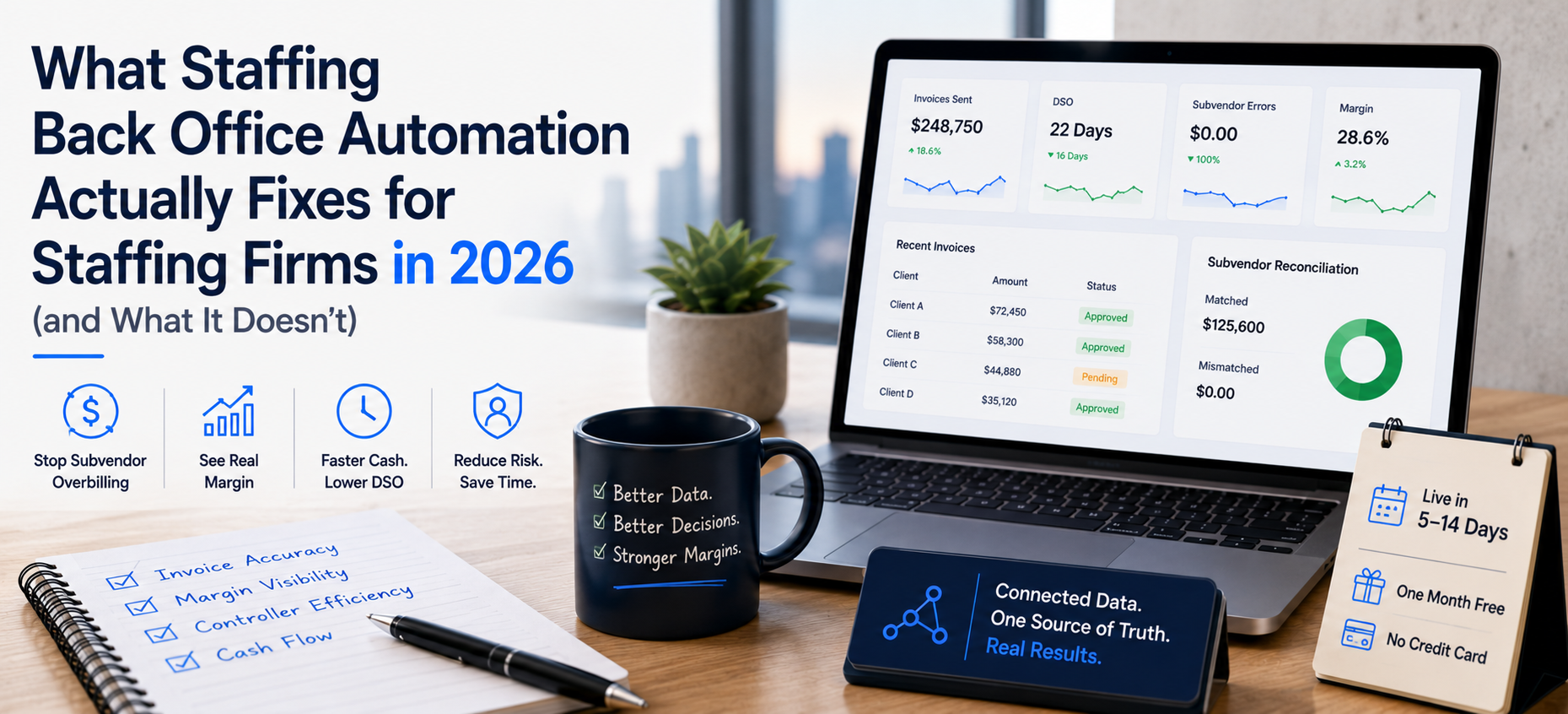
What Staffing Back Office Automation Actually Fixes for Staffing Firms in 2026 (and What It Doesn’t)
Quick answer: Staffing back-office automation only creates value when it removes specific operational losses. For staffing firms, those losses usually include sub-vendor invoice errors, invisible margins, controller overload, and lost invoices. This guide explains what staffing back-office automation actually fixes in 2026, and what it does not.
Why “AI Will Transform Staffing” Is the Wrong Question
Owners do not lie awake wanting “cognitive automation.” They lie awake because something costs them money they can see and money they cannot. The useful question is not “how do we adopt AI?” It is “which specific, repeating loss does staffing back-office automation actually remove?”
That reframing matters because most of the headline-grabbing claims predictive hiring, biometric verification, bias-free screening sit in the recruiting and HR stack, not the back office where the margin actually leaks. According to the American Staffing Association, back-office inefficiencies remain one of the top operational challenges for small and mid-size staffing firms. Velorona is deliberately a back-office platform for small US IT staffing firms, not a recruiting tool. Being clear about that boundary is the point of this article.
What Does Staffing Back-Office Automation Actually Fix?
There are four bleeds where connected staffing back-office automation software produces a result you can name, measure, and tie directly to the bottom line. These are not abstract efficiency gains. They are specific losses that repeat every week until something structural changes.
1. Sub-Vendor Invoice Errors – The Biggest Leak in Staffing Back-Office Automation
Most staffing firms leak 3 to 5 percent of sub-vendor spend to invoice errors. On $500K of sub-vendor spend, that is $12,000 to $25,000 a year leaving the building invisibly.
The cause is simple: nobody is automatically comparing the hours you approved for a consultant against the invoice the sub-vendor submitted. Manual eyeballing at scale misses things. Velorona matches each inbound sub-vendor invoice against the consultant hours you approved and flags the mismatch before you pay it. This is the single highest-value thing staffing back-office automation does for a firm like Raj’s, because it stops real dollars from walking out the door every pay cycle.
The IRS guidance on 1099-NEC reporting makes clear that misclassified payments and inaccurate contractor records are among the most common audit triggers for small businesses another reason accurate sub-vendor data matters beyond just margin.
2. Margin You Cannot See Until Year-End
If you cannot say what your margin is on a given client without two days of Excel work, you are making placement decisions in the dark. You might be placing more consultants at Client X because it “feels” like a good account, when the numbers say Client Y is twice as profitable per head.
When the outbound client invoice and the inbound sub-vendor invoice are generated from the same approved hours, margin becomes a byproduct of the workflow rather than a quarterly archaeology project. The data already exists; the question is whether your system makes it visible or buries it across spreadsheets.
TechServe Alliance research consistently shows that IT staffing firms with real-time margin visibility grow faster and retain clients longer than those relying on quarterly Excel rebuilds.
3. Controller Overload and Key-Person Risk
Priya, the controller who is the institutional memory of the back office, is a single point of failure. If she leaves, goes on vacation, or simply burns out, the firm does not know where to find half the data it needs to bill, pay, or reconcile.
Three things in staffing back-office automation reduce that risk directly:
- Bulk approval lets an approver clear up to 50 timesheets in a single click instead of reviewing each one individually.
- The sub-vendor portal lets vendors approve their own consultants’ hours, so the owner stops chasing six vendors at 7 p.m. on a Friday.
- A complete action history with timestamps moves institutional knowledge out of one person’s head and into the system, where it is searchable and auditable.
The controller’s role shifts from data entry to analysis, and the firm is no longer hostage to a single person’s spreadsheets. The Society for Human Resource Management estimates that replacing a mid-level operations or finance employee costs 50 to 75 percent of their annual salary making key-person risk a concrete dollar figure, not an abstract concern.
4. Lost Invoices and Slow Cash
Client portal auto-delivery replaces the email-and-attachment ritual. Instead of composing an email with a PDF that a client later claims never arrived, the invoice lands in a portal automatically. You see when the client opened it, viewed it, and approved it.
This is why firms typically see a 15 to 30 day improvement in Days Sales Outstanding (DSO) within the first quarter. The “we never received your invoice” dispute the one that quietly resets your payment clock by weeks becomes impossible because both sides see the same record.
The Staffing Industry Analysts report that DSO above 55 days is a leading indicator of working capital stress at small staffing firms, a problem that effective staffing back-office automation addresses structurally.
What Does Velorona Deliberately Not Do?
Honesty is part of the positioning. Velorona is not:
An ATS or recruiting platform. Sourcing, screening, and candidate communication belong to CEIPAL, Bullhorn, and JobDiva. Velorona does not touch the recruiting funnel.
A payroll bureau. Velorona produces Payroll Details for transparency. It does not pay employees, withhold taxes, or file W-2s. It makes you payroll-ready by handing clean, verified hours and rates to your payroll process. Payroll execution via Gusto Embedded is on the 2026 roadmap.
A generic time tracker. Time tracking is the input, not the product. The value is what happens to those hours downstream: invoices, reconciliation, and structured payroll data. A time tracker alone does not solve the staffing back-office problem.
If a prospect is genuinely better served by an enterprise ATS, the right answer is to say so. Saying no is a positioning tool, not a lost sale.
How to Separate a Vague Pitch From a Claim That Actually Matters
Software marketing is full of phrases that sound impressive but change nothing on your P&L. The test is simple: does the claim name a specific problem, in words the buyer uses, with a number attached? Or does it offer generic uplift that could apply to any company in any industry?
| Vague pitch (will not change your P&L) | Specific claim (worth investigating) |
|---|---|
| “Gain workforce insights” | “You cannot state your margin on Client X without two days of Excel work.” |
| “Transform your back office” | “Your controller spends Friday nights chasing approvals. That drops from 12 hours to 90 minutes.” |
| “Boost efficiency with AI” | “Your client said the invoice never arrived, again. Portal delivery with read tracking fixes that.” |
| “Improve operational performance” | “Stop paying sub-vendor invoices for hours your consultants did not work.” |
If a vendor’s pitch stays entirely in the left column, the product will not produce a measurable result. Look for the right column: named bleeds, named roles, and specific time or dollar figures you can verify.
Which Roadmap Items Should Influence a Buying Decision?
Some capabilities staffing firms ask about are genuinely useful but are on Velorona’s 2026 roadmap rather than shipped today: QuickBooks Online sync, Stripe Connect for portal payments, SSO, a public API and Zapier integration, payroll execution via Gusto Embedded, automated 1099-NEC generation, and kiosk attendance with photo and face match.
The honest advice is to buy on what is live today, not what a vendor promises for next quarter. The live moats are:
- Bidirectional sub-vendor invoice reconciliation
- Client portal auto-delivery with read tracking
- Multi-tier sub-vendor support for three or more party chains
- Multi-currency rate cards with FX lock
Treat the roadmap as upside, not as a promise to plan around. Until QuickBooks Online sync ships, historical data and accounting records move via CSV import.
How Does Pricing Compare to Enterprise Alternatives?
| Dimension | Enterprise platforms (CEIPAL, Bullhorn, JobDiva) | Velorona |
|---|---|---|
| Annual cost | $20,000 to $50,000 or more | $48 to $120 per user per year ($4 to $10 per user per month) |
| Implementation time | 6 to 12 weeks | 5 to 14 days |
| Setup cost | $8,000 to $15,000 | $0 |
| Target company size | 100 or more consultants | 30 to 300 consultants |
| Trial | Varies | One month free, no credit card |
That price gap is the reason a 15 to 50 person staffing firm can finally run a real staffing back-office automation system instead of a spreadsheet. Velorona charges per user per month with no per-consultant or per-vendor fees, so scaling feels free.
How Do Sub-Vendor Reconciliation and Multi-Currency Work Together?
For many US IT staffing firms especially those concentrated in NJ/NYC, Dallas–Fort Worth, and Atlanta billing US clients in USD while paying sub-vendors in INR is daily reality. Most tools require a manual FX conversion in a spreadsheet. Velorona builds multi-currency rate cards and FX lock into the invoicing workflow natively, so the bill rate, the payout rate, and the margin are all visible in one view without manual arithmetic.
Combined with bidirectional reconciliation, you see what you billed the client, what the sub-vendor invoiced you, and whether those numbers match across currencies before you pay.
FAQ: What Staffing Back-Office Automation Does and Does Not Do
Does Velorona use AI to verify time or screen candidates?
Velorona is back-office software. It captures geolocation on clock-in and keeps a full audit trail; it does not screen, rank, or source candidates. That is an ATS function.
Will it replace my controller?
No. It removes the manual reconciliation and approval-chasing that consume a controller’s week, so the role shifts from data entry to analysis. The firm is no longer hostage to one person’s spreadsheets.
Can it handle multi-currency C2C chains?
Yes, multi-currency rate cards with FX lock, and native support for three or more party sub-vendor chains.
Does it run payroll or file 1099s?
Not today. Payroll Details provide transparency now. Payroll execution and automated 1099-NEC generation are on the 2026 roadmap.
How fast can a firm get started?
Live in 5 to 14 days with no setup fee. Historical data imports via CSV. A one-month free trial requires no credit card.
What happens when a sub-vendor disputes hours?
Every submission, edit, and approval is captured in an action history with timestamps behind two-factor authentication. A disputed hours question is resolved from the record in minutes instead of from memory and email threads.
See the Fix, Not the Hype
If you want to know exactly which of your bleeds staffing back-office automation through Velorona stops and which it honestly does not touch the fastest way is a working demo against your own numbers.