Can Your Billing Process Handle an International Client?
Introduction: Winning International Work Is Only Half the Job
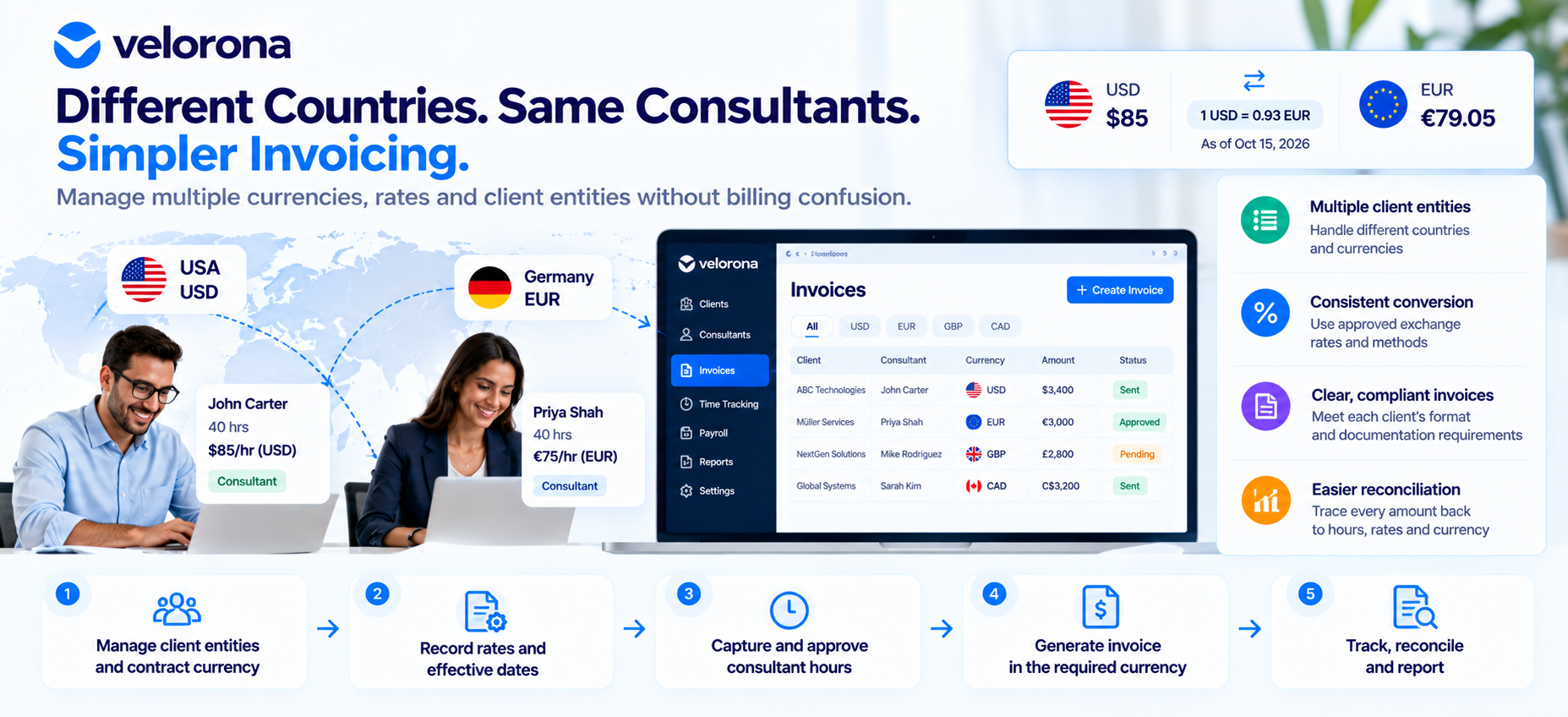
Picture a staffing firm that places consultants with a client operating in both the United States and Germany. The U.S. entity expects invoices in USD, while the German entity requires invoices in EUR. For the first few billing cycles, everything appears to be working smoothly.
Then someone on the finance team notices that a euro invoice total does not quite match the approved hours and rate card. No single mistake stands out. One invoice was converted manually. The next used an exchange rate from a different date. A converted figure was re-entered into a spreadsheet and rounded along the way.
Individually, these differences may seem minor. But when they go unexplained across recurring invoices, they can create additional reconciliation work. Once a client’s accounts payable team questions one figure, it may scrutinize other invoices more closely, too.
This is a hypothetical scenario, not a specific client case study. It illustrates a broader operational challenge: winning international staffing business is only part of the equation. Your billing process also needs to support the currencies and reconciliation requirements specified in each client agreement.
For staffing firms expanding across borders, that means understanding which currencies must be used, how conversions should be handled, and how the figures on an invoice can be traced back to approved hours and agreed rates.
Why Multi-Currency Billing Matters for Staffing Firms
International staffing engagements can introduce billing requirements that a firm working exclusively with domestic clients may not encounter. Depending on the client agreement and the firm’s operating model, these can include:
- Multiple client entities: A client may operate through entities in different countries, each with its own invoicing requirements.
- Contractually specified invoice currencies: An agreement may require billing in a particular currency for a region, entity, or statement of work.
- Different billing arrangements: Consultants and assignments may be subject to different arrangements depending on where the work is performed and which entity is paying.
- Currency-specific invoice requirements: Clients may request particular invoice formats, tax identifiers, or supporting documentation.
- Multi-currency financial reporting: Finance teams may need to consolidate invoices denominated in different currencies into an internal reporting currency.
- Coordination across teams: Operations, finance, and accounting need to work from consistent information when rates, billing assumptions, or conversion methods change.
Not every international contract requires all these capabilities. A client headquartered abroad may still require invoices in only one currency. Another client may have separate entities with different contractual billing requirements.
The important distinction is between where a client operates and what the contract actually requires.
Before accepting an international engagement, staffing firms should establish the applicable invoice currency, agreed billing rates, conversion requirements, and supporting documentation expectations for that specific arrangement.
How Manual Currency Conversion Creates Billing Risks
When currency conversion is handled manually through spreadsheets, email threads, or one-off calculations, inconsistencies can develop over time.
Common sources of difficulty include:
- Converting invoice amounts manually without a documented, repeatable method.
- Using different exchange rates across billing cycles without a clear reason.
- Applying an exchange rate from the wrong date.
- Re-entering converted amounts into spreadsheets or billing systems, introducing transcription errors.
- Mixing the original invoice currency with an internal reporting currency without labeling the figures clearly.
- Failing to record the exchange-rate source or conversion method, making it difficult to explain historical figures.
An exchange-rate difference does not automatically mean an error occurred. Currency rates fluctuate, and a conversion based on the invoice date may legitimately differ from one based on the payment date.
The risk is not variation itself. It is being unable to explain the variation because the method and assumptions were not documented.
To avoid confusion, a staffing firm’s finance team should distinguish four separate elements:
- Contract currency: The currency specified in the client agreement for billing.
- Invoice currency: The currency in which the invoice is issued, which should follow the agreement unless the parties have agreed otherwise.
- Conversion rate and method: The rate and approach used when a conversion is required.
- Internal reporting currency: The currency used for financial analysis or consolidated reporting, which may differ from both the contract and invoice currencies.
These elements are related, but they are not interchangeable. Keeping them distinct makes it easier to explain how an invoice amount was calculated and how it relates to internal financial reporting.
This article is intended as operational guidance, not accounting or tax advice. Foreign-currency accounting and tax treatment can vary by jurisdiction and entity structure, so firms should confirm the applicable requirements with a qualified accounting professional.
How Small Currency Discrepancies Can Accumulate
The following is a hypothetical illustration. It is not a real client example or a reported Velorona customer result. All figures are for demonstration purposes only.
Suppose a staffing firm has a recurring monthly engagement billed in euros under the client agreement.
The consultant records 160 hours at a contracted rate of €95 per hour.
The invoice calculation is:
- Approved hours: 160
- Contracted rate: €95 per hour
- Invoice total: €15,200
The client is billed €15,200 each month. Internally, however, the staffing firm tracks its margin in USD for consolidated reporting.
In the first month, the finance team converts the invoice total using an illustrative exchange rate of 1 EUR = 1.080 USD.
The resulting internal reporting figure is:
€15,200 × 1.080 = $16,416
In the second month, the euro invoice is still €15,200. However, another team member uses a rate of 1 EUR = 1.095 USD, taken from a different date.
The resulting reporting figure is:
€15,200 × 1.095 = $16,644
The difference between the two USD reporting figures is $228, even though the invoice amount in euros has not changed.
<text color=”secondary” size=”sm”>Illustrative comparison</text>
| Item | Month 1 | Month 2 |
|---|---|---|
| Approved hours | 160 | 160 |
| Contracted rate | €95/hour | €95/hour |
| Invoice total | €15,200 | €15,200 |
| Illustrative conversion rate | 1.080 | 1.095 |
| USD reporting figure | $16,416 | $16,644 |
The $228 difference does not, by itself, establish that either calculation is wrong. The rates may reflect different dates or legitimate reporting assumptions.
The operational problem arises if the firm cannot explain why each rate was selected or which conversion approach should have been used.
Across recurring invoices and multiple currency pairs, undocumented differences can make financial reconciliation more difficult. The impact depends on the amounts involved, exchange-rate movements, and how the firm accounts for the differences.
The lesson is straightforward: a converted figure should be traceable to the original amount, the rate used, and the method applied.
Why Currency Conversion and Reconciliation Need to Work Together
Calculating a converted amount is only one part of a reliable billing process. Staffing firms also need to establish that the underlying invoice is correct and that any reporting figures can be traced back to it.
Before an invoice is finalized or a reporting period is closed, the team may need to verify:
- The currency specified in the applicable client agreement.
- The approved billing rate and billable hours behind the invoice.
- The invoice amount expressed in the required currency.
- The exchange rate and conversion method, where conversion is necessary.
- The invoice line items and underlying calculations.
- The relationship between the original invoice amount and converted reporting figures.
- The supporting records needed to explain a discrepancy later.
A defined reconciliation process does not eliminate the need for human review. Some differences require someone to confirm which rate applies, investigate a discrepancy, or determine how a rounding difference should be handled.
What a consistent process can do is make exceptions visible for review before they become larger reconciliation problems.
This is similar to the principle behind Velorona’s sub-vendor invoice reconciliation, which matches incoming sub-vendor invoices against approved consultant hours and flags mismatches before payment. This feature addresses discrepancies between invoices and approved hours; it should not be confused with automatically resolving every foreign-exchange or accounting issue.
What to Check Before Accepting an International Staffing Contract
Multi-currency readiness is worth reviewing before a contract is signed, rather than after the first invoice has been issued.
During an RFP review or vendor evaluation, consider the following questions:
- Which currencies are required? Identify the invoice currency for each client entity, region, or statement of work.
- Are rates and currencies documented? Confirm that the agreement clearly specifies the applicable billing rates and invoice currency.
- How should exchange-rate movements be handled? Establish whether the agreement specifies a fixed rate, periodic rate updates, or another approach.
- What supporting documents are required? Confirm what the client’s accounts payable team expects with each invoice.
- How are discrepancies resolved? Identify who investigates billing questions and how corrections are handled.
- Can finance report across the relevant currencies? Determine whether the firm can distinguish original invoice amounts from converted reporting figures.
- Can the current workflow support the arrangement? Assess whether the process can handle the requirements without excessive manual work.
Not every client procurement process will ask these questions directly. Nor does multi-currency capability guarantee that a firm will win a particular contract.
The purpose of this review is to identify operational gaps before the firm commits to an arrangement it may not be prepared to support consistently.
A Practical Multi-Currency Billing Checklist
Use this checklist as a starting point for an internal finance standard operating procedure (SOP). Adapt it to the requirements of your agreements and accounting processes.
Before generating an invoice
- Confirm the agreed invoice currency for the relevant client entity or region.
- Verify approved consultant hours and applicable billing rates.
- Check that the billing period and invoice details match the agreement.
- Confirm any relevant PO information and supporting documentation requirements.
When conversion is required
- Follow the documented exchange-rate approach applicable to the transaction.
- Record the rate source, date, and conversion method where required by the firm’s process.
- Check calculations and currency labels.
- Keep the original invoice amount separate from converted reporting amounts.
- Confirm that rounding is handled consistently with the applicable process.
Before finalizing and reporting
- Reconcile invoice records against approved timesheets, rates, and other underlying billing records.
- Review line items and calculations for discrepancies.
- Flag unexplained differences for investigation rather than resolving them silently.
- Retain supporting information needed to explain the figures later.
- Confirm that the workflow follows the client agreement and applicable accounting requirements.
The goal is not to add unnecessary checks to every transaction. It is to make the necessary checks repeatable, documented, and appropriate for the arrangement being billed.
Already Using Accounting or Staffing Software?
Many staffing firms already use accounting software, spreadsheets, or staffing platforms. Yet their multi-currency workflows may still involve disconnected steps.
For example, a team might track consultant hours in one system, prepare invoices in another, and manually transfer converted amounts into a spreadsheet for reporting.
Each tool may work as intended on its own. The difficulty can lie in the handoffs between them.
This is not a universal problem: some existing systems may already support the firm’s requirements effectively. The best starting point is to map the actual workflow rather than assume that the current setup either solves every problem or necessarily needs replacing.
Trace one invoice from beginning to end:
- Where are the approved hours recorded?
- How is the applicable billing rate verified?
- Where is the invoice prepared?
- If conversion is required, where is the rate recorded and applied?
- How does the converted amount reach internal reporting?
- Can the team explain any difference between the original invoice and the reported figure?
This exercise helps identify where manual entry, disconnected records, or unclear ownership may introduce unnecessary work.
How Velorona Fits Into Multi-Currency Staffing Operations
For staffing firm owners and finance managers managing international billing, Velorona’s payroll and billing workflow is described as supporting client invoicing and sub-vendor payments in different currencies.
For example, the workflow can support billing a U.S. client in USD while paying an India-based sub-vendor in INR, with foreign-exchange rates locked automatically so that margin remains visible in USD.
This approach is intended to address one of the operational challenges discussed above: inconsistent conversions affecting recurring transactions and internal margin visibility.
Velorona also supports related back-office processes:
Invoices generated from approved hours
Through its invoicing workflow, invoices are generated from approved hours rather than relying on manually re-entered hours for each billing cycle. This helps connect invoice calculations to the underlying approved time records.
Sub-vendor invoice reconciliation
The platform matches incoming sub-vendor invoices against approved consultant hours and flags mismatches before payment. This supports the review of invoice discrepancies before they progress through the payment process.
These capabilities address specific parts of the billing workflow. They should not be taken as a guarantee that every international invoicing, tax, compliance, or accounting requirement is automatically handled.
Multi-currency readiness also depends on the client agreement, the firm’s accounting treatment, and its internal processes. Staffing firms should confirm that their particular arrangements are supported and obtain appropriate accounting guidance where needed.
For firms billing across borders, including IT staffing firms, reviewing how invoicing, currency handling, and sub-vendor reconciliation fit together can help identify gaps before they affect routine operations.
Frequently Asked Questions
1. What is multi-currency billing in staffing?
Multi-currency billing is the process of invoicing or managing billing arrangements involving more than one currency. For a staffing firm, this might mean invoicing one client entity in USD and another in EUR, or billing a client in one currency while paying a sub-vendor in another. The exact requirements depend on the agreements and operating model involved.
2. Why do staffing firms need to review currency requirements before signing an international contract?
Different client entities or regions may have different invoice-currency and documentation requirements. Reviewing these requirements in advance helps a firm determine whether its billing, reporting, and reconciliation processes can support the proposed arrangement before invoices begin going out.
3. What causes discrepancies in multi-currency billing?
Potential causes include inconsistent exchange-rate dates, undocumented conversion methods, manual re-entry of amounts, rounding differences, and confusion between the invoice currency and the internal reporting currency. An exchange-rate difference alone does not prove an error; the relevant rate and method need to be understood in context.
4. Should the invoice currency and reporting currency be the same?
Not necessarily. The invoice currency is the currency in which the client is billed under the agreement. The internal reporting currency is the currency used for financial analysis or consolidated reporting. A firm may need to report an invoice in a different currency from the one in which it was issued. The appropriate treatment depends on the firm’s requirements and accounting policies.
5. How can a staffing firm reduce manual currency-conversion errors?
A firm can document its conversion method, record the relevant rate and date, keep original invoice amounts separate from converted figures, verify calculations, and reconcile invoices against approved hours and rates. Where software supports the required workflow, automation may reduce manual re-entry, but the firm still needs appropriate review and accounting procedures.
6. Does multi-currency billing software resolve every foreign-exchange issue?
No. Software can support defined billing and currency workflows, but the firm’s client agreements, accounting treatment, and internal procedures still matter. Staffing firms should verify which capabilities their chosen platform supports and confirm jurisdiction-specific accounting or tax requirements with a qualified professional.
7. How does Velorona support multi-currency staffing operations?
According to the capabilities described for Velorona, its payroll and billing workflow supports invoicing clients and paying sub-vendors in different currencies, with foreign-exchange rates locked automatically so that margin remains visible in USD. It also generates invoices from approved hours and matches incoming sub-vendor invoices against approved consultant hours, flagging mismatches before payment. Firms should confirm how these capabilities apply to their specific requirements.
8. What should a staffing firm check before sending an international invoice?
Confirm the contractually required invoice currency, approved hours, billing rate, billing period, and applicable PO details. Where conversion is required, follow the documented exchange-rate method and check the calculations. Verify the invoice format and supporting documentation, and ensure that any unexplained discrepancy is reviewed before the invoice is finalized.
Conclusion: Make Multi-Currency Readiness Part of Your Growth Plan
Winning international staffing work is an important milestone, but the contract is only the beginning. The ongoing challenge is to support the required currencies, billing rates, conversions, and reconciliation processes consistently across billing cycles.
Before your next international RFP or client agreement, review how your firm handles invoice currencies, approved rates, exchange-rate methods, and supporting records. Identify where manual work or disconnected systems could make figures difficult to explain.
The objective is not to eliminate every exchange-rate difference. It is to make sure those differences can be understood, traced, and handled through a consistent process.
If you want to explore how Velorona’s staffing back-office capabilities—including multi-currency billing and sub-vendor invoice reconciliation could fit into your workflow, book a 15 minute demo