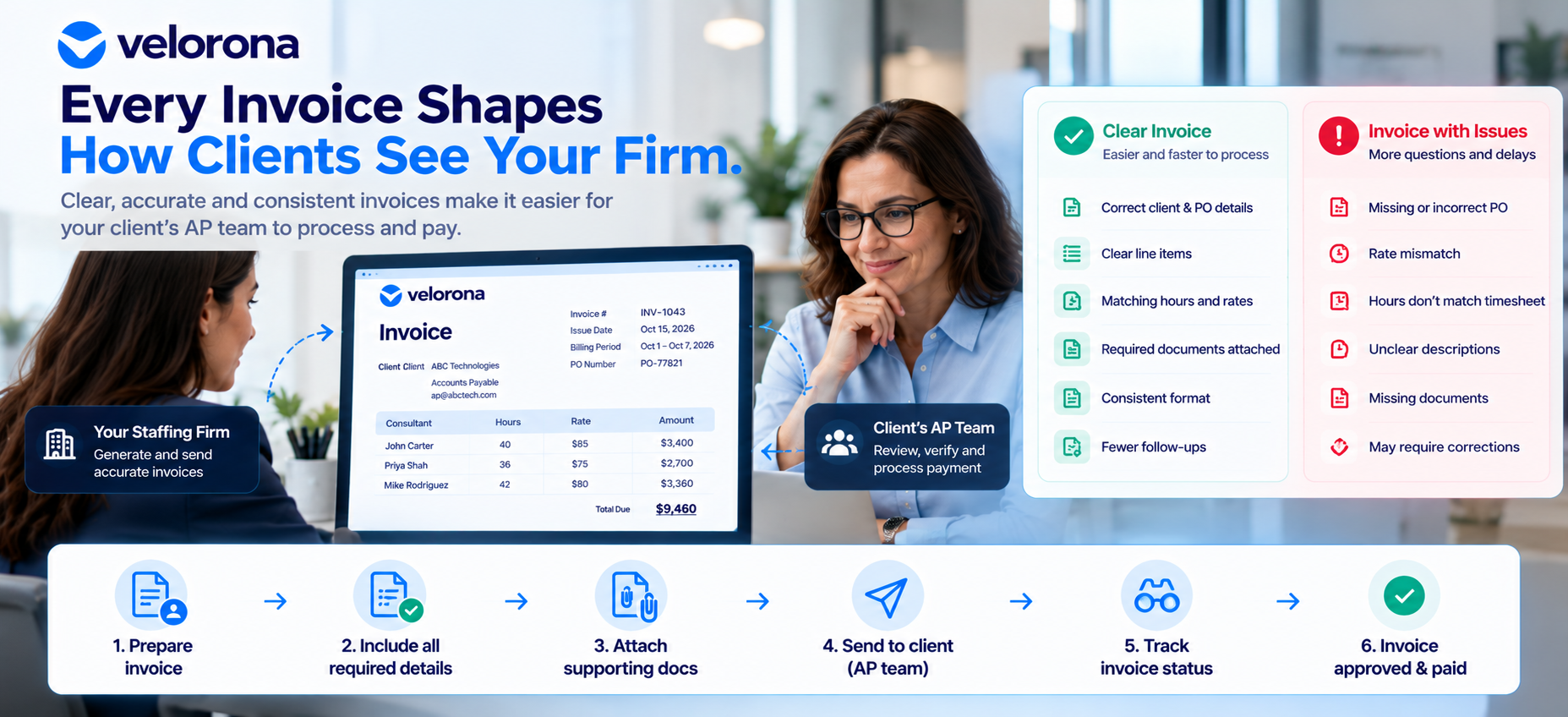
Why Invoice Quality Matters to Your Staffing Agency’s Brand
How Often Does Your Client See Your Invoice?
A prospective client might review your sales presentation once or twice before signing an agreement. After the placement, however, the relationship involves more than the sales team. The client’s accounts payable (AP) and finance teams become regular points of contact, and invoices are one of the main ways they interact with your staffing firm.
Depending on the billing cycle, that interaction may happen weekly, biweekly, or monthly throughout the engagement. For example, a twelve-month contract with weekly billing could generate roughly 50 invoices for the client’s AP team to review.
That repetition matters. A sales presentation creates an initial impression; invoices create a recurring operational experience. If they are clear, accurate, and consistent, they are easier to review. If they contain recurring errors or unclear information, they can create additional work for the client.
The practical question is simple: when a client’s AP team opens your invoice, can they understand and verify it without unnecessary follow-up? Or do they need to clarify a number, locate supporting documentation, or request a correction?
Repeated across billing cycles, that experience becomes part of how the client works with your firm.
That is why staffing invoice management involves more than generating a document and requesting payment. It also requires a repeatable process for producing accurate invoices that meet each client’s requirements.
An Invoice Is an Operational Touchpoint, Not Just a Financial Document
An invoice may appear to be a straightforward request for payment: hours, rates, totals, and a due date. In practice, it also communicates how clearly your firm manages its billing process.
When an AP reviewer opens an invoice, several details influence how easy it is to process.
- Organization: Can the reviewer quickly locate the billing period, purchase order number, line items, and total due?
- Clarity: Do the descriptions explain what was billed, or could they prompt follow-up questions?
- Consistency with supporting records: Do the hours and rates match the approved timesheets and applicable rate agreement?
- Completeness: Does the invoice include the required purchase order (PO) information and supporting documentation?
- Conformance: Does the invoice meet the client’s submission requirements, including the required format, file type, fields, and delivery channel?
- Follow-through: When a correction is needed, is there a defined process for investigating and resolving it?
Together, these details affect the work required to process an invoice. A clear invoice can make information easier to verify, while recurring inconsistencies can introduce additional steps into an already busy AP workflow.
Some billing workflows also provide visibility into invoice activity, such as when an invoice was sent, opened, reviewed, or approved. This can help a firm understand the status of an invoice, depending on the system being used.
One distinction is important: professional formatting cannot compensate for inaccurate billing. A polished invoice containing incorrect hours is still incorrect. Good presentation makes accurate information easier to review; it does not replace the checks needed to establish accuracy.
What a Professional Staffing Invoice Should Get Right
Before examining common invoice problems, it helps to establish what a well-prepared staffing invoice should contain.
Requirements vary by client agreement, industry, and AP process. However, a professional staffing invoice will commonly include the following elements where applicable:
- Correct client legal entity and vendor information.
- A unique invoice number and issue date.
- The specific billing period covered.
- Clear, itemized line items tied to the work being billed.
- Applicable billing rates and accurate calculations.
- Relevant PO number and supporting PO information, where required.
- Subtotal, applicable taxes, total due, and payment terms.
- Required supporting documentation, such as approved timesheets or expense records.
- Consistent, readable formatting.
The objective is not to force every client into one universal invoice format. It is to ensure that each invoice meets the requirements of the relevant agreement and the client’s AP process.
A quick invoice template review checklist
Use these questions to assess your current invoice template:
- Does the invoice clearly identify your firm, the client, and the relevant parties’ contact details?
- Is the invoice number unique and clearly displayed?
- Is the billing period stated explicitly?
- Are line items specific enough for the reviewer to understand what is being charged?
- Can the rates and hours be checked against the relevant source records?
- Is PO information included when the client requires it?
- Are the total due, payment terms, and due date easy to locate?
- Is the required supporting documentation attached or clearly referenced?
Not every client will require every item. Use the checklist alongside the specific client’s agreement and submission instructions to determine what applies.
What Recurring Invoice Errors Communicate
A single invoice error that is identified and corrected promptly does not define a vendor relationship. Mistakes can happen.
The concern is a recurring pattern of errors that requires the client to repeat the same checks or requests.
Examples of common staffing invoicing issues include:
- A billing rate that does not match the signed agreement.
- Invoiced hours that differ from the approved timesheet.
- A missing or incorrect PO number.
- Supporting documentation that exists but is difficult to locate.
- The same type of correction appearing across multiple billing cycles.
- Different invoice formats or descriptions being used for the same type of work without a clear reason.
Individually, these issues may be straightforward to resolve. Repeated across billing cycles, however, they can make the process less predictable.
A client’s AP team may begin checking invoice details more closely, requesting clarification, or holding an invoice while a discrepancy is investigated. The exact response depends on the client’s internal process and the nature of the issue.
These problems do not necessarily indicate poor recruiting performance or an overall failure of the staffing firm. They concern the reliability of its billing workflow.
That distinction matters. Strong consultant performance and accurate billing are separate parts of the client experience, and both need appropriate attention.
Why Consistency Matters More Than One Perfect Invoice
One accurate invoice is a positive outcome. A reliable billing process means being able to maintain that standard across subsequent billing cycles.
Consistency should come from a repeatable workflow rather than relying entirely on one employee’s memory or attention to detail.
Several practices can help:
- Standardized client-specific templates: Maintain the appropriate format and required fields for each client.
- Consistent billing descriptions: Use clear, repeatable descriptions for the same types of charges.
- Checks against approved hours and rates: Verify the underlying information before an invoice is issued.
- PO verification: Confirm the relevant PO details and, where applicable, the remaining authorized balance.
- A defined exception process: Establish who investigates discrepancies and how corrections are documented.
- Organized supporting records: Keep the records needed to explain an invoice accessible.
- Clear ownership: Define who reviews, approves, and sends invoices so that responsibilities do not fall between teams.
Consistency does not mean every invoice must look identical. Clients may have different PO structures, documentation requirements, and submission procedures.
It means the process reliably meets the requirements of each client, every billing cycle.
Digital Delivery and Client Portal Requirements
Invoice quality involves both the document itself and the way it is submitted.
Some clients accept invoices by email. Others require submission through a dedicated client portal or vendor management system, potentially with specific file formats, naming conventions, or supporting documents. Some may require both email and portal submission.
A reliable delivery process should address the following:
- Confirm whether the client requires email, portal submission, or both.
- Follow the requested file format and naming conventions.
- Include supporting documents in the required format.
- Track submission status and the handling of corrections.
- Verify that the invoice has reached the appropriate destination or contact.
An accurate invoice sent through the wrong channel can still create avoidable work. Similarly, submitting a document through the correct channel does not automatically guarantee faster approval or payment.
Each client’s review process and timeline differs. Delivery is one part of the overall billing workflow, alongside invoice accuracy, completeness, and the client’s internal procedures.
A Practical Invoice Quality Checklist
Use this checklist before each billing cycle. It can be incorporated into your firm’s standard operating procedure (SOP).
- Is the invoice addressed to the correct client entity?
- Does it cover the correct billing period?
- Do the billed hours match the relevant approved timesheets?
- Do the rates match the applicable approved terms?
- Are the calculations and totals correct?
- Is the required PO information included?
- Are the supporting documents attached or accessible where required?
- Is the invoice formatted clearly and consistently with the client’s requirements?
- Is it being submitted through the required channel?
- Is there a defined process for tracking questions and corrections?
These checks cover many of the recurring issues discussed in this article. They are not a guarantee that every error will be caught, but they provide a consistent review process before an invoice reaches the client’s AP team.
If an invoice fails a check, resolve the discrepancy or route it to the appropriate person for review rather than allowing an unexplained difference to pass through.
Already Using Accounting or Staffing Software?
Many staffing firms already generate invoices through accounting or staffing software instead of preparing each document manually. This can be a useful part of a more organized process, but a digitally generated invoice is not automatically accurate.
For example, an invoice can still contain incorrect hours if data is manually re-entered between a timesheet system and a billing tool. A required PO number may be omitted if the relevant field is not populated or checked. Inconsistent templates can also produce different descriptions for similar charges.
The issue is not necessarily the software itself. Some platforms already support effective validation and reconciliation. The important question is whether the firm’s complete workflow consistently produces accurate, client-ready invoices.
Review how information moves through each stage:
- How do approved hours reach the billing process?
- How are applicable rates verified?
- How are client-specific invoice requirements applied?
- How are PO details checked?
- How are discrepancies identified and corrected?
- Where are supporting records stored, and who can retrieve them?
The invoice is the final output of this chain. Its quality depends on the information and checks that come before it.
How Velorona Fits Into Professional Billing Workflows
Velorona is a back-office platform for staffing firms. Its invoicing and reconciliation features support several of the processes involved in producing consistent invoices.
Invoices generated from approved timesheets
Velorona generates client invoices from approved timesheets, reducing the need to re-enter approved hours manually during each billing cycle.
The platform supports different invoice types, including client-based invoices that can consolidate multiple consultants, employee-based invoices for individual contractors, and general invoices for flat-fee billing. Custom invoice templates can be configured per client to support client-specific formatting requirements.
These capabilities support the billing workflow, but firms still need to verify that rates, PO information, and other client-specific details are correct.
Sub-vendor invoice reconciliation
For firms managing C2C arrangements or sub-vendor relationships, Velorona’s Vendor Hub matches incoming sub-vendor invoices against approved consultant hours and flags mismatches before payment.
This helps surface discrepancies between incoming vendor invoices and the approved hours used to check them. It is one part of the reconciliation process, rather than a guarantee that every type of billing discrepancy will be identified.
PO balance tracking
Velorona tracks PO balances and triggers alerts when 80% of the authorized amount has been reached. This can help firms monitor usage against the authorized amount and identify potential overages for review.
Timesheet approval records
Through its timesheet workflow, timesheet approvals and rejections are timestamped. Approved hours flow into invoicing without requiring a separate manual transfer step, helping connect the billing record to the underlying timesheet approval.
Together, these features support invoice generation, timesheet tracking, PO monitoring, and sub-vendor reconciliation within a connected back-office workflow.
They do not guarantee that every invoice will be error-free, and Velorona does not deliver invoices through every possible client portal. Firms should confirm that the platform’s capabilities match their own client requirements.
Finance and controller teams can also review the platform’s finance manager information to understand how its reconciliation workflow fits into their operations.
Frequently Asked Questions
1. Why does invoice quality matter to a staffing agency’s brand?
Invoices are recurring operational touchpoints between a staffing firm and its client’s finance team. Clear, accurate, and consistent invoices make information easier to review, while recurring errors can create additional questions and corrections. Invoice quality contributes to the client’s day-to-day experience, although it does not determine the overall relationship on its own.
2. What should a professional staffing invoice include?
Depending on the client agreement, a staffing invoice may include the correct client and vendor details, invoice number, issue date, billing period, itemized charges, approved hours, applicable rates, PO information, totals, payment terms, and supporting documentation. The exact requirements should be confirmed for each client.
3. What are the most common staffing invoice errors?
Examples include incorrect billing rates, differences between invoiced and approved hours, missing PO information, unclear line items, missing supporting documentation, and repeated corrections. A review process that checks invoices against approved hours, rates, and client requirements can help identify these issues before submission.
4. How can staffing firms improve invoice consistency?
Staffing firms can use client-specific invoice templates, standardize billing descriptions, verify hours and rates, check PO information, organize supporting records, and define responsibility for reviewing and sending invoices. A documented exception process also helps teams handle discrepancies consistently.
5. Does professional invoice formatting guarantee faster payment?
No. Clear formatting can make invoice details easier to review, but payment timing also depends on the client’s AP procedures, contractual terms, required documentation, approval process, and other factors. An accurate invoice submitted through the wrong channel may still require correction or resubmission.
6. Is generating invoices through software enough to ensure accuracy?
Not necessarily. Software can support invoice generation, validation, and reconciliation, but the outcome depends on the information entered, the workflow configuration, and the checks performed. Firms should review the complete process from approved timesheets and billing rates through to final invoice delivery.
7. How does Velorona help staffing firms manage invoice quality?
Velorona generates invoices from approved timesheets, supports client-specific invoice templates, matches incoming sub-vendor invoices against approved consultant hours, flags mismatches before payment, tracks PO balances, and timestamps timesheet approvals and rejections. These capabilities support consistent billing operations but do not guarantee that every invoice will be error-free.
8. How often should a staffing firm review its invoice process?
The source workflow supports reviewing invoices before each billing cycle. Firms can also periodically examine previously issued invoices to identify recurring issues, such as repeated rate discrepancies, missing PO details, or inconsistent supporting documentation. The review frequency should fit the firm’s billing volume and operational requirements.
Conclusion: Make Every Billing Cycle a Consistent Experience
An invoice is more than a request for payment. It is a recurring part of how a staffing firm’s operations are experienced by the client’s finance team.
Presentation and accuracy work together, but they serve different purposes. Clear formatting makes information easier to review; accurate underlying data makes the invoice correct. Neither alone determines how a client perceives the firm or whether it renews, but together they can make routine billing interactions more predictable.
A practical starting point is to review the last three to six invoices sent to one client.
Look for recurring corrections, unclear descriptions, missing supporting records, and inconsistencies between billing periods. Check whether each invoice meets the client’s requirements and whether the supporting information is easy to retrieve.
Those patterns provide a more useful picture of your staffing invoice management process than a single invoice viewed in isolation.
If you want to examine how approved timesheets, invoicing, reconciliation, and PO tracking fit together, explore Velorona’s payroll and billing workflow to assess whether its capabilities align with your firm’s operational needs.
Related Reading
- Staffing Firm Audit Trail: The Missing Layer in Your Back Office
- Staffing Back Office: Client Experience After Placement
- Staffing Client Invoice Portal: Stop Losing Cash to Lost Invoices
- Timesheet Software for Staffing: Turn Hours into Invoices
- Multi-Tier Staffing Vendor Management: Control C2C Chains