The Staffing Firms Winning RFPs Aren’t Winning on Price
In consolidated staffing RFPs, rate and consultant quality have become table stakes every firm’s numbers look similar within a few percentage points. What now decides these deals is staffing RFP win rate built on operational visibility: whether a firm can show a client real-time hours and automated invoicing, or only send a proposal PDF. This guide covers why that gap is opening up, and what it costs firms that ignore it.
He lost the RFP in April. Mid-size logistics company, looking to consolidate their contractor placements with a single staffing partner 25 consultants, a year-long contract, the kind of deal that would have been a meaningful jump for his firm.
He didn’t lose on rate. He’d checked. His numbers were competitive, maybe even slightly better than what the incumbent had been charging. He didn’t lose on consultant quality either two of the people he’d put forward had cleared technical rounds with the client’s own engineering team.
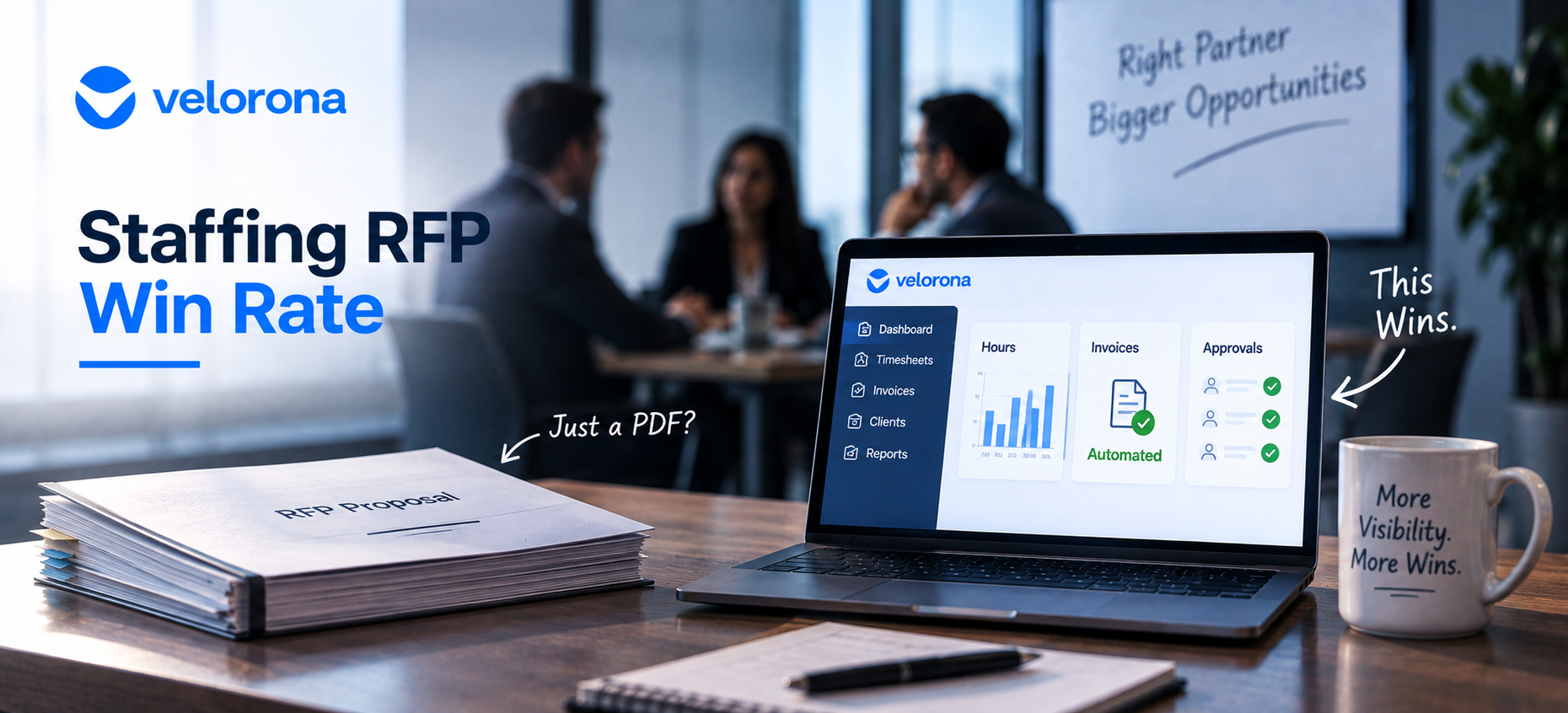
He found out why in June, from a mutual contact who’d sat in on some of the other pitches. The firm that won showed the client a live portal during their pitch real-time hours, automated invoicing, a client-side view of everything. His firm had sent a proposal PDF and a reference list.
“It wasn’t even close,” the contact told him. “It wasn’t about the consultants. It was that their operation looked like it was built for 2026, and yours looked like it was built for 2015.”
What’s Actually Deciding Consolidated Staffing RFPs Now?
Rates have compressed across the board every firm’s numbers look similar within a few percentage points. Consultant quality is table stakes; if you can’t clear technical rounds, you’re not in the conversation at all.
Why Operational Visibility Has Become the Differentiator
What’s actually separating firms in these deals is operational visibility. Clients consolidating their contractor spend into fewer, larger relationships look explicitly for a partner whose back-office resembles infrastructure they can build on not a liability they’ll have to manage from their side.
A live client portal with automated invoicing, real-time timesheet approval visibility, and a timestamped audit trail if a dispute arises these used to be nice-to-haves. In consolidated RFPs specifically, they’re becoming the deciding factor. The client is essentially asking one question underneath the formal evaluation: “Can I trust this firm to run point on something bigger than what I’m giving them today?”
Firms still pitching on rate and consultant quality alone compete on the two dimensions that have become hardest to differentiate on while ignoring the one dimension where a genuine gap still exists.
The Staffing RFP Win Rate Gap in Numbers
| Evaluation Criterion | Differentiated Firms 5 Years Ago | Differentiates Firms Now |
|---|---|---|
| Rate | Yes , meaningful spread across firms | Rarely compressed to within a few percent |
| Consultant quality | Yes, clear differences | Table stakes not a differentiator if you clear technical rounds |
| Operational visibility (portal, live hours) | Not evaluated | Increasingly the deciding factor |
| Audit trail / dispute history | Not evaluated | Growing factor in consolidated deals |
| Implementation speed | Not evaluated | Relevant clients want the new relationship live fast |
Is This a Temporary Trend or a Structural Shift in Staffing RFP Win Rate?
CEIPAL and Bullhorn have offered this kind of visibility for years but priced at $30,000 to $50,000 a year, they were only accessible to firms already running 100+ consultants. Per the USP positioning Velorona publishes directly: CEIPAL runs $30K–$50K/year with 12-week implementation and $8,000–$15,000 in setup fees; Bullhorn runs $50K+/year. That’s why, until recently, a 30–80 consultant firm competing for a consolidated RFP against a similarly sized competitor operated on a level playing field neither could afford portal-level visibility, so nobody had it, and everyone competed on rate and quality alone.
Why the Playing Field Has Changed
That playing field isn’t level anymore. The same back-office capability that required a $30K+ annual platform now runs at a small fraction of that cost. Consequently, the firms adopting it aren’t waiting for permission. They’re already showing up to RFPs with a live portal on their laptop while their competitors show up with a PDF.
In the loss described above, the feedback took two months to surface and only through an informal, off-the-record conversation. Most firms never receive that specific a debrief after an RFP loss. As the American Staffing Association notes, client decisions in staffing often hinge on operational reliability as much as placement quality but that feedback rarely surfaces in formal vendor debriefs, which means the pattern stays under-recognized even as it compounds across multiple RFP cycles.
Every RFP where that visibility gap shows up and you’re not the one closing it is a preview of the next one.
What Changed After the Loss?
He didn’t change his rates. He didn’t change how he vetted consultants. He changed what he brought to the next pitch a live client portal, the same one his existing clients used, instead of a proposal document.
Three months after the logistics deal, a similar consolidation RFP came up with a different prospect. This time, he shared his screen instead of his slide deck. He won that one.
What the Next Pitch Looked Like
Instead of describing how billing worked, he showed it. He opened the client portal live on the call — the prospect could see approved timesheet hours broken down by week, the invoice generated automatically from those hours, the read receipt showing when the invoice was opened, and the audit trail timestamping every approval. No composing emails. No PDF attachments. No “I’ll follow up with the invoice by end of day.”
The prospect’s ops team went quiet for a few seconds. Then they asked how quickly the firm could get them live.
This is the same dynamic covered in depth in How One Staffing Sales Call Closed on the Demo Alone showing a live portal instead of describing one. The RFP context just makes the stakes more visible: a consolidated, year-long engagement where the client is explicitly evaluating operational maturity, not just headcount capability.
How Does Portal Visibility Connect to Client Retention After the Win?
Winning the RFP is one thing. Keeping the account through the first renewal is another.
The most common reason staffing clients quietly reduce their engagement at renewal isn’t price and isn’t placement quality. It’s the accumulated sense that the vendor doesn’t have operations under control missed invoices, wrong amounts, no visibility into what was approved. We cover this pattern in Your Client Said They Never Got the Invoice. Again.
The Compounding Retention Benefit
When a client signs after seeing the portal on a pitch call, they’ve already set an expectation for how billing works. The portal delivers on that expectation automatically invoices generating from approved timesheets, read receipts confirming delivery, automated reminders at 7, 14, and 30 days past due. The sales promise and the operational reality match from day one.
That’s how a staffing firm converts an RFP win into a multi-year relationship instead of a one-contract trial that doesn’t renew. The DSO improvement firms see typically 15–30 days within the first quarter after switching to portal delivery is documented in Cut Your Staffing Firm’s DSO Without Chasing Clients. The sub-vendor invoice reconciliation running in the background means the margin on that new consolidated engagement stays accurate from the first billing cycle not discovered as a $18,000 leak eleven months in.
What Should You Honestly Expect and What Isn’t Ready Yet?
Velorona handles timesheets with multi-level approval and time locking, sub-vendor invoicing with bidirectional reconciliation via the vendor hub, client portal auto-delivery with read receipts and scheduled reminders, multi-currency invoicing (USD/INR with FX lock), expense tracking, time-off, schedules, payroll details, bulk timesheet approval, and audit logs with 2FA.
The Team plan costs $10/month per user ($7/month on annual billing), with no setup fees and no implementation cost. Firms typically go live in 5 to 14 days relevant for RFPs where the client asks how quickly the new relationship can become operational. Full plan details sit on the pricing page.
What Isn’t Available Today
However, Velorona does not do the following today: Stripe Connect for clients to pay invoices directly through the portal targets Q3 2026. QuickBooks Online integration targets Q3 2026 (until then, export clean matched data via CSV). The team currently builds SSO. In addition, Public API + Zapier targets Q3 2026. Payroll execution via Gusto Embedded targets Q4 2026. Finally, 1099-NEC auto-generation targets Q4 2026. The FAQ page covers additional details.
One month free trial. No credit card required.
Frequently Asked Questions About Winning Staffing RFPs on Operational Visibility
How do I know if I lost a deal on price, quality, or operational visibility?
Ask directly and don’t assume price was the reason without confirming it. As in the scenario above, informal post-RFP feedback often surfaces a different cause than what the client states officially, if they state one at all. Specifically, ask the prospect’s ops contact (not procurement) what the winning firm’s demo looked like. That’s usually where the visibility gap shows up.
Does a client portal matter in smaller, single-placement deals or only in consolidated RFPs?
It matters most visibly in consolidated RFPs because operational visibility becomes an explicit evaluation criterion. However, the same trust dynamic applies to any client relationship. We cover the single-placement retention side in Your Client Said They Never Got the Invoice. Again.
Can a smaller firm really compete with CEIPAL-level visibility without a $30K+ budget?
Yes. The specific capability that matters in these RFPs live hours approval, automated invoicing, client-facing portal with read receipts is available at a fraction of legacy platform pricing. Velorona’s Team plan runs $10/month per user ($7 annual). A 5-person internal team pays $420/year. CEIPAL runs $30K–$50K. The gap has closed on price without closing on capability.
How quickly could a firm start showing this in pitches?
Typically within 5 to 14 days of setup since the same client portal used for existing clients is what gets shown to prospects, there’s no separate sales environment to build or maintain. Consequently, the sales asset is ready almost immediately after going live.
Does operational visibility replace the need for strong consultant vetting and competitive rates?
No, rate and quality are still required to get into the conversation at all. Operational visibility is what differentiates among firms that have already cleared that bar. In other words, it doesn’t replace the table stakes it wins the deals where everyone has already met the table stakes.
What if the client is still primarily evaluating on price?
Some clients are, and that’s a signal worth reading correctly. A client evaluating purely on price is typically not the kind of consolidated, infrastructure-level relationship where operational visibility matters most. Competing on price alone is a race to the bottom that larger firms with more volume will usually win. Finding the clients who are asking “will billing be a mess?” and showing them it won’t is a better use of the same sales cycle.
Before Your Competitor Shows Up to the Next RFP With a Live Portal
The firm that won the logistics deal didn’t have better consultants or a better rate. It had a live client portal on its laptop and the willingness to open it on the call.
That gap operational visibility shown versus operational quality described is now deciding consolidated staffing deals. The firms recognizing this early are building a compounding advantage: each RFP win establishes a relationship where the portal reinforces the promise through every billing cycle, every renewal, every expansion.
Book a demo of Velorona and see what a live client portal looks like in your next pitch before your competitor shows up with one first. Or start a free 30-day trial, no credit card required, live in 5 to 14 days.
Related reading:
- How One Staffing Sales Call Closed on the Demo Alone
- Your Client Said They Never Got the Invoice. Again.
- Cut Your Staffing Firm’s DSO Without Chasing Clients
- Staffing Firm Audit Trail: Resolve Wage Disputes in Minutes, Not Weeks
- The $18,000 Leak Most IT Staffing Firms Don’t Find Until It’s Too Late
- Staffing Firm Margin: Where It Actually Disappears
- The Complete Guide to Staffing Agency Back Office Software