Timesheet Productivity Insights: What Your Hours Reveal
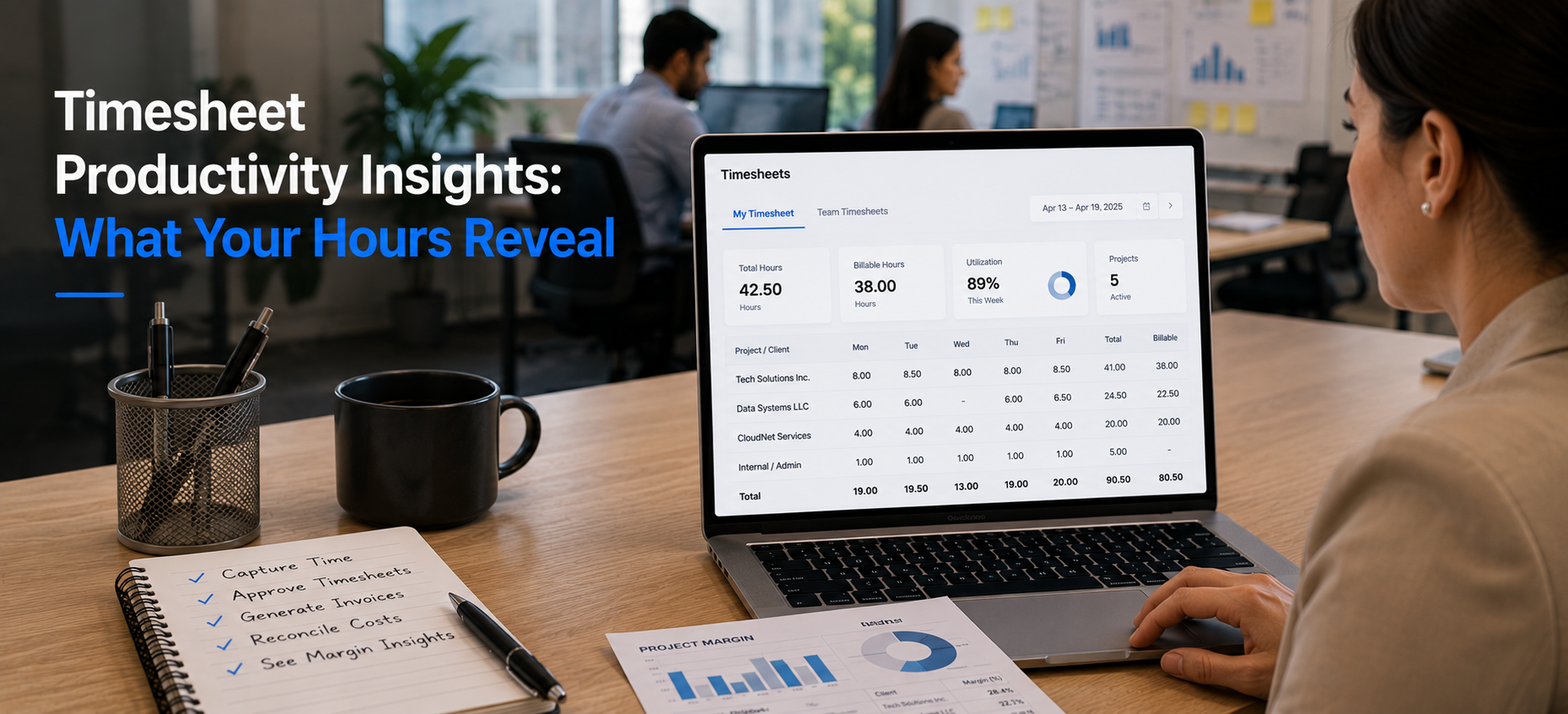
Quick answer: Timesheet productivity insights come from connected time data, not from logged hours alone. When approved hours feed invoicing and subvendor reconciliation, they reveal where margin leaks and which clients pay off. They also show where teams are overloaded. As a result, a staffing firm makes decisions from evidence rather than from gut feel.
What Can Timesheet Productivity Insights Reveal?
Being busy is not the same as being profitable. Therefore, the useful question is not how many hours were logged. Instead, it is what those hours produced.
For example, which client is profitable? Which assignment runs over? And where is effort being lost?
Timesheet productivity insights answer that. However, they only work when the data is connected. Hours sitting in an isolated tracker tell you who showed up.
In contrast, the same hours connected to invoicing and reconciliation tell you where the money went. So the value is in the connection, not the clock. As McKinsey has documented, organizations that act on connected operational data consistently outperform those that rely on instinct.
Why Do Manual Methods Hide the Real Story?
When time, billing, and reconciliation live in separate spreadsheets, the picture is always late. Moreover, it is often wrong.
By the time month end arrives, the insight that could have changed a decision is already history. Consequently, the firm reacts instead of plans.
Velorona removes that lag. Because approved hours drive the client invoice and reconcile the inbound subvendor invoice from one source, the picture is current. In other words, it is not reconstructed weeks later.
How Does Connected Data Produce Insight Without Micromanaging?
Good insights do not require hovering over staff. First, a consultant submits a timesheet or clocks in through timelogs.
Next, an approver clears entries in bulk. Then the system shows how time maps to clients, projects, and the work schedule.
As a result, managers gain visibility, and consultants are trusted rather than policed. According to Gallup, this kind of trust based transparency is closely tied to higher engagement. Therefore, accountability comes from clear records, not surveillance.
How Do Insights Expose Margin Leaks?
The most expensive insight is the one most firms get too late. For example, a subvendor invoiced for hours the consultant did not work.
Most staffing firms lose 3 to 5 percent of subvendor spend to invoice errors. That is $12,000 to $25,000 a year on $500K of spend.
However, Velorona matches inbound subvendor invoices against approved hours. It does this through the Vendor Hub and flags mismatches before payment. As a result, the insight arrives in time to protect margin rather than to explain its loss.
Can Time Data Help With Capacity and Burnout?
Yes. When hours are tracked across clients and assignments, you can see who is overloaded. You can also see who has bandwidth.
Therefore, capacity planning becomes a matter of evidence rather than guesswork. Furthermore, it helps a firm distribute work before someone quietly burns out.
The work schedule and time off tracking sit in the same system. So the same data that drives billing also supports healthier workloads. As the World Health Organization notes, burnout is now a recognized occupational phenomenon, and workload visibility is one practical defense against it.
What Do These Insights Look Like in Practice?
| Question an owner asks | What connected time data shows |
|---|---|
| Are we profitable on this client? | Revenue and cost per client, from approved hours |
| Is a subvendor over invoicing? | Mismatches flagged before payment |
| Who is overloaded this week? | Hours by consultant against the schedule |
| Can we prove disputed hours? | Timestamped audit trail with two factor authentication |
What Is Honest About Scope?
Velorona produces insight from connected back-office data. However, it does not provide predictive analytics or business intelligence forecasting. It also does not run payroll or score employees.
Those features are either out of scope or, for payroll execution and QuickBooks Online sync, on the 2026 roadmap. Until then, data moves via CSV. In short, the insight Velorona offers comes from one reliable source of approved hours feeding billing, reconciliation, and Payroll Details.
What Does It Cost and How Fast Is Go Live?
Starter is $6 per user per month, and Team is $10 per user per month. Furthermore, annual billing saves 30 to 33 percent. There is also a one month free trial with no credit card, no setup fee, and a 5 to 14 day go live.
In contrast, enterprise staffing platforms take 6 to 12 weeks to implement. They also charge $8,000 to $15,000 to set up. The American Staffing Association publishes further benchmarks on staffing operations.
For related reading, see how to eliminate payroll errors by fixing your time data first. You can also read how to fix timesheet chaos and get invoices out the same week.
FAQ: Timesheet Productivity Insights
What do timesheet productivity insights reveal that hours alone do not?
They show where margin leaks and which clients are profitable. In addition, they show where teams are overloaded, because the hours are connected to invoicing and reconciliation.
Does this require monitoring employees closely?
No. Insight comes from connected records and an audit trail, not from surveillance. Therefore, managers gain visibility without hovering.
How does it help prevent burnout?
Hours tracked across clients and assignments show who is overloaded. As a result, work can be redistributed before it becomes a problem.
Does Velorona forecast or run payroll?
No. It does not provide predictive analytics or run payroll. Instead, it produces insight from connected hours. Payroll execution is a 2026 roadmap item.
See What Your Timesheets Reveal
See how connected approved hours turn time data into decisions about margin, capacity, and profitability.
Book a personalized demo: velorona.com/demo