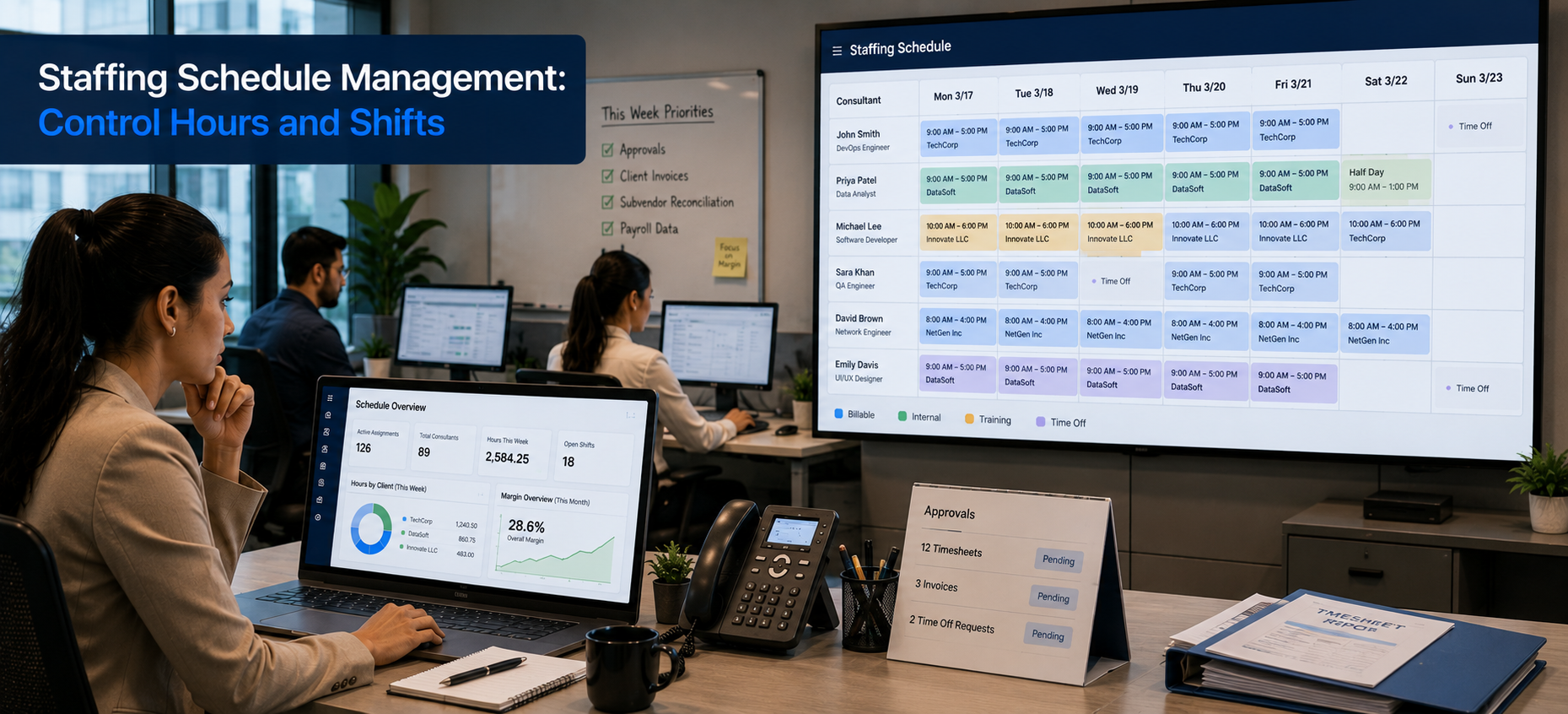
Staffing Schedule Management: Control Hours and Shifts
Quick answer: Staffing schedule management keeps work hours, shifts, time off, and approvals in one place. Velorona connects the schedule to time capture, then turns approved hours into invoices and clean pay data. As a result, the owner controls hours without manual chasing. To stay honest, Velorona prepares payroll data; it does not run payroll or file taxes.
Why Does Managing Work Hours Get Harder as You Grow?
For a small team, tracking hours feels simple. However, that changes fast. As the firm scales, the task grows complex.
Multiple clients, remote consultants, and shifting assignments all add friction. Therefore, manual methods start to break. Often, the result is inaccurate pay and confused schedules.
So staffing schedule management is not just a calendar. Instead, it is the system that keeps hours, shifts, and approvals aligned. The U.S. Department of Labor also requires accurate records of those hours.
What Should Staffing Schedule Management Actually Do?
The job is to connect the schedule to the work. First, it should plan shifts and assignments. Then it should capture the hours actually worked. Finally, it should turn those hours into billing and pay data.
Velorona does this in one place. A consultant submits a timesheet or clocks in through timelogs with geolocation on clock in.
Next, the work schedule shows assignments for consultants and shifts for hourly teams. As a result, planned hours and worked hours sit side by side.
How Does Automation Improve Accuracy?
Manual tracking invites error. A missed punch or a math mistake quietly distorts pay. Moreover, those errors add up over a month.
Automation fixes this. With Velorona, approved hours are recorded once. After that, they flow into invoicing and Payroll Details without rekeying.
Therefore, managers spot discrepancies early. In addition, an approver clears up to 50 timesheets in a single click. Consequently, corrections happen before payday, not after.
How Does Scheduling Connect to Billing and Pay?
This is where staffing schedule management earns its keep. The hours on the schedule are the hours you bill and pay against.
When hours are approved, the client invoice is generated from those exact hours. Then it is delivered to a tracked portal. As a result, you see when the client opened, viewed, and approved it.
The same approved hours also reconcile the inbound subvendor invoice through the Vendor Hub. Consequently, billing and pay draw from one source instead of diverging.
How Does It Protect Margin Across Schedules?
Scheduling control also protects profit. Most staffing firms leak 3 to 5 percent of subvendor spend to invoice errors. That is $12,000 to $25,000 a year on $500K of spend.
However, Velorona flags any mismatch before payment. For example, a consultant works 40 approved hours, but a subvendor bills 45. The system catches it first. According to Harvard Business Review, weak cost visibility is a common way growing firms erode their own margins.
How Does It Reduce the Administrative Burden?
Managing hours, schedules, and approvals by hand is a full time job. So consolidating them matters.
Velorona brings these tasks into one platform. Therefore, the team spends less time on paperwork. Instead, they focus on placements and clients.
In addition, time off and holiday tracking sit in the same schedule. As a result, an approver sees leave context while reviewing hours. The American Staffing Association notes that this kind of operational efficiency is what lets smaller firms scale.
How Does It Help With Compliance and Disputes?
Labor rules do not pause as you grow. So clean records matter.
Velorona stores every entry, edit, and approval in a timestamped action history. Furthermore, two factor authentication protects that record. Consequently, a wage dispute resolves in minutes from evidence, not memory.
What Does Velorona Do, and Not Do?
| Live today | On the 2026 roadmap or out of scope |
|---|---|
| Work schedule, shifts, and assignments | Payroll execution (2026 roadmap) |
| Timesheets, timelogs, geolocation, bulk approval | Kiosk face match attendance (Q3 2026) |
| Client invoicing and subvendor reconciliation | QuickBooks Online sync (2026 roadmap) |
| Time off tracking, Payroll Details, audit trail | Performance scoring or surveillance (not a Velorona function) |
To be precise, Velorona is staffing back office software. It produces Payroll Details for transparency. However, it does not run payroll or file taxes. Until QuickBooks Online sync ships, data moves via CSV.
What Does It Cost and How Fast Is Go Live?
Starter is $6 per user per month, and Team is $10 per user per month. Furthermore, annual billing saves 30 to 33 percent. There is also a one month free trial with no credit card, no setup fee, and a 5 to 14 day go live.
In contrast, enterprise platforms take 6 to 12 weeks to implement. They also charge $8,000 to $15,000 to set up. For staffing benchmarks, the American Staffing Association publishes useful data.
For related reading, see how to run your staffing back office on one platform. You can also read about workforce management software for staffing.
FAQ: Staffing Schedule Management
What does staffing schedule management include?
It keeps work schedules, shifts, time off, and approvals in one place. Therefore, planned hours and worked hours stay aligned.
Does scheduling connect to billing?
Yes. Approved hours generate client invoices and reconcile subvendor invoices from the same source.
Does Velorona run payroll?
No. It produces Payroll Details and prepares clean data for your payroll process. Payroll execution is a 2026 roadmap item.
Does it monitor employee performance?
No. It gives managers visibility into hours and workload. However, it does not surveil or score staff.
See Staffing Schedule Management in Action
See how Velorona connects schedules, hours, billing, and reconciliation into one controlled flow.
Book a personalized demo: velorona.com/demo