The Hidden Revenue Loss From Staffing Invoice Errors
The Billing Error Nobody Complains About
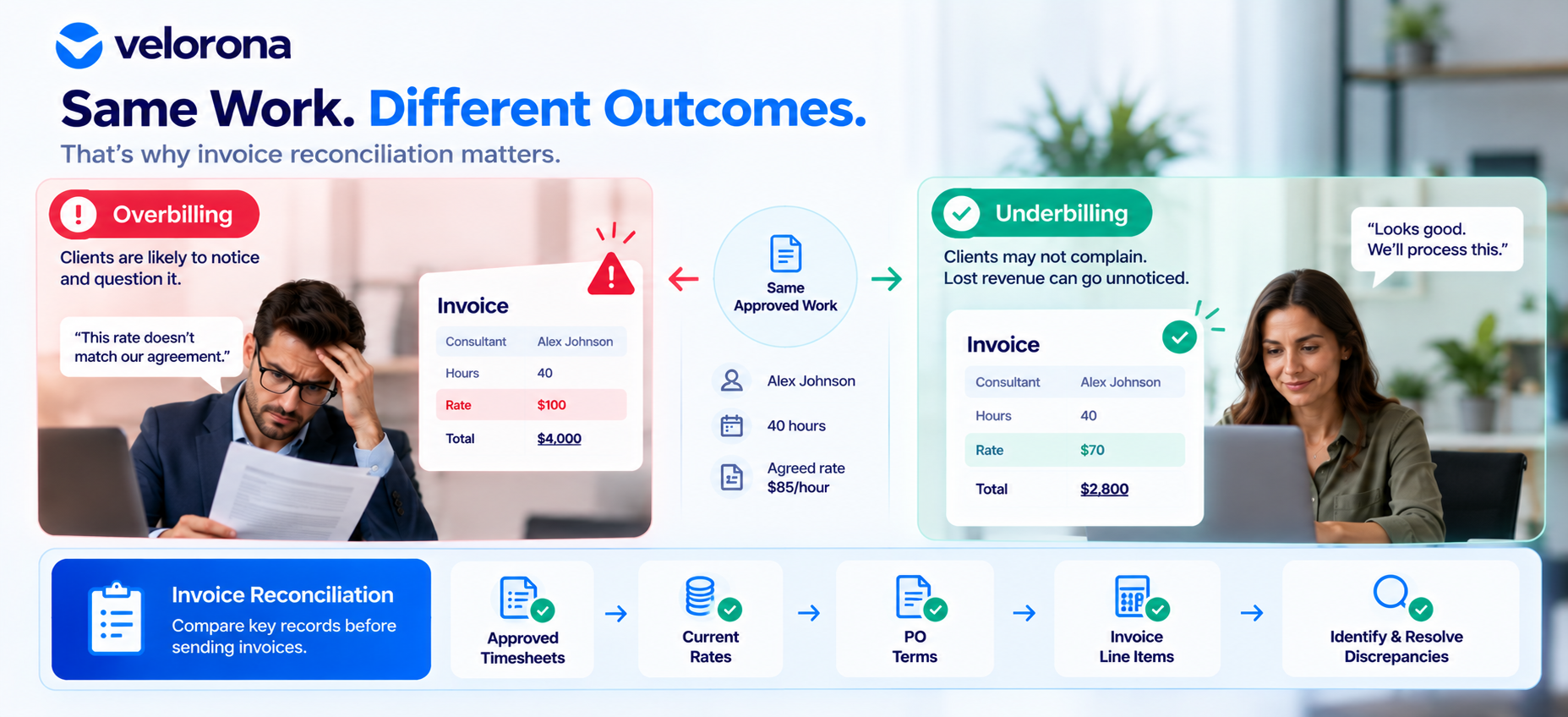
When a staffing firm overcharges a client, the mistake is likely to get noticed. An account manager receives an email questioning the amount. A controller asks why the invoice does not match the purchase order (PO). Overbilling is visible because clients have a financial incentive to challenge it.
Underbilling is different.
When a client receives an invoice for less than the approved hours, agreed rates, and applicable terms support, there may be no reason for them to flag the discrepancy. They pay the amount requested, and the staffing firm may never realize that revenue was missed.
That asymmetry makes underbilling particularly difficult to detect. Approved hours, billing rates, and PO terms may all be documented, yet a mismatch can go unnoticed when no one compares the underlying records. A quality check that asks only whether an invoice looks obviously wrong can miss errors that work in the client’s favor.
This does not mean every staffing firm is losing revenue or that every billing discrepancy is recoverable. It means firms need a staffing invoice reconciliation process that checks for both overbilling and underbilling.
Where Staffing Firms Can Lose Billable Revenue
Underbilling rarely has to come from one major mistake. It can result from small discrepancies across consultants, clients, and billing cycles.
1. Approved Hours That Never Reach the Invoice
A consultant submits a full week of hours, and the timesheet receives approval. However, a correction, late submission, or manual re-entry step causes some hours to disappear before the invoice is prepared.
The invoice may still look reasonable, making the missing hours difficult to spot without comparing it against the approved timesheet.
2. Rate Changes That Never Reach Billing Records
A client agrees to a rate increase during a renewal, scope change, or other adjustment. If the updated rate is documented but not reflected in the billing records used to generate invoices, the firm may continue charging the old, lower rate.
The problem is not necessarily the agreement itself. It is the gap between the agreed rate and the rate actually applied.
3. Differences Between Approved Timesheets and Invoiced Hours
When timesheets are maintained in one file, approvals happen over email, and invoices are prepared in a separate spreadsheet, each handoff creates an opportunity for error.
Hours can be transposed, rounded down, duplicated, or omitted. Without a direct comparison between approved hours and invoiced hours, these differences can remain undetected.
4. Calculation and Rounding Errors
Manually multiplying hours by rates across numerous invoice line items increases the chance of arithmetic mistakes.
These errors can lead to either overbilling or underbilling. However, an undercharge may be less likely to trigger a question from the client, which makes reconciliation important in both directions.
5. Purchase Order Balances and Billing Details That Go Unchecked
A purchase order establishes an authorized amount and may include specific billing terms. Recorded usage and invoiced amounts need to be reviewed against those terms.
Without regular checks, a firm may under-invoice against an available balance or exceed the authorized amount.
Not every PO discrepancy represents lost revenue. It may reflect an approved extension, a scope change, or hours that were not billable under the agreement. The objective is to compare PO terms, authorized amounts, recorded usage, and billing activity before deciding whether an exception needs correction.
Why Manual Invoice Checks Can Miss Revenue Gaps
Many staffing teams prepare invoices using a combination of spreadsheets, email approvals, timesheet exports, and separate billing records. This approach can work, particularly for smaller firms. The important question is not whether the process is manual, but whether it checks the necessary records consistently for every billing cycle.
Manual reviews often catch visible problems first: an incorrect total, a client name assigned to the wrong invoice, or an obviously incorrect rate.
Less visible discrepancies are harder to detect. Three missing hours in a 40-hour week may not make an invoice total look unusual. A rate change approved two months ago may remain buried in an email. A PO balance may go unchecked long after an engagement begins.
Finding these issues requires comparing multiple records for every relevant client and consultant. That can be manageable with a small number of accounts, but maintaining the same level of consistency becomes more challenging as the number of clients, consultants, and billing cycles grows.
A reliable process should therefore do more than check whether an invoice looks reasonable. It should verify that the invoice agrees with the records that support it.
Overbilling and Underbilling Require Different Checks
Overbilling occurs when a client is charged more than the agreed or supported amount. Examples include billing unapproved hours, applying a rate above the agreed rate, or making a calculation error that inflates the total.
Underbilling occurs when the invoice is lower than the amount supported by approved hours, applicable rates, and contractual terms. Examples include omitting approved hours, continuing to use an outdated rate, or failing to bill eligible usage under a PO.
A process designed only to prevent overbilling can help reduce client disputes, but it does not necessarily protect the firm’s revenue. The objective is not to find reasons to charge more. It is to ensure that every invoice accurately reflects what was approved and agreed.
| Issue | Possible cause | Records to check |
|---|---|---|
| Hours missing from an invoice | Timesheet correction or manual re-entry error | Approved timesheet versus invoice line items |
| Billed rate differs from the agreement | Rate change not updated in billing records | Agreed rate versus current billing record |
| Invoice total does not reconcile | Manual calculation or rounding error | Line-item calculations versus invoice total |
| PO usage does not match billing activity | PO balance or terms not checked regularly | PO terms, authorized amount, recorded usage, and invoices |
| Billed hours exceed approved hours | Unapproved or duplicated time entries | Timesheet approval records versus invoice |
What Should Staffing Invoice Reconciliation Compare?
A practical staffing invoice reconciliation process compares the supporting records before an invoice is sent, rather than reviewing the invoice in isolation.
1. Approved Timesheet Hours Against Invoice Hours
Confirm that every approved, billable hour is reflected on the invoice and that no unapproved hours have been included.
2. Agreed Billing Rates Against Invoice Rates
Check that the rate applied matches the current agreement for the relevant client and consultant, rather than an outdated default.
3. Approved Rate Changes Against Current Billing Records
Verify that rate increases or other approved adjustments have been updated in the system used to generate invoices—not simply documented in an email or agreement.
4. Invoice Calculations Against the Underlying Line Items
Recheck the calculations and totals. A quick visual review may not reveal a small arithmetic error across multiple line items.
5. PO Terms, Authorized Amounts, and Recorded Usage Against Billing Activity
Compare what has been invoiced with the applicable PO terms, the authorized amount, and the recorded usage. Review discrepancies in both directions without assuming that every difference is a billing error.
Finding a discrepancy is the beginning of the review, not the end of it. Some exceptions may be legitimate because of an approved scope change or documented rate adjustment. Others may be errors that need to be corrected before the invoice is sent.
Reconciliation helps identify where attention is needed. A person still needs to review the evidence, determine what is correct, and approve the appropriate action.
A Practical Example of Missed Revenue
The following is a hypothetical illustration, not a real client result.
Imagine a staffing firm billing a client for one consultant over a four-week period. The consultant’s approved timesheets show 160 hours.
During invoice preparation, a four-hour correction from week two is missed. Those hours were initially logged, disputed, and subsequently re-approved, but the correction never makes it back onto the invoice. The firm invoices 156 hours instead of 160.
Separately, the client approved a rate increase from $75 per hour to $80 per hour starting in week three. However, the person preparing the invoice continues to use the old rate in the billing spreadsheet.
If both discrepancies were identified before the invoice was sent, the calculation would look like this:
- Missing hours: 4 hours × $80 = $320
- Rate underbilling: 80 hours in weeks three and four × $5 rate difference = $400
- Total illustrative difference: $320 + $400 = $720
In this scenario, the two discrepancies amount to $720 for one consultant over one month.
The figures are illustrative. Actual differences depend on a firm’s billing rates, approved hours, contractual terms, and how frequently such discrepancies occur. The example does not establish that every firm experiences these gaps or that every identified amount can be recovered.
The operational lesson is that small errors can accumulate when the same process gaps recur across consultants and billing periods.
How to Introduce a Reliable Reconciliation Process
A structured process does not have to be complicated. It needs clear checks, assigned responsibility, and a way to resolve exceptions.
- Identify the source records. Establish which timesheets, rate agreements, PO documents, and prior invoices support each billing cycle.
- Define the required checks. Specify which hours, rates, PO details, and client requirements need to be verified.
- Compare against approved records. Review invoice line items against the underlying evidence rather than relying only on the previous month’s invoice.
- Flag discrepancies before sending. Identify missing hours, rate mismatches, and calculation differences for review.
- Assign responsibility for resolution. Ensure a designated person reviews each flagged exception instead of allowing it to remain unresolved.
- Document corrections. Record the decision and retain relevant supporting information so the team can explain the adjustment later if necessary.
- Review recurring problems. Look for patterns, such as rate cards that are not updated or timesheet corrections that repeatedly fail to reach billing.
Pre-Invoice Reconciliation Checklist
Use this checklist before sending each invoice:
- Every approved, billable hour for the period is reflected on the invoice.
2. The rate matches the current agreement for the client and consultant.
3. Recent approved rate changes have been updated in billing records.
4. Line-item calculations and invoice totals have been checked.
5. PO terms, authorized amounts, balances, and recorded usage have been compared against billing activity
6. Any discrepancy has been reviewed and resolved by an assigned person.
7. Supporting records for adjustments and corrections have been retained.
The checklist provides a repeatable review structure. Its effectiveness still depends on the accuracy of the source records and whether the team follows through on exceptions.
Already Using Accounting or Staffing Software?
Having software does not automatically mean every billing record is reconciled.
Even when a staffing firm has moved beyond spreadsheets, timesheets, rate changes, PO documents, and invoices may remain in separate tools or workflows. Data may still need to be transferred manually between them.
Instead of asking only, “Do we have software?”, ask:
- Does the current workflow compare approved timesheet hours with invoiced hours?
- Are current, agreed rates checked against the rates applied to invoices?
- Are approved rate changes reflected in billing records?
- Are PO terms, balances, and recorded usage reviewed together?
- Are discrepancies flagged for review before invoices are sent?
- Is someone responsible for resolving and documenting each exception?
Some systems may already support these checks. Others may automate invoice generation without comparing invoices against every relevant source record. Assess your existing workflow before assuming that software either does or does not address the problem.
How Velorona Can Support Invoice Reconciliation
Velorona supports parts of the reconciliation workflow by connecting approved consultant hours with invoicing and providing visibility into related billing records.
Generate Client Invoices From Approved Hours
Velorona’s invoicing workflow generates client invoices from approved consultant hours. This reduces the need to rebuild invoice line items manually in a separate spreadsheet, helping limit the risk of hours being omitted or re-entered incorrectly between approval and billing.
Match Incoming Sub-Vendor Invoices Against Approved Hours
The Vendor Hub and sub-vendor portal support matching incoming sub-vendor invoices against approved consultant hours and flagging mismatches before payment is processed.
This brings reconciliation into the money-out process as well as client billing. A flagged mismatch still needs review before the team decides how to resolve it.
Monitor PO Balances Against Billing Activity
For PO-based engagements, Velorona tracks PO balances against recorded billing activity and alerts the team when usage reaches 80% of the authorized amount. This helps the team see approaching PO limits and review usage before the authorized budget is exhausted.
Read more about how digital PO tracking prevents billing surprises for staffing firms.
Improve Visibility Into Client Invoice Delivery
Velorona delivers client invoices through a client portal alongside email delivery, with visibility into when invoices are sent, viewed, and approved. This can help teams investigate invoice-receipt questions and understand the status of client invoices.
For more context, read how automated invoicing can help staffing firms address DSO.
These workflows do not eliminate the need for judgment. A flagged discrepancy still needs a person to review the supporting records and determine the correct action. The goal is to make key comparisons more consistent rather than relying entirely on someone remembering to perform them manually.
Check What You Charge and What You Miss
Overbilling is more likely to attract attention because the client has a reason to question it. Underbilling can remain invisible because the client has little incentive to investigate an invoice that is lower than expected.
A reconciliation process focused only on avoiding client complaints may therefore overlook discrepancies that affect revenue.
Before an invoice goes out, compare approved hours, applicable rates, invoice calculations, and relevant PO details against the records that support them. Do not rely solely on whether the final total looks reasonable.
Reconciliation cannot guarantee error-free invoices or recover every missed dollar. It can, however, give staffing firms a structured way to identify discrepancies that might otherwise go unnoticed.
Ready to See How This Works in Practice?
Explore how approved hours, incoming sub-vendor invoices, and PO balances can be checked as part of the billing workflow.
Frequently Asked Questions
What is staffing invoice reconciliation?
Staffing invoice reconciliation is the process of comparing an invoice with the records that support it, such as approved timesheets, agreed billing rates, PO terms, and invoice calculations. The aim is to identify discrepancies before they lead to billing errors or unresolved questions.
How can staffing invoice errors lead to revenue loss?
Errors such as omitted approved hours, outdated billing rates, and incorrect calculations can cause a staffing firm to invoice less than the amount supported by its records. If these discrepancies are not identified, the firm may not realize that billable revenue was missed.
What is the difference between overbilling and underbilling?
Overbilling means charging more than the approved or agreed amount. Underbilling means charging less than the amount supported by approved hours, applicable rates, and contractual terms. A complete reconciliation process checks for both.
Which records should staffing firms compare before sending invoices?
At a minimum, firms should compare approved timesheets against invoice hours, agreed rates against billed rates, approved rate changes against current billing records, line-item calculations against invoice totals, and PO terms and usage against billing activity.
Does using staffing or accounting software prevent invoice errors?
Not automatically. Software may automate invoice creation without comparing every invoice against the relevant timesheets, rate agreements, or PO records. Staffing firms should assess whether their current workflow performs the checks they need and provides a process for reviewing discrepancies.
Can invoice reconciliation guarantee that a staffing firm will recover missed revenue?
No. Reconciliation can help identify discrepancies, but not every difference represents a billing error or a recoverable amount. The team must review the relevant agreements and records before deciding whether an adjustment is appropriate.
Related Reading
- Staffing Client Invoice Portal: Stop Losing Cash to Lost Invoices
- Timesheet Software for Staffing: Turn Hours into Invoices
- Multi-Tier Staffing Vendor Management: Control C2C Chains
- Staffing Firm Audit Trail: The Missing Layer in Your Back Office