Automated Time Tracking: How Staffing Firms Cut Manual Work
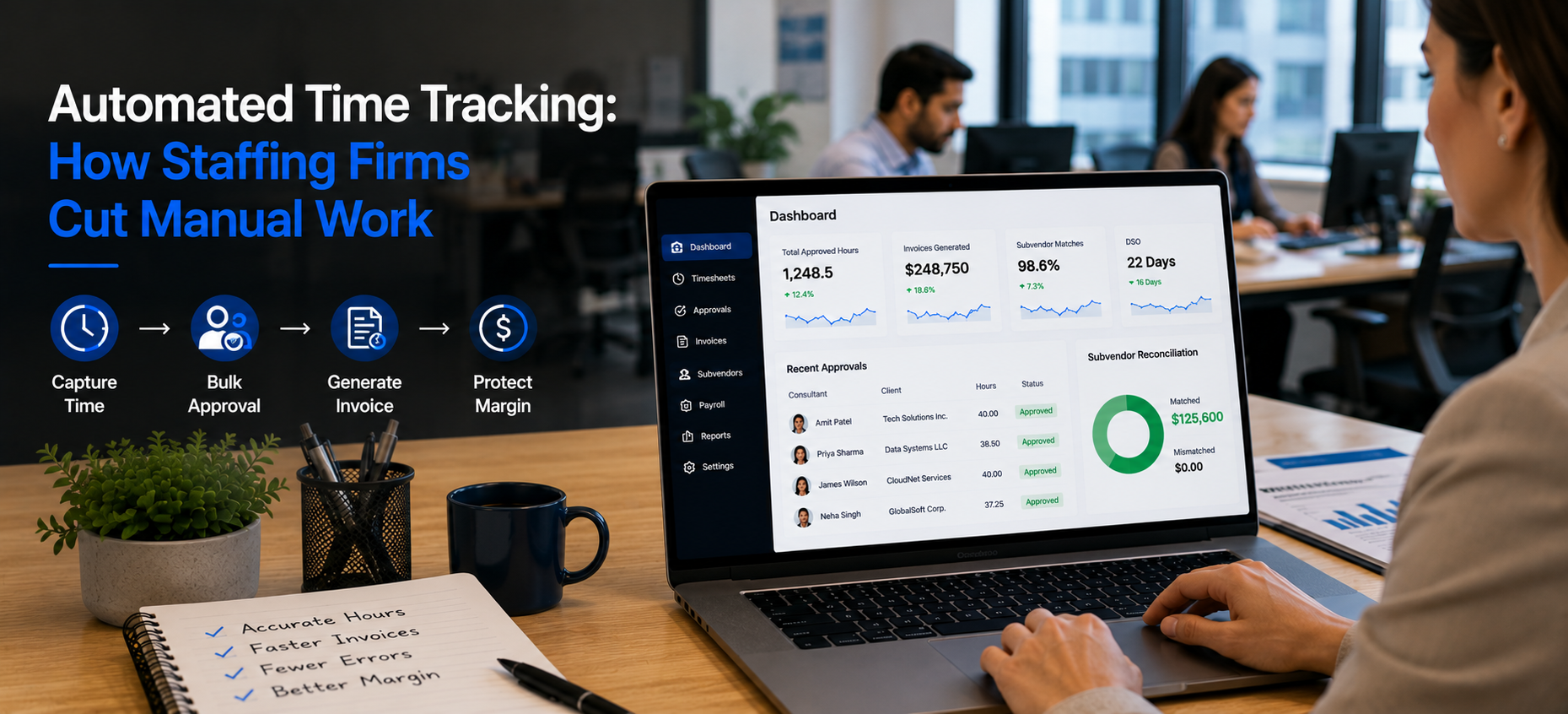
Quick answer: Automated time tracking means approved hours move from capture to invoice without manual re-entry. Velorona automates the routing, approval, invoicing, and subvendor reconciliation around one set of hours. As a result, you get less spreadsheet work, fewer billing errors, and margin you can see. In short, it is not a faster way to do the same manual steps.
What Does Automated Time Tracking Mean for a Staffing Firm?
Workplace dynamics have changed. Because of this, the timesheet has moved from a back office formality to the trigger that starts your billing cycle. However, automation only helps if it removes manual steps.
Done properly, automated time tracking means a consultant logs hours once. After that, the system carries those hours through approval, invoicing, and reconciliation on its own.
If you still copy numbers between a tracker and an accounting tool, you have automated nothing. Therefore, the test is simple. Does the software remove the handoffs, or does it just speed them up?
Why Is Manual Work the Real Bottleneck?
Without automation, time tracking turns into time wasting. For instance, the controller at an 80 consultant firm spends the week chasing missing entries and recalculating rates.
She also reconciles subvendor invoices by hand. Consequently, each manual step is slow. Moreover, each one is a place an error hides.
The problem was never a shortage of effort. Instead, it is the absence of a connected workflow. As the American Staffing Association regularly points out, operational drag like this is what stalls growing firms.
How Does Velorona Automate the Back Office?
Velorona connects the chain so one approval drives everything. First, consultants submit a timesheet or clock in through timelogs with geolocation on clock in.
Next, a multi level approval workflow routes entries automatically. Then approvers clear up to 50 in a single click.
Finally, approved hours generate the client invoice and deliver it to a tracked portal. At the same time, they reconcile the inbound subvendor invoice and update Payroll Details. As a result, the repetitive work that consumed the controller’s Friday shrinks to a short exception review.
How Does Automated Time Tracking Protect Margin?
Automation matters most where money leaks quietly. Most staffing firms lose 3 to 5 percent of subvendor spend to invoice errors. That is $12,000 to $25,000 a year on $500K of spend.
However, Velorona automatically matches inbound subvendor invoices against approved consultant hours. It does this through the Vendor Hub and flags mismatches before payment.
Consequently, the highest value automation is not faster timesheets. Rather, it is catching the bad invoice before it is paid.
Can Automation Make Margin Visible?
Yes. When approved hours drive both the client invoice and the subvendor cost, margin becomes a byproduct of the workflow.
So instead of spending two days in a spreadsheet, the owner can see margin clearly. For example, the dashboard shows revenue per consultant, cost per consultant, margin per assignment, and margin per client.
This kind of visibility changes decisions. According to Harvard Business Review, poor cost visibility is one of the most common reasons growing firms erode their own margins. Therefore, seeing profitability in real time is a real advantage.
What Is Automated Today, and What Is Not?
| Live today | On the 2026 roadmap |
|---|---|
| Routing, bulk approval, geolocation | Payroll execution |
| Automated client invoicing and portal delivery | QuickBooks Online sync |
| Subvendor reconciliation, multi currency | Public API and Zapier |
| Payroll Details, audit trail with two factor authentication | 1099 NEC generation, kiosk attendance |
To be honest about scope, Velorona does not run payroll. It also does not file taxes or provide predictive analytics. Instead, it automates the staffing back office around verified hours. Until QuickBooks Online sync ships, data moves via CSV.
What Does It Cost and How Fast Is Go Live?
Starter is $6 per user per month, and Team is $10 per user per month. Furthermore, annual billing saves 30 to 33 percent. There is also a one month free trial with no credit card, no setup fee, and a 5 to 14 day go live.
In contrast, enterprise staffing platforms take 6 to 12 weeks to implement. They also charge $8,000 to $15,000 to set up.
For related reading, see how to get payroll ready in minutes instead of days. You can also read about automated invoicing for staffing firms.
FAQ: Automated Time Tracking
How does automated time tracking cut manual work?
It routes timesheets to the right approver and clears them in bulk. After that, it turns approved hours into invoices and reconciliation automatically. Therefore, the handoffs disappear.
Is automation hard to adopt?
No. There are no setup fees, a 5 to 14 day go live, and a one month free trial. As a result, the automated process is simpler than the manual one from day one.
Does it use AI to monitor employees?
No. Velorona records hours, captures geolocation on clock in, and keeps an audit trail. However, it does not score or surveil staff.
Does it run payroll?
No. It produces Payroll Details. Payroll execution is on the 2026 roadmap.
See Automated Time Tracking for Staffing
See how one approval drives invoicing, reconciliation, and margin visibility, with no manual re-entry.
Book a personalized demo: velorona.com/demo