How Staffing Back-Office Operations Support Client Retention
Introduction: The Work Behind a Smooth Renewal
A staffing firm makes the right placement. The consultant starts on time, settles into the role, and the hiring manager is satisfied. From the outside, the client relationship appears to be going well.
Then the first invoice arrives.
The client’s accounts payable team has a question about a billing rate. Someone requests last quarter’s timesheets to reconcile them against a purchase order. An invoice needs a correction and reissue.
These situations are not unusual. They are part of the work that happens after a placement—and they influence how a client experiences a staffing firm throughout an engagement.
Clients don’t experience a staffing firm only through the people it places. They also experience it through invoices, timesheet approvals, documentation requests, billing questions, and the follow-ups required to resolve them.
Recruiting quality remains essential. Strong delivery is often what wins the business in the first place. But once consultants are working, the consistency of the back-office process also shapes the day-to-day relationship.
Organized documentation, accurate billing, and predictable workflows can make working with a staffing firm easier for a client’s finance and operations teams.
These practices do not guarantee client satisfaction or renewal. However, they can reduce avoidable friction and support a more consistent working relationship.
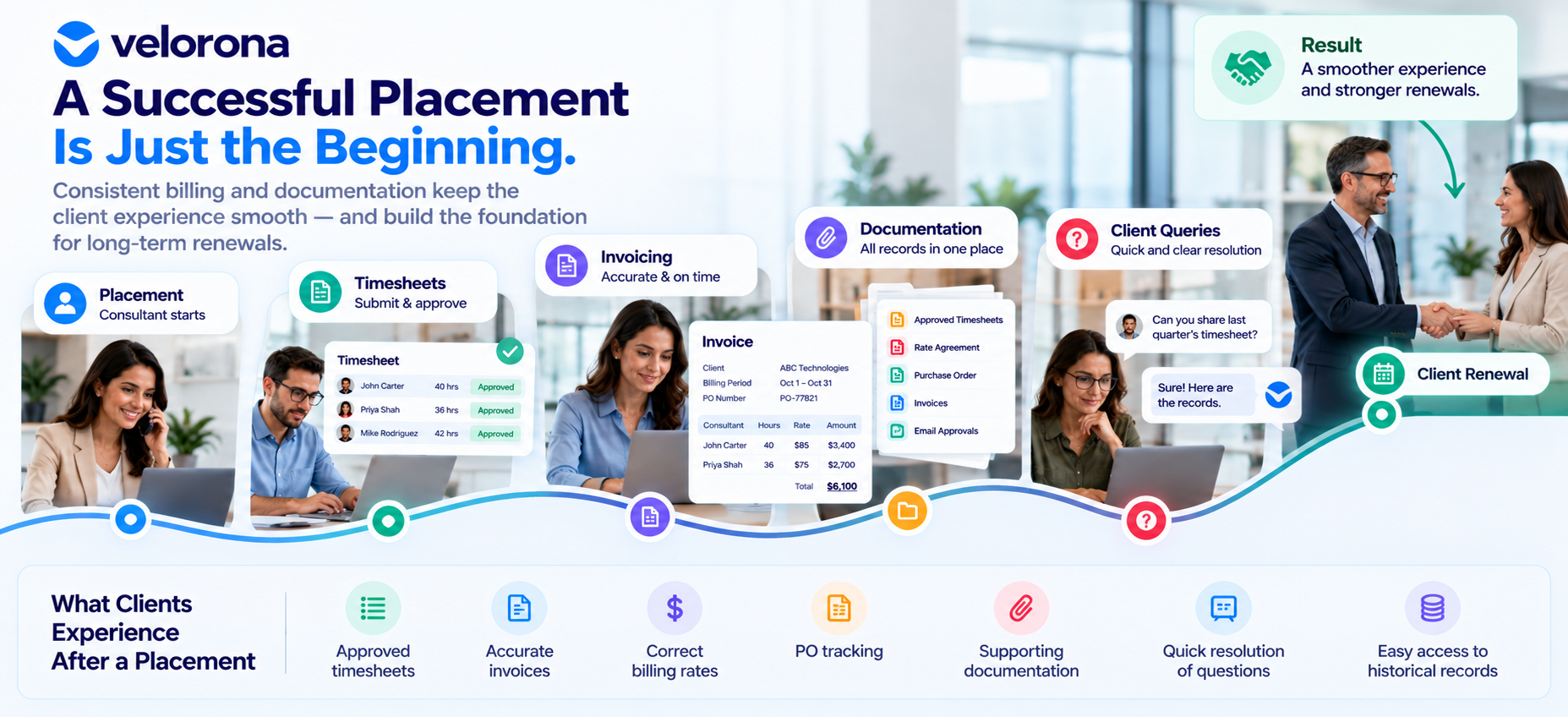
What Clients Experience After a Placement
Once a consultant starts working, the relationship becomes an ongoing operational process. Several recurring activities contribute to the client’s experience:
- Timesheet submission and approval: Hours are submitted and approved on a predictable schedule.
- Invoice preparation and submission: Invoices reflect the correct hours, rates, and billing periods and are delivered on time.
- Billing-rate accuracy: Invoices reflect the agreed rates, including approved changes.
- Purchase order (PO) tracking: Invoices are associated with the appropriate PO and remain within authorized limits where applicable.
- Supporting documentation: Records are available to substantiate billed amounts.
- Invoice questions and corrections: Clients have a clear way to raise issues and receive corrected information.
- Historical record retrieval: The firm can locate earlier invoices, timesheets, and related records when needed for reconciliation or an audit request.
These processes do not replace strong recruiting and delivery. A client dissatisfied with a consultant’s performance is unlikely to be persuaded by accurate invoices alone.
But when delivery is going well, recurring operational interactions become an important part of the relationship. A reliable timesheet approval workflow, combined with a consistent invoicing process, helps make that part of the engagement more predictable.
How Inconsistent Billing Creates Extra Work for Clients
Billing problems don’t have to be major disputes to create frustration. Sometimes, they are small issues that require someone on the client side to notice a discrepancy, request clarification, and wait for a resolution.
Common examples include:
- Invoices that need correcting: Incorrect hours or billing periods require investigation and reissue.
- Rates that don’t match approved terms: The client must reconcile the difference before processing payment.
- Missing supporting records: Accounts payable requests documentation before approving an invoice.
- Unclear PO information: Procurement needs additional details to confirm that a charge is authorized.
- Timesheet and invoice discrepancies: Billed hours do not match the hours approved for the consultant.
- Repeated documentation requests: Records are difficult to locate or are not organized consistently.
Any one of these issues may be straightforward to resolve. The challenge is when similar problems recur across billing cycles.
Clients managing several vendor relationships may notice which vendors consistently provide the information they need and which require repeated follow-ups.
These problems are not universal. Many staffing firms maintain accurate billing processes, and many client engagements proceed without significant billing questions. But when inconsistencies occur, they create additional work for accounting, procurement, and operations teams.
The practical goal is to reduce avoidable corrections and make it easier to answer questions when they arise.
Why Organized Documentation Matters Over Time
A staffing engagement rarely involves just one invoice. It may continue across multiple billing periods, with rate changes, PO updates, supporting records, and occasional corrections along the way.
Keeping documentation organized for one billing cycle is useful. Maintaining a connected record throughout the engagement is more demanding.
Over time, clients may need a staffing firm to:
- Retrieve invoices and their supporting timesheets from previous billing periods.
- Verify the billing rates that applied during a specific period.
- Locate approved rate changes and their effective dates.
- Connect invoices to the relevant purchase orders.
- Explain corrections and discrepancies with a record of what changed.
- Respond consistently to requests for historical documentation.
The distinction is between storing records and being able to retrieve and connect them when needed.
A firm might have every invoice and timesheet saved somewhere but still struggle to assemble a complete record for one client, quarter, or purchase order. The information may be spread across email threads, spreadsheets, accounting software, and shared drives.
Not every client requests the same level of documentation, and documentation alone does not determine whether a client renews. Still, when a question comes in, the firm’s ability to provide a clear answer can make the process easier for everyone involved.
The Link Between Operational Consistency and Client Confidence
A repeatable back-office process makes routine interactions more predictable. That is the practical value of operational consistency: less unnecessary friction and a clearer process for handling routine work and exceptions.
In practice, this can mean:
- Invoices follow a consistent review and submission process.
- Billing questions can be investigated using accessible records.
- Documentation requests have a clear owner and response process.
- Clients do not have to chase multiple employees for the same information.
- Corrections and exceptions are recorded and handled consistently.
These practices can help a staffing firm respond more clearly when a client needs an explanation or supporting documentation.
However, it is important not to overstate the relationship. Better documentation does not automatically create trust, guarantee client satisfaction, or secure a renewal. Renewal decisions can also depend on delivery quality, pricing, relationships, business needs, and procurement requirements.
Operational consistency is one part of the overall client experience—not a substitute for the other factors that influence a client’s decision.
What a Renewal-Ready Staffing Operation Looks Like
A staffing firm should not have to reconstruct months of records just before a renewal discussion or scramble to resolve recurring billing issues. The underlying processes are easier to maintain when they are part of everyday operations.
Consider these eight practices:
- Review invoices before submission. Check billed hours, rates, billing periods, and relevant PO details before sending an invoice to the client.
- Match approved hours to billable hours. Establish a reliable process for checking that the hours being billed correspond to approved timesheets.
- Verify applicable billing rates. Keep a record of agreed rates and approved changes, including when those changes take effect.
- Organize PO records. Where clients use purchase orders, maintain the relevant details and monitor authorized limits.
- Keep historical documentation accessible. Make it possible to retrieve records from earlier billing periods without rebuilding the file from scratch.
- Assign responsibility for billing questions. Ensure that the client knows whom to contact and that someone is responsible for following through.
- Review recurring discrepancies. Look for patterns in invoice corrections, missing records, or approval delays rather than treating every issue as an isolated event.
- Document exception handling. Establish a consistent method for recording and resolving unusual billing situations.
The objective is to maintain consistency throughout the contract—not to organize everything only when a renewal approaches. Processes such as vendor and PO tracking are generally easier to manage continuously than to reconstruct after the fact.
A Practical Client-Experience Checklist
Use the following checklist to assess how consistently your back office supports client-facing operations.
For each question, mark Consistent, Needs improvement, or Not yet established.
- Can we explain an invoice without searching across multiple systems?
- Can we retrieve the supporting timesheet for a billed amount?
- Can we verify the applicable billing rate and locate the relevant approval?
- Can we find the associated PO records when required?
- Can we respond to documentation requests through a defined process?
- Do we track and resolve recurring invoice discrepancies?
- Is the process documented well enough that it does not depend on one employee’s memory?
If several answers fall under “Needs improvement” or “Not yet established,” use them as starting points for improving the process. They do not automatically indicate a failing operation; they identify areas where greater consistency may help.
Start with one client or billing period. Trace an invoice from the approved hours through submission, supporting documentation, and any subsequent correction. Note where information is missing, disconnected, or dependent on manual follow-up.
That exercise can reveal practical improvements without requiring an immediate overhaul of every back-office system.
Already Using Staffing or Accounting Software?
Many staffing firms have already digitized parts of their back office. They may use one tool for time tracking, another for accounting, and a separate spreadsheet or system for purchase orders.
That is a useful starting point, but having software does not automatically mean the processes are connected.
A firm may still need manual exports, email follow-ups, or separate searches to assemble a complete record. Even when every document exists digitally, retrieving a clear answer can remain difficult if the information is disconnected.
Instead of assuming that another tool will solve the problem, map the workflow as it operates today.
When a client questions an invoice:
- Where do you find the approved timesheet?
- How do you verify the applicable billing rate?
- Where are the relevant PO details stored?
- Can you identify what changed if an invoice was corrected?
- How many systems or people are involved in assembling the answer?
The gap between having digital tools and having connected, retrievable records is worth examining. The right solution depends on where the actual workflow breaks down.
How Velorona Fits Into Consistent Staffing Operations
Velorona is back-office software built for staffing firms managing consultants, timesheets, and client billing. Its features support several of the operational processes discussed in this article.
Timesheet approvals: Timesheets can have Open, Submitted, Approved, or Rejected statuses. Approval and rejection actions are timestamped, providing a record of the decision.
Client invoicing: Invoices are generated from approved hours. Draft invoices can be edited, while key details on finalized invoices are locked. This supports a process in which billed hours originate from approved timesheets rather than being reconstructed manually each cycle.
Invoice delivery and activity: Invoices can be delivered through the client portal alongside email. The portal provides visibility into invoice activity, including when an invoice was sent, opened, reviewed, and approved. Clients can also approve hours and invoices through the portal and leave inline comments.
Vendor invoice reconciliation: Velorona’s Vendor Hub matches incoming sub-vendor invoices against approved consultant hours and flags mismatches before payment. This helps firms identify discrepancies during reconciliation.
PO monitoring: PO balances are tracked, with alerts triggered when 80% of the authorized amount has been reached.
Together, these features can help firms maintain more consistent records across timesheets, client invoicing, vendor reconciliation, and PO tracking.
Velorona does not manage recruiting or candidate pipelines, and it does not replace the relationship work performed by account managers. Nor does using the software guarantee that a client will renew. Its role is to support the operational processes that take place after a placement.
As a hypothetical example, consider a firm that needs to answer a question about a previous invoice. If it can retrieve the corresponding approved timesheet, applicable billing information, and related records in one connected workflow, it may be better positioned to respond promptly. The actual response time will depend on the firm’s processes and the records involved, and whether that responsiveness affects a renewal decision will vary by client.
To explore the relevant features, visit Velorona’s invoicing page or review the timesheet workflow.
Frequently Asked Questions
1. How do back-office operations affect client retention in staffing?
Back-office operations shape a client’s recurring experience after a placement. Accurate invoices, consistent timesheet approvals, accessible documentation, and clear resolution of billing questions can reduce unnecessary work for the client’s finance and operations teams. These practices may support the relationship, but they do not guarantee retention.
2. Why are accurate invoices important for staffing firms?
Accurate invoices help clients reconcile charges against approved hours, agreed rates, and relevant purchase orders. When invoices contain discrepancies or missing information, clients may need to request corrections or supporting records before processing payment.
3. What documentation should a staffing firm be able to retrieve?
Depending on the engagement and the client’s requirements, relevant records may include invoices, supporting timesheets, applicable billing rates and approved changes, purchase order information, correction histories, and supporting correspondence or documentation. The exact requirements can vary by contract and client.
4. How can staffing firms make billing more consistent?
Firms can establish a repeatable invoice-review process, match billed hours against approved timesheets, verify applicable rates, organize PO records, assign responsibility for billing questions, and review recurring discrepancies. Documenting exception-handling procedures can also help ensure that issues are resolved consistently.
5. Does using staffing software automatically improve client retention?
No. Software can support processes such as timesheet approvals, invoicing, documentation retrieval, and vendor reconciliation, but it cannot guarantee a renewal. Client retention also depends on delivery quality, pricing, relationships, business requirements, and other factors.
6. What should staffing firms look for in back-office software?
Start with the workflow problems the firm needs to address. Relevant capabilities may include timesheet approval tracking, invoice generation from approved hours, invoice activity visibility, PO monitoring, and sub-vendor invoice reconciliation. Firms should evaluate how well these capabilities fit their actual processes rather than assuming that more software will automatically resolve every issue.
7. How can a staffing firm tell whether its back-office process needs improvement?
Try retrieving a complete record for a recent client invoice. Check whether the firm can locate the approved timesheet, applicable billing rate, relevant PO information, and any correction history without extensive searching or relying on one employee’s memory. Repeated gaps can indicate where the process needs attention.
Conclusion: Make Consistency Part of the Client Experience
A client relationship does not end when a placement is made. It continues through invoices, timesheet approvals, documentation requests, and the occasional correction.
Recruiting capability, consultant performance, and relationship management remain essential. But accurate billing and accessible records can make the operational side of working with a staffing firm easier for the client to manage.
The goal is not to promise that clean invoices will secure a renewal. It is to reduce avoidable questions, establish repeatable processes, and make it easier to explain what has been billed and why.
Ask yourself: does your back-office process make your client’s work easier, or does it create unnecessary follow-ups?
If the answer points to recurring friction, start by reviewing your placement-to-payment workflow and identifying where information becomes difficult to verify or retrieve.
If you want to see how Velorona supports timesheets, invoicing, PO monitoring, and sub-vendor reconciliation, book a 15-minute demo to explore the workflow and assess how it might fit your firm’s operations.
Related Reading
- Staffing Firm Audit Trail: The Missing Layer in Your Back Office
- Staffing Back Office: Client Experience After Placement
- Staffing Client Invoice Portal: Stop Losing Cash to Lost Invoices
- Timesheet Software for Staffing: Turn Hours into Invoices
- Multi-Tier Staffing Vendor Management: Control C2C Chains