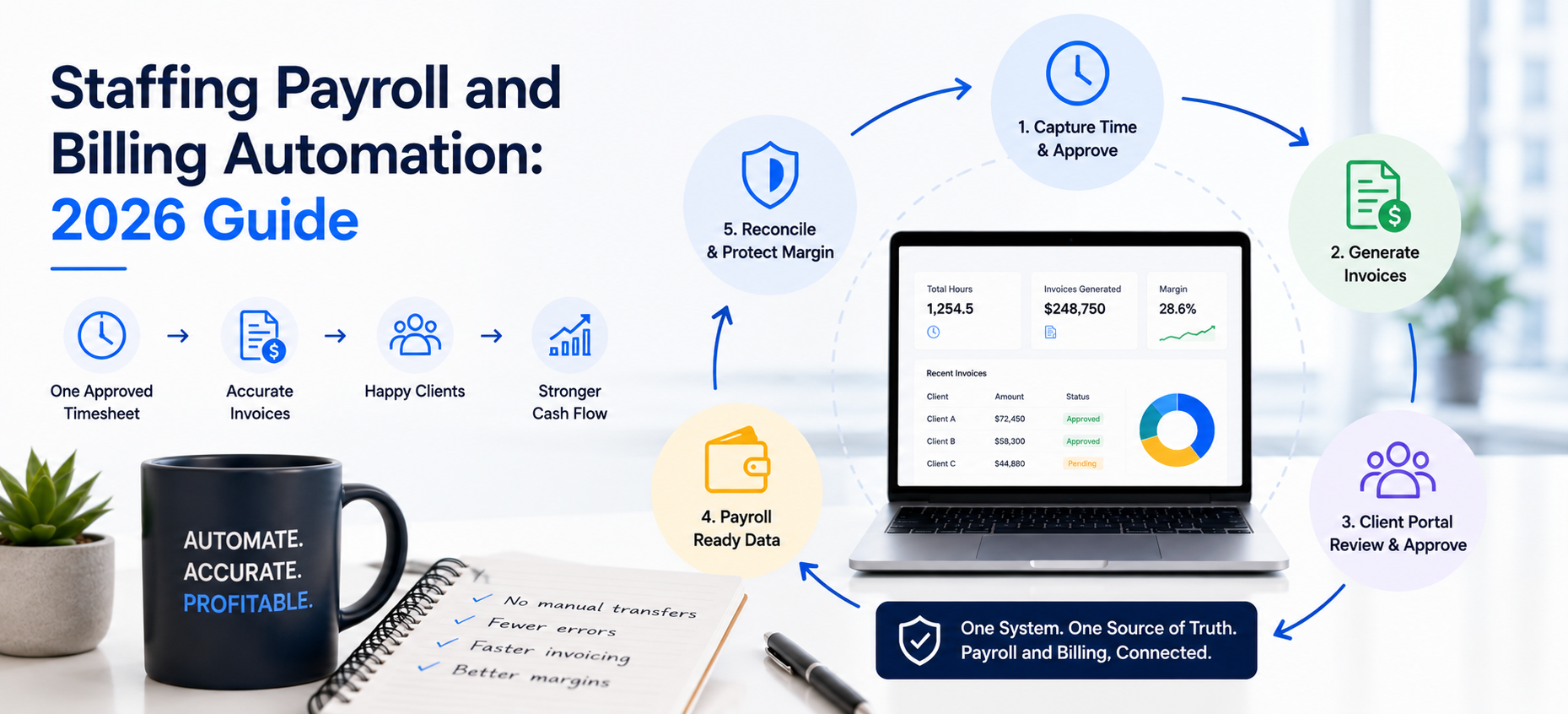
Staffing Payroll and Billing Automation: 2026 Guide
Quick answer: Staffing payroll and billing automation connects every step in one system, from approved hours to invoices and from timesheets to payroll prep. Payroll and billing break when data moves through manual handoffs. The fix makes every downstream figure trace back to the same approved timesheet, so no manual transfer exists between them. This guide covers the four firm types, their failure points, and the fix for each.
What Are the Four Firm Types and Their Failure Points?
Most staffing firms fall into one of four operational profiles. The table maps each to its failure point and its fix, and the sections that follow explain each in practice.
| Firm type | Failure point | Fix |
|---|---|---|
| Excel first firm | Formula breaks, key person leaves, no audit trail | Automated timesheet to invoice workflow |
| Tools plus spreadsheets | Manual transfers between apps introduce errors | Connect time tracking to invoicing |
| Siloed tools firm | Five logins, no live margin view | Consolidate onto one platform |
| Platform hitting a ceiling | C2C subvendor invoicing needs workarounds | Bidirectional reconciliation |
Why Does Staffing Billing Break at Scale?
For staffing firms, the problem compounds quickly. You are not managing one payroll. Instead, you are managing dozens of pay schedules, multiple employment types, variable bill rates per client, and invoice cycles that may not align with pay cycles. Without staffing payroll and billing automation, every one of those variables stays a manual step.
According to Bullhorn’s annual industry research, staffing leaders consistently rank back office automation ahead of AI recruiting as an operational priority. The reason is simple. Ultimately, the back office is where cash flow and client retention are won or lost.
How Do Firms Currently Manage Payroll and Billing?
The Excel first firm builds invoices from a template and runs pay on old formulas. Therefore, when a key person leaves, institutional knowledge leaves with them. By contrast, the tools plus spreadsheets firm has tools that do not connect, so spreadsheets sit between them as a translation layer, and each transfer is a chance for a mistake.
Meanwhile, the siloed tools firm has five logins and five data sets, so margin visibility per client requires a manual spreadsheet build. Finally, the platform firm has consolidated but hits a ceiling where Corp to Corp subvendor invoicing requires a workaround at scale.
What Does the 2026 Market Demand from Back Office Software?
According to Staffing Industry Analysts, tighter margins mean firms cannot make up for inefficiency with volume growth. Therefore staffing payroll and billing automation needs to do several things at once. It must capture time to invoice with no manual transfer, deliver a client facing review portal, handle subvendor and C2C billing in the same system, tie payroll to the same records as billing, and keep a full audit trail.
What Does Fixing It Actually Look Like?
First, approved hours flow automatically into invoice generation, which removes the most common source of billing errors. Second, a client portal replaces email invoicing, so disputes resolve faster and DSO shrinks. Furthermore, bidirectional subvendor reconciliation catches $12,000 to $25,000 a year at $500K spend. Finally, payroll data lives in the same system as billing, so there is no separate reconciliation.
The shared principle is straightforward. Because every figure traces to one approved timesheet, the manual handoffs that introduce errors simply disappear.
For related reading, see staffing payroll prep and automated invoicing for staffing firms.
Frequently Asked Questions
Does Velorona run payroll?
No. It produces Payroll Details and prepares clean data for your payroll process. Payroll execution is a Q4 2026 roadmap item.
Is it built for staffing or general payroll?
It is built specifically for the staffing billing cycle. Moreover, subvendor invoicing sits on the same platform as client billing.
How fast is go live?
Typically 5 to 14 days, with no setup fees and data imported via CSV.
What does staffing payroll and billing automation save?
At $500K subvendor spend it recovers $12,000 to $25,000 a year. In addition, portal delivery drops DSO 15 to 30 days in the first quarter.
Book a personalized demo at velorona.com/demo.