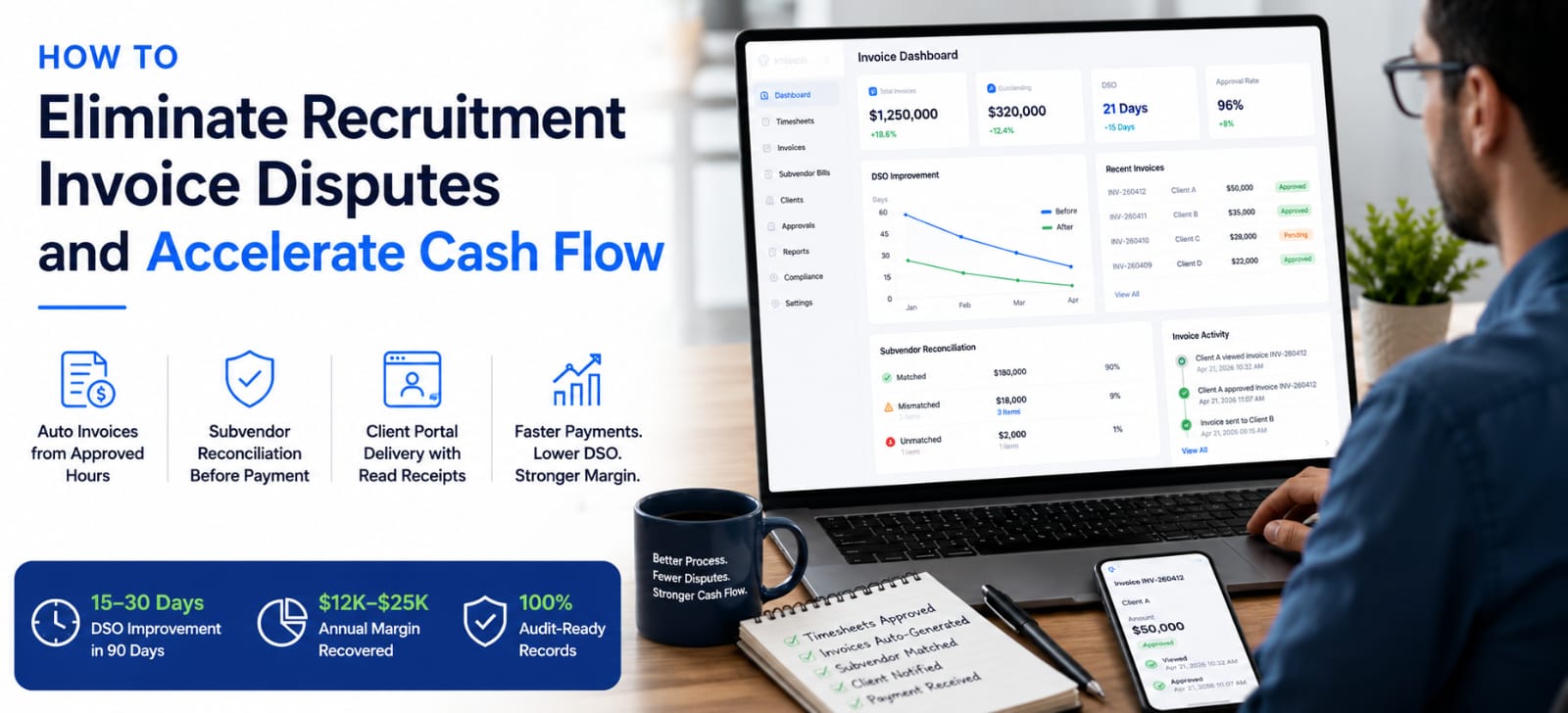
Quick answer: Staffing and recruiting agencies eliminate recruitment invoice disputes by delivering invoices to a client portal rather than email. With portal delivery, you see exactly when the client opened, viewed, and approved the invoice. Combined with automatic invoice generation from approved hours and subvendor reconciliation before payment, the disputed billing cycle disappears, and DSO drops 15 to 30 days within the first quarter.
Why Are Recruitment Invoice Disputes the Silent Growth Killer?
For staffing and recruiting agencies, an invoice dispute is more than a late payment. It is a breakdown in trust that consumes time at every level of the firm. When a client’s finance team questions a bill, it usually stems from a lack of transparency in the post hire phase.
The data gap is the first cause. Recruitment invoice disputes arise when the client’s record of hours does not match the agency’s invoice. Manual transcription errors are the second cause, since moving data from a tracker to invoicing software by hand creates mistakes. No proof of delivery is the third, because email leaves no evidence the invoice arrived.
How Does Subvendor Reconciliation Prevent the Biggest Billing Error?
Most dispute guides focus on what you bill your client. However, for IT staffing firms running C2C subvendor arrangements, the larger error often happens on the inbound side. The subvendor invoices for hours that did not happen.
A subvendor sends an invoice for 40 hours. Your consultant worked 36. At a $100 hourly rate, that is $400 per occurrence. Across 20 to 30 subvendor relationships in a year, most firms with $500K in subvendor spend leak $12,000 to $25,000 annually. Bidirectional reconciliation fixes this by auto matching every incoming subvendor invoice against approved hours before payment.
How Does a Client Portal Eliminate “I Never Received It” Disputes?
The most effective fix is stopping email invoicing entirely. When an invoice is a PDF sent to an AP inbox, you have no visibility into whether it arrived. The client says they never received it, weeks later, and the payment clock resets.
A client portal changes the mechanism. The invoice is delivered inside a branded portal with no attachment to lose. You see a timestamped record of when it was opened, viewed, and approved. If the client has not opened it in 72 hours, you know before the due date. According to Dun & Bradstreet research on DSO, firms that move from email to automated delivery reduce DSO meaningfully in the first cycle.
Manual Billing vs Automated System
| Dimension | Manual (email + spreadsheets) | Automated portal (Velorona) |
|---|---|---|
| Data source | Multiple spreadsheets | One approved timesheet record |
| Client visibility | Reactive PDF by email | Proactive portal with read receipts |
| Error rate | 5 to 10% | Under 1% |
| Dispute resolution | Days of back and forth | Minutes from a timestamped record |
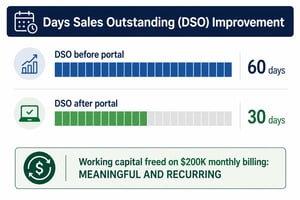
| Cash flow (DSO) | 45 to 60 days | 15 to 30 days |
| Subvendor matching | Manual weekly eyeballing | Auto matched before payment |
Where Does the DSO Improvement Come From?
How Does Velorona Fix Both Sides of the Invoice Problem?
Bidirectional reconciliation matches every subvendor invoice against approved hours before payment. Client portal auto delivery removes email from the equation. Zero manual transfer means approved timesheet hours become invoice line items automatically.
For deeper context, see automated invoicing for staffing firms and how to close the staffing cash gap.
Frequently Asked Questions
What is the most common cause of recruitment invoice disputes?
Either the client’s records do not match the agency’s invoice, or the invoice was never seen by the correct AP contact. Both are solved by a shared portal record with read receipts.
How does automated invoicing speed up payment?
By removing the manual verification step. Approved hours generate the invoice, the invoice goes to the portal, and the client accepts without a back and forth audit.
What is DSO and why does it matter?
Days Sales Outstanding measures the average days between invoicing and payment. High DSO directly reduces working capital for firms billing weekly.
Does Velorona run payroll?
No. It produces Payroll Details and prepares clean data for your payroll process. Payroll execution is a 2026 roadmap item.
Book a personalized demo at velorona.com/demo.