AI Recruitment Tools for Staffing Firms: 2026 Guide
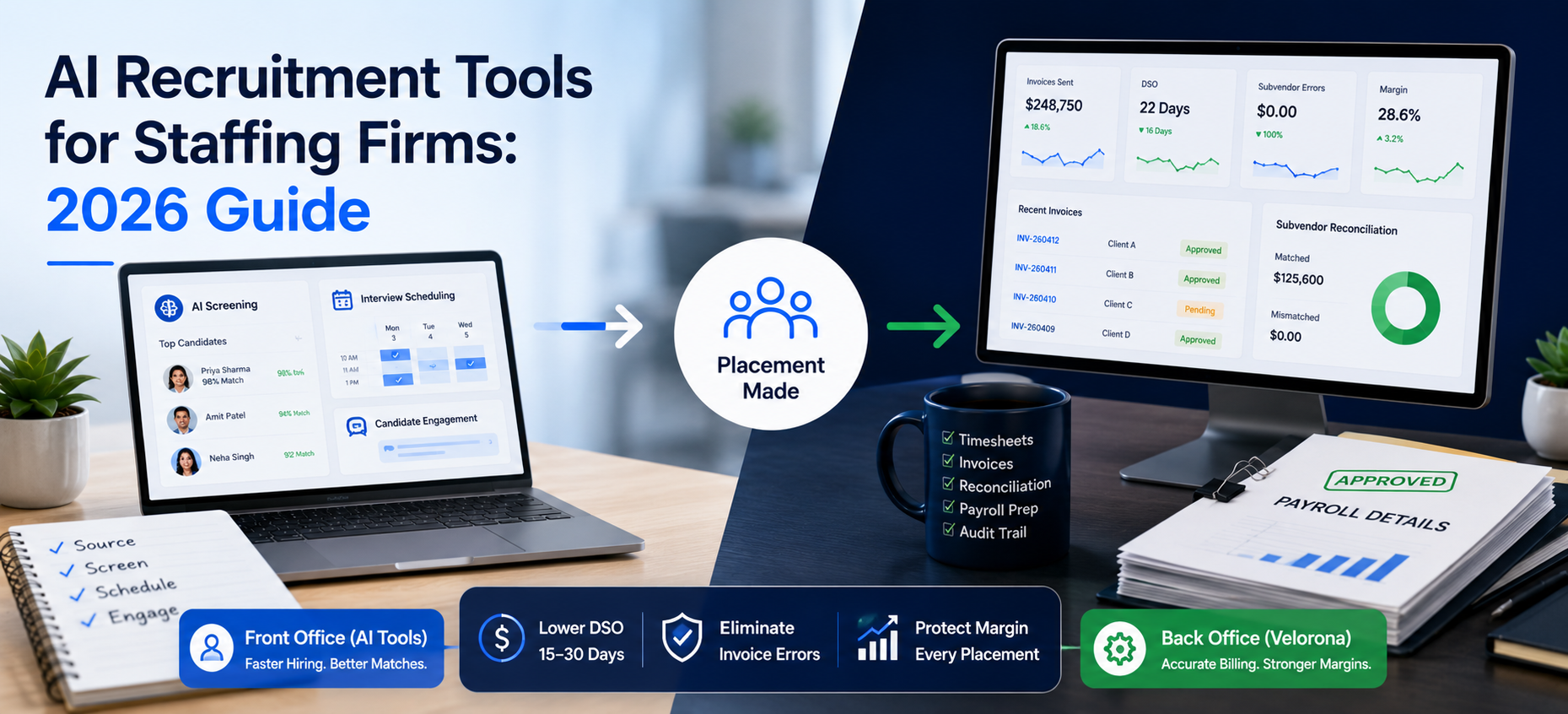
Quick answer: AI recruitment tools for staffing work in the front office for sourcing, screening, and scheduling. They do not fix the back office, where billing errors, DSO drag, and subvendor overbilling live. This guide separates what AI recruiting genuinely delivers from what gets oversold, and shows where a back office platform like Velorona fits after the placement.
What Does Each Category Actually Do?
Before evaluating any tool, it helps to be clear about which problem you are solving. The table below contrasts the two categories, and the sections that follow explain where each one earns its place.
| AI recruitment tools (front office) | Back office platform (Velorona) | |
|---|---|---|
| Problem solved | Screening volume, slow scheduling | Billing errors, DSO drag, subvendor overbilling |
| Where it operates | Sourcing, screening, scheduling | Post placement: timesheets, invoices, payroll |
| Key metric | Time to fill, cost per hire | DSO, subvendor error rate, margin per client |
According to Bullhorn industry research, AI adoption in staffing is now the baseline rather than the leading edge. However, broader analysis from the IBM Institute for Business Value notes that many AI projects stall. Often that happens because firms buy the wrong category for the problem they actually have.
Where Do AI Recruitment Tools for Staffing Genuinely Help?
AI helps most at the top of the funnel, where volume is high. Specifically, it speeds up screening, interview scheduling, and candidate communication. As a result, it reduces time to fill and recruiter hours per placement.
That is real value, and it is worth pursuing where the volume justifies it. Therefore AI recruitment tools for staffing clearly earn their place in the front office.
What Do AI Recruitment Tools for Staffing Not Fix?
AI recruiting does not generate your client invoice, match a subvendor invoice against approved hours, or prepare clean payroll data. Instead, those are back office functions. Consequently, a firm can have the best sourcing engine available and still leak $12,000 to $25,000 a year to subvendor invoice errors at $500K spend.
In other words, the front office fills the role, while the back office decides whether the placement is actually profitable.
How Should You Evaluate AI Hiring Compliance?
AI hiring tools carry real compliance obligations. For instance, the U.S. Equal Employment Opportunity Commission has issued guidance on automated systems in employment decisions. In addition, the Federal Trade Commission has warned about biased or opaque automated tools. Therefore you should evaluate any AI recruiting tool against that guidance before you buy.
Where Does the Back Office Fit?
After the placement, the work shifts to timesheets, invoices, reconciliation, and Payroll Details. Velorona handles that layer. Importantly, it is not an ATS and does not source or screen candidates.
For related reading, see staffing back office automation on one platform and what back office automation actually fixes.
Frequently Asked Questions
Does Velorona use AI to screen candidates?
No. Velorona is back office software. Therefore it does not source, rank, or screen candidates.
Can I use an AI recruiting tool and Velorona together?
Yes. Because they solve different problems, they work well side by side. AI recruiting handles the front office, while Velorona handles billing and payroll prep after the placement.
What is the back office ROI?
At $500K subvendor spend, reconciliation recovers $12,000 to $25,000 a year. Furthermore, portal delivery drops DSO 15 to 30 days in the first quarter.
Are AI hiring tools regulated?
They face growing scrutiny. Accordingly, review EEOC and FTC guidance on automated employment tools before buying.
Book a personalized demo at velorona.com/demo.