Beyond Candidate Profiles: What to Include in a Staffing Proposal
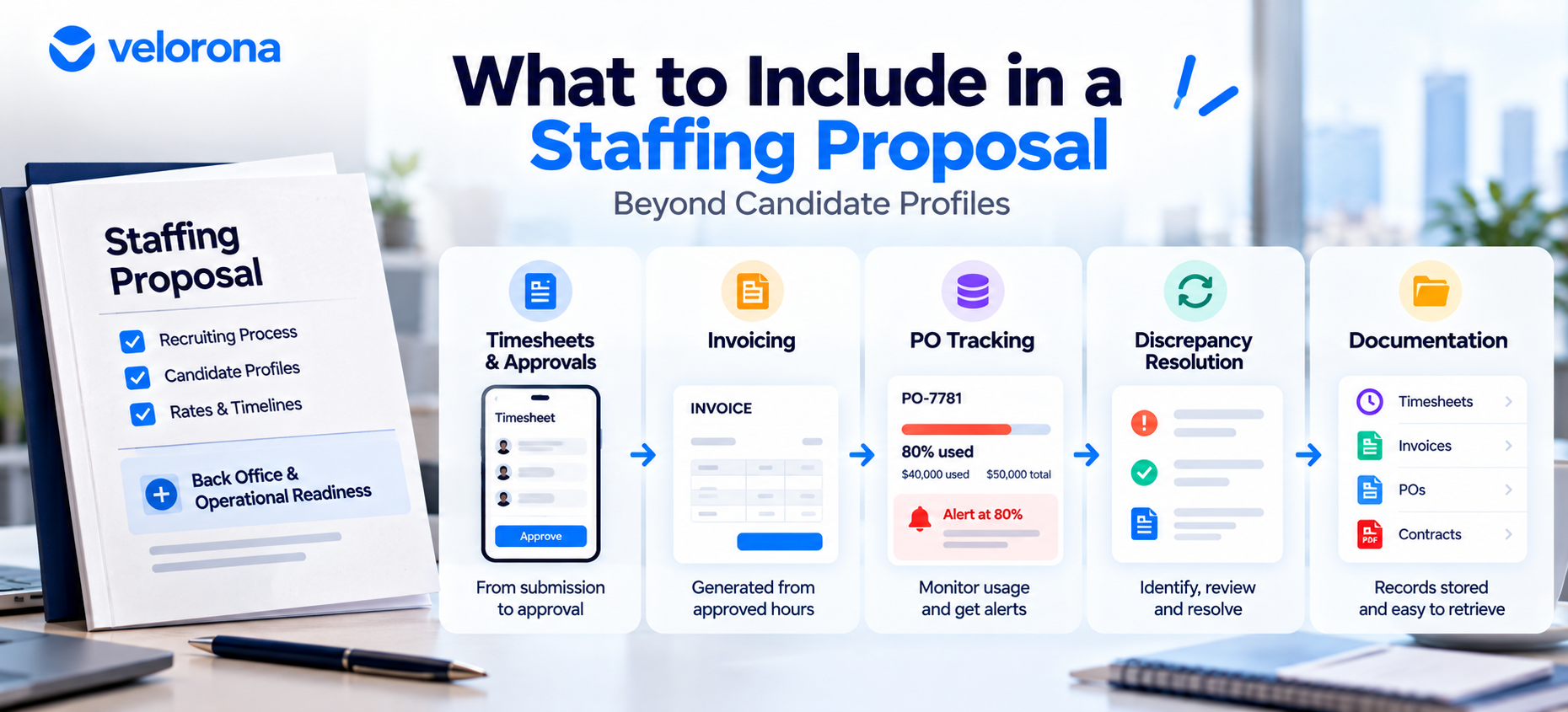
A strong staffing proposal covers recruiting and rates, then answers what finance and procurement ask next: how timesheets get approved, invoices get checked, POs get tracked, and records get retrieved. This guide covers what to include in a staffing proposal beyond candidate profiles, with example wording and a readiness checklist.
A staffing firm puts together a proposal for a mid-sized company that needs twelve contract developers over two quarters. The proposal is strong. It covers the recruiting process, the candidate pipeline, industry experience, rates, and how fast the first candidates can start.
Before signing, someone from finance or procurement asks a different question. How will timesheets get approved? How will invoices be generated, and how will we know they’re accurate? What happens when our purchase order nears its limit?
If the proposal doesn’t answer those, the firm may not lose the deal. But it left out information the client will need anyway, often after the contract starts, when the answers are harder to give.
What Do Staffing Proposals Often Overlook?
Most proposals are built around what’s easiest to sell: recruiting process, candidate quality, industry expertise, rate cards, and timelines. That makes sense, because recruiting is the service the client is hiring for. It also anchors most RFP responses. A request for proposal (RFP) is the document clients issue asking vendors how they would handle an engagement.
What gets less attention is what happens after placement. Areas that may deserve a paragraph or two:
- Timesheet submission and approval
- Invoice preparation and accuracy checks
- PO usage monitoring. A purchase order (PO) is the client’s authorization for a set amount of spend.
- Billing discrepancy handling
- Supporting documentation, such as approved timesheets and rate confirmations
- Audit or compliance record requests
- Sub-vendor management, for firms placing consultants through subcontracted vendors
None of these is required for every client. Some RFPs spell out exactly what they want in an operations or finance section. Others don’t ask at all. A proposal padded with unrequested detail gets longer without getting more useful. Address these areas where they matter.
Why Does Operational Readiness Matter After Placement?
Recruiting starts an engagement. Everything after that is operational, and it usually involves different people on the client side. Think accounts payable (AP), procurement, or finance, not the hiring manager who ran interviews.
A few situations come up often enough to plan for:
- The client’s finance team asks how approved hours become an invoice, and on what schedule.
- A PO nears its limit, and someone must flag it before an invoice goes over budget.
- The AP team returns an invoice and asks for a correction.
- A client requests supporting timesheets months later, for an audit or a routine check.
- A billing discrepancy surfaces, and someone must find its source.
Operational readiness doesn’t outrank recruiting. A firm that can’t find good candidates won’t get hired, however clean its invoicing is. But a firm that explains how it handles these situations gives the client something concrete to evaluate. For the procurement view, see what clients evaluate beyond recruiting.
What Should the Operational Section of a Proposal Include?
A short section, often half a page, can cover the areas most likely to come up. Give the reader enough detail to understand how the relationship will run. Skip a full description of internal process. Cover each area in two or three sentences, and describe only what the firm actually does.
Timesheet and Approval Workflow
Explain how consultants submit hours, who reviews and approves them, and how long that usually takes. Example: “Consultants submit hours weekly through a web or mobile portal. Hours move through a defined approval chain before they’re eligible for billing, and each approval is timestamped.” See Velorona’s timesheets.
Invoice Preparation and Accuracy
Explain how approved hours and agreed rates produce an invoice, and what gets checked before it’s sent. Example: “Invoices generate from approved hours and the client’s confirmed rates. Hours, rates, and PO references are checked before delivery.” Firms whose invoices build directly from approved hours can say so here.
PO Tracking
Explain how the firm monitors PO balances and what happens as a limit nears. Example: “PO usage is reviewed against invoiced amounts continuously. An alert fires as usage approaches the limit, so billing stays within what the client authorized.” For more, read how digital PO tracking prevents billing surprises.
Documentation and Record Retrieval
Explain where supporting records live and how fast you can retrieve them. Example: “Approvals and billing records carry a timestamped history and can be produced on request, including for audit review.” Audit readiness means producing documentation without a scramble when someone asks.
Billing Issue Resolution
Explain how a discrepancy gets identified, who reviews it, and how corrections happen. Example: “A flagged discrepancy is reviewed against the original approved hours and rate. We issue a corrected invoice once the source is confirmed.” A repeatable process backed by a timestamped record resolves disputes faster than rebuilding history from email. See How to Resolve a Wage Dispute in Minutes, Not Weeks.
Sub-Vendor Billing
Firms placing consultants through sub-vendors should explain how sub-vendor hours get approved and how sub-vendor invoices are checked against those approved hours before payment. Clients ask about this often in IT staffing, where multiple vendor layers are common.
How Do Weak Proposal Statements Compare to Stronger Ones?
Broad, reassuring language tells the reader very little. Use the stronger versions as examples only. Each firm should describe its actual process, and if the real workflow is simpler, the proposal should say so.
| Vague Statement | More Concrete Explanation |
|---|---|
| “We provide accurate invoicing.” | How invoices are checked against approved hours, rates, and PO details before sending |
| “We maintain proper records.” | How timesheets and billing records are organized, and how fast they can be retrieved |
| “We monitor POs.” | How usage is reviewed, and how an approaching limit is flagged |
| “We have an approval process.” | Who reviews timesheets, how approvals move up the chain, and how pending ones are followed up |
| “We resolve billing issues quickly.” | How a discrepancy is identified, assigned, reviewed, and corrected |
How Does a Connected Workflow Strengthen a Proposal?
A manual process reads as separate tasks, each done by a different person on a different schedule. A connected workflow reads as one chain, where each step feeds the next: timesheet submission, approval, invoice generation, reconciliation, documentation.
When these steps live in one system, a proposal can describe the whole chain in a few sentences. Records also don’t need rebuilding afterward, because the approval history sits next to the invoice it produced. The vendor hub is one example of that setup for sub-vendor work.
Software alone doesn’t connect every process, though. A firm might run a time-tracking app, a separate invoicing tool, and a spreadsheet for PO tracking, with manual handoffs between them. An honest section describes what’s actually linked. If timesheets are re-entered by hand, say so rather than implying automation that isn’t there.
What Readiness Checklist Should You Run Before Submitting?
Before sending a proposal, check these:
- Can we explain how timesheets get submitted and approved?
- Can we explain how approved hours become invoices?
- Can we describe how invoice accuracy is checked?
- Can we explain how PO usage is monitored?
- Can we retrieve supporting records when requested?
- Can we explain how billing discrepancies are handled?
- Can we demonstrate our process if the client asks?
- Are all operational claims accurate and verifiable?
- Have we followed the client’s specific RFP requirements?
The last item matters most. Shape the operational section around what the client asked for, and leave out sections nobody requested. For a demo script, see How to Show Clients Your Staffing Back Office.
How Can Velorona Help?
Velorona is back-office software for US IT staffing firms with 30–300 consultants. These capabilities relate directly to a proposal’s operational section:
- Timesheet approvals. Consultants submit hours on web or mobile, and hours pass through a timestamped approval chain before billing.
- Invoice generation. Approved hours convert into invoices at the client’s confirmed rates, without re-keying.
- Reconciliation. Sub-vendor invoices match against approved consultant hours, and mismatches flag before payment. See Bidirectional Invoice Reconciliation.
- PO tracking. Usage is tracked against invoiced amounts, with an alert at 80% of the limit.
- Multi-party chains. Sub-vendors approve their own consultants’ hours in a portal, and C2C billing runs through the same workflow.
- Visibility. Invoice status and margin by client, consultant, and vendor, plus timestamped audit logs.
These describe what the platform does today. Whether any of it belongs in a specific proposal depends on what that client’s RFP asks for.
What Should You Honestly Expect From Velorona?
The Team plan costs $10/month per user ($7 on annual billing), with no setup fees. Firms typically go live in 5 to 14 days. See the pricing page.
However, Velorona does not do the following today. QuickBooks Online synchronization sits on the roadmap, with CSV export covering the handoff. Stripe Connect payment through the portal also sits on the roadmap. SSO is in development. Payroll execution via Gusto Embedded targets Q4 2026, as does 1099-NEC auto-generation. Don’t promise any of these in a proposal. The FAQ page has current status.
One month free trial. No credit card required.
FAQ: Back-Office Content in Staffing Proposals
Should every staffing proposal include an operations section?
No. Follow the client’s RFP. Add one where the client asks, or where finance and procurement are likely to question the process.
How long should the operational section be?
Often half a page. Two or three sentences per area is enough.
Can I describe a process we haven’t fully built?
No. Describe only what the firm does today. If a step is manual, say so.
What do clients ask about most?
Invoice accuracy, PO usage, and how fast you can produce supporting records.
Does a strong operations section win the deal?
Not by itself. Clients also weigh talent, price, and references. It answers questions they would likely ask anyway.
What about sub-vendor billing?
Explain how sub-vendor hours get approved and how their invoices are checked before payment.
Answer the Question Before the Client Has to Ask It
A staffing proposal should start with what the client’s RFP asks for. Where it’s relevant, it can also explain how the firm manages work after placement. The aim isn’t a longer proposal. It’s an answer to a question finance and procurement will likely ask, ideally before the contract starts.
Book a 15-minute demo to see timesheets, approvals, invoicing, and PO tracking connected end to end. Or start a free 30-day trial, no credit card required.
Related reading: