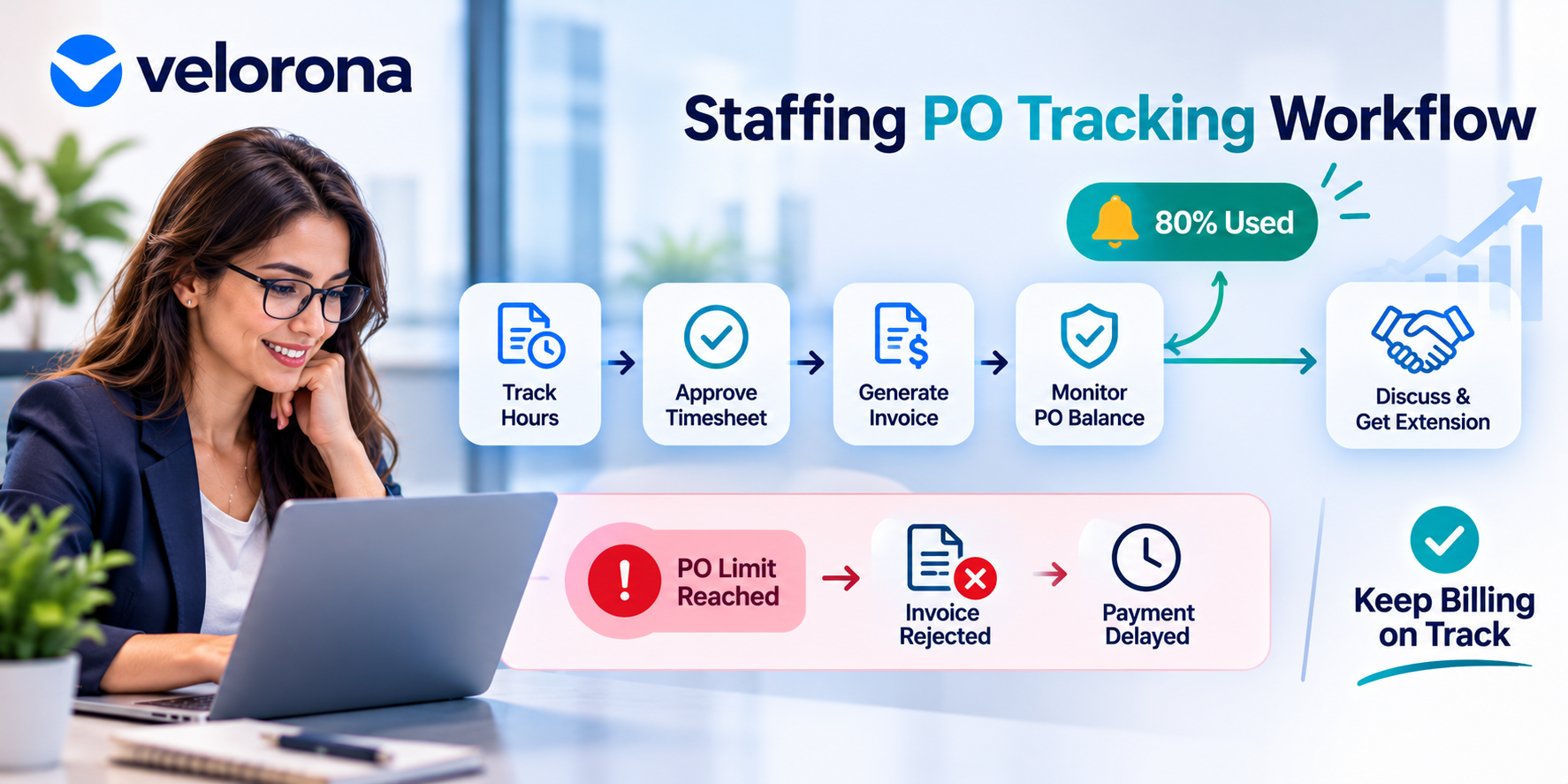
Staffing PO Tracking: How to Avoid Unexpected Billing Delays
Your consultants are still working. Their timesheets are approved. The engagement is ongoing. Then an invoice comes back with a message: “PO limit reached, please clarify.”
Now your finance team is reviewing purchase order (PO) records, your account manager is contacting the client, and the client’s accounts payable (AP) team is waiting for a revised invoice or updated authorization before processing can continue.
For staffing firms that bill against client-approved POs, this situation is familiar. The problem is not necessarily careless accounting. A PO’s approved amount may be consumed faster than expected, while the remaining balance goes unchecked until an invoice reaches the client.
What happens next depends on the client’s procurement policies, contractual terms, and approval process. An extension might be resolved quickly, or it might take considerably longer if additional approvals are required.
Either way, discovering the issue after an invoice is submitted puts the staffing firm in a reactive position.
Effective staffing PO tracking helps teams identify approaching limits early, contact clients before authorization becomes urgent, and reduce avoidable billing disruptions.
What Does a PO Limit Mean for a Staffing Firm?
A purchase order is a client’s authorization for a defined amount of spending, usually associated with a particular engagement or period.
For staffing firms, the PO may establish the approved spending limit for one consultant, several consultants, or a broader engagement. The specific arrangement depends on the client’s procurement process and agreement with the staffing firm.
As consultants work, their billable hours and applicable rates contribute to the amount charged against the authorization.
Several changes can cause the remaining balance to decrease faster than expected:
- A consultant works more hours than originally anticipated.
- An additional consultant starts working under the same PO.
- A billing rate changes.
- Overtime or an expanded scope increases expected charges.
- Multiple consultants draw against a shared PO.
These situations do not necessarily indicate that something has gone wrong. However, they make it important to monitor PO usage alongside approved hours and billing records.
Staffing firms should also understand the specific terms attached to each PO, including its authorized amount, covered period, applicable consultants, and renewal conditions.
Not every staffing engagement uses a PO, and clients do not all follow the same rules. Some use blanket POs, while others issue authorizations with narrower scopes or defined renewal periods. A reliable tracking process needs to account for those differences rather than assume every client operates identically.
Why Do Staffing Firms Discover PO Problems Too Late?
PO issues often develop gradually. The balance decreases over several weeks, but nobody recognizes how close the engagement is to its limit until the next invoice is prepared.
Common causes include:
- Infrequent spreadsheet updates: PO usage is recorded only when someone has time to update the tracking sheet.
- Disconnected systems: Timesheet, invoicing, and PO information are maintained separately, making the overall picture harder to see.
- Unclear ownership: No specific person is responsible for monitoring PO consumption and initiating client conversations.
- Last-minute checks: Finance reviews the remaining authorization only when preparing an invoice.
- Unrecorded changes: A rate or hours adjustment is not reflected in the PO tracking record.
- Unconfirmed extensions: A verbal discussion about additional authorization is never documented or formally confirmed.
The common issue is a gap between how quickly a PO is being consumed and how often the team checks its remaining balance.
A Hypothetical Example
Imagine a staffing firm has three consultants billing against a $120,000 annual PO.
Two consultants’ hours are recorded in one spreadsheet, while the third consultant is tracked separately because they joined the engagement later.
By week 30, the combined billing has reached the PO limit. However, because the records are maintained separately, nobody notices until the invoice for week 31 is flagged.
This example is illustrative, not a reported client result. It shows how fragmented tracking can make it difficult to understand total PO consumption across an engagement.
As a staffing firm manages more clients, consultants, and sub-vendors, maintaining a consolidated view becomes increasingly important.
What Happens When a PO Reaches Its Limit?
Once an engagement reaches or exceeds its authorized spending limit, the next steps depend on the client’s agreement and procurement process.
Possible consequences include:
- The client holds or rejects an invoice until the discrepancy is resolved.
- The client requests an updated PO, formal extension, or replacement authorization.
- The staffing firm’s finance team or account manager contacts the relevant client representative.
- The invoice moves through another review or approval cycle.
- Payment is delayed while the authorization issue is investigated.
- The client’s budget owner needs to clarify why spending has reached or exceeded the approved amount.
The exact outcome varies by client. A PO reaching its limit does not mean every subsequent invoice will automatically be rejected, but the firm should not assume that additional charges will be approved after the fact.
A PO warning is not authorization to exceed the approved amount.
If the remaining balance is insufficient for upcoming work, the staffing firm should clarify the next steps with the client and obtain the required written authorization before proceeding with additional charges, in accordance with the applicable agreement.
The earlier this conversation begins, the more opportunity both sides have to resolve the issue before it interrupts billing.
How PO Threshold Alerts Help Prevent Billing Delays
Rather than discovering a PO problem when an invoice is held, staffing firms can monitor usage and establish a warning threshold.
A threshold alert provides an early signal that the remaining authorization needs attention. It does not change the PO limit or guarantee an extension. Its purpose is to give the team time to review upcoming work and contact the client.
A practical PO monitoring process includes the following steps:
- Record the PO details. Document the authorized amount, covered period, applicable consultants, and renewal conditions.
- Track PO usage consistently. Use billing records, approved hours, and applicable rates to monitor consumption.
- Establish a warning threshold. Choose a level that allows enough time to discuss additional authorization.
- Assign responsibility. Identify who receives the alert and who is responsible for contacting the client.
- Review upcoming work. Compare the remaining balance with the expected charges for scheduled work.
- Contact the client early. Discuss whether an extension or replacement PO will be required.
- Document the outcome. Record the client’s response and confirm the necessary authorization before billing against an increased amount.
A Hypothetical Example: The 80% Warning
Suppose a staffing firm is tracking a $75,000 PO and uses an internal warning threshold of 80%.
When the tracked amount reaches $60,000, the team reviews the remaining $15,000 against upcoming work. If six weeks of scheduled work remain, the account manager contacts the client’s procurement representative to discuss whether additional authorization is needed.
This gives the client an opportunity to review the request before the current authorization is exhausted.
The figures are illustrative. The appropriate threshold depends on the engagement, consumption rate, and the client’s approval timeline.
As explained in How Digital PO Tracking Prevents Billing Surprises for Staffing Firms, the objective is to identify approaching limits before they become an urgent billing problem.
How to Choose the Right PO Warning Threshold
There is no single percentage that works for every staffing engagement.
A useful threshold gives the team enough time to identify the issue, review upcoming charges, and obtain any required client authorization before the remaining balance runs out.
Consider these factors when setting a threshold.
1. How Quickly Is the PO Being Consumed?
A PO supporting three full-time consultants may be used up faster than one supporting a single part-time consultant.
The warning threshold should reflect the expected pace of billing, not just the current balance.
2. How Frequently Is Usage Updated?
A tracking process updated regularly can provide a more current picture than one reviewed only at month-end.
If updates happen infrequently, the team may need a more conservative warning threshold to allow for the time between reviews.
3. How Long Does Client Approval Take?
Some clients can review an extension quickly. Others require multiple approvals from procurement, finance, or a budget owner.
The longer the approval process, the earlier the staffing firm should consider initiating the conversation.
4. Who Must Approve an Extension?
The account manager should know which client contact or department is responsible for PO extensions and whether additional documentation is required.
This helps avoid discovering an approval requirement only after the balance has been exhausted.
5. How Much Work Remains?
The remaining balance should be considered alongside the value of upcoming work.
A PO with 20% remaining might be sufficient for a short engagement but inadequate for several more weeks of scheduled billing.
A Hypothetical Threshold Comparison
Imagine one client typically takes three weeks to process a PO extension. The staffing firm may choose an earlier internal warning threshold, such as 70%, to allow time to start the conversation.
For another client with a faster approval process, a later threshold might be workable.
These are illustrative examples, not universal recommendations. The right threshold depends on actual usage, expected charges, and the client’s process.
Most importantly, crossing a threshold is a prompt to review and communicate. It does not authorize the firm to continue billing beyond the approved limit.
A Practical Staffing PO Monitoring Checklist
- Use this checklist as a starting point for an internal standard operating procedure (SOP).
2. Confirm the applicable PO limit and covered period.
3. Record PO start dates, end dates, and renewal conditions where relevant.
4. Identify the consultants and engagements covered by each PO.
5. Track usage consistently in a shared, accessible record.
6. Check how completed but not-yet-invoiced work affects the remaining authorization.
7. Establish a warning threshold based on expected usage and approval lead time.
8. Assign an owner for monitoring PO balances and responding to alerts.
9. Compare upcoming work with the remaining authorized amount.
10. Contact the client before the limit becomes an urgent issue.
11. Document extensions, replacement POs, and written approvals.
12. Confirm the correct PO reference and authorized amount before submitting each invoice.
The checklist is most effective when it becomes part of the regular billing workflow rather than an occasional month-end exercise.
Is Spreadsheet-Based PO Tracking Enough?
A spreadsheet is not automatically a bad way to track purchase orders. A well-maintained spreadsheet can work for a staffing firm that has a manageable number of engagements and a consistent update process.
The important question is whether the process reliably identifies approaching limits.
Review your current setup:
- How often are PO balances updated: daily, weekly, or only when invoices are prepared?
- Can finance and account managers see the same current balance?
- Is someone explicitly responsible for monitoring PO usage?
- Does the tracking account for completed work that has not yet been invoiced?
- Are rate and hours changes reflected in the tracking records?
- Is there a warning when a PO approaches its limit?
- Are extensions and replacement POs documented in a shared location?
- Can the team compare upcoming billing with the remaining authorization?
A spreadsheet may be sufficient if the information is accurate, regularly updated, visible to the right people, and supported by clear responsibilities.
The risk comes from a process without a clear owner, reliable updates, or a trigger to act before the authorization runs low.
As the number of engagements grows, connected workflows can help reduce the effort required to keep PO usage and billing records aligned.
How Velorona Supports PO Tracking and Staffing Billing
Velorona supports staffing firms with back-office workflows for timesheets, invoicing, PO tracking, and sub-vendor invoice reconciliation.
Several capabilities are directly relevant to monitoring purchase orders.
PO Balance Tracking With an 80% Alert
Velorona tracks PO balances and triggers an alert when 80% of the authorized amount has been reached.
This provides an early signal for the finance team or account manager to review the remaining balance and determine whether a conversation about additional authorization is needed.
The alert does not increase the PO limit, approve additional spending, or guarantee that the client will grant an extension. The necessary authorization still depends on the client’s process.
Learn more about Velorona’s invoicing workflow.
Invoicing From Approved Consultant Hours
Velorona supports invoice generation from approved consultant hours, reducing the need to rebuild billing information through a separate spreadsheet and manually re-enter the same details.
Its timesheet workflow includes Open, Submitted, Approved, and Rejected statuses, with approval and rejection actions timestamped.
This helps establish a structured connection between timesheet approval and invoice preparation. The firm must still verify that the applicable rates, PO details, and contractual billing requirements are correct.
Explore Velorona Timesheets.
Client Invoice Delivery and Activity Visibility
Velorona delivers invoices through a client portal alongside email and provides visibility into invoice activity, including when an invoice was sent, opened, reviewed, and approved.
This gives staffing teams a clearer record to consult when following up on invoice status.
It does not guarantee immediate client approval or change the agreed payment terms, but it can help clarify where an invoice stands in the client’s process.
Learn more about Velorona’s client workflows.
Sub-Vendor Invoice Reconciliation
For C2C engagements, staffing firms may also need to compare incoming sub-vendor invoices with the consultant hours they have approved.
Velorona’s Vendor Hub compares incoming sub-vendor invoices against approved consultant hours and flags mismatches for review before payment.
This supports a more structured reconciliation process for firms managing billing across multiple vendors.
Read more about Sub-Vendor Invoice Reconciliation: Best Practices.
What the Workflow Can—and Cannot—Do
These capabilities help teams track PO balances, connect approved hours with invoice preparation, and identify certain invoice mismatches.
They do not replace the need to maintain accurate PO records, verify applicable rates, follow contractual terms, or obtain authorization from the client.
The key benefit is earlier visibility: a warning that gives the team an opportunity to investigate and act before a PO limit becomes an unexpected billing obstacle.
Don’t Wait for the Invoice to Reveal the Problem
A PO limit does not necessarily become a billing problem because the engagement was managed poorly. It can become a problem because nobody noticed how quickly the remaining authorization was being consumed.
Staffing firms can reduce this risk by monitoring PO usage regularly, assigning responsibility for threshold alerts, reviewing upcoming work, and contacting clients before additional authorization becomes urgent.
The goal is not to predict every change in spending. It is to identify when the current authorization may no longer be sufficient and start the conversation early enough to respond.
Review your current process: Can your team identify an approaching PO limit before an invoice is held, or does the issue become visible only after the client flags it?
If you want to see how PO tracking fits into a staffing back-office workflow, book a Velorona demo.
Frequently Asked Questions
1. What is PO tracking in staffing?
PO tracking is the process of monitoring a client’s approved purchase order amount against the billing activity associated with an engagement. It helps staffing firms understand how much authorization remains and identify when they may need to contact the client about an extension or replacement PO.
2. Why is purchase order tracking important for staffing agencies?
Staffing firms may have several consultants billing against one PO, and their hours and rates can consume the approved amount over time. Monitoring usage helps teams identify approaching limits before an invoice is held or additional authorization becomes urgent.
3. What happens when a staffing firm’s client PO reaches its limit?
The outcome depends on the client’s procurement process and contractual terms. The client may hold an invoice, request updated authorization, or require an extension or replacement PO. Staffing firms should confirm the required next steps rather than assume that additional charges will be approved after the limit is reached.
4. What percentage should trigger a PO warning?
There is no universally correct threshold. The appropriate percentage depends on how quickly the PO is being consumed, how often records are updated, the amount of work remaining, and how long the client takes to approve an extension. The threshold should provide enough time to review the situation and contact the client.
5. Does an 80% PO alert mean a staffing firm can continue billing?
No. An 80% alert is a warning that the PO is approaching its limit. It does not increase the approved amount or authorize additional charges. The staffing firm must follow the applicable agreement and obtain any required authorization from the client.
6. Can staffing firms track POs in a spreadsheet?
Yes. A spreadsheet can work if balances are updated consistently, the information is accessible to the relevant team members, and someone is responsible for reviewing usage and taking action. As operations grow, disconnected records and manual updates can make it harder to maintain a reliable view across engagements.
7. How often should staffing firms review PO balances?
The review frequency should reflect the pace of billing and the time required to obtain additional authorization. Faster PO consumption or longer client approval timelines may require more frequent monitoring. The important thing is to identify potential shortfalls early enough to respond.
8. How does Velorona help with staffing PO tracking?
Velorona tracks PO balances and triggers an alert at 80% of the authorized amount. It also supports invoice generation from approved consultant hours, client invoice activity visibility, and reconciliation of incoming sub-vendor invoices against approved hours. These capabilities support the billing workflow but do not authorize spending beyond a PO limit.
9. Does a PO alert automatically request or approve an extension?
No. The alert signals that the PO balance needs attention. The staffing firm must review expected usage, contact the relevant client representative, and follow the client’s process for obtaining any required extension or replacement authorization.
10. What should a staffing firm do when a PO is nearly exhausted?
Review the current balance against upcoming work, confirm the applicable PO terms, and contact the client or designated approver to discuss the next steps. Document the response and obtain the required authorization before billing against an increased amount or proceeding with additional charges where authorization is required.