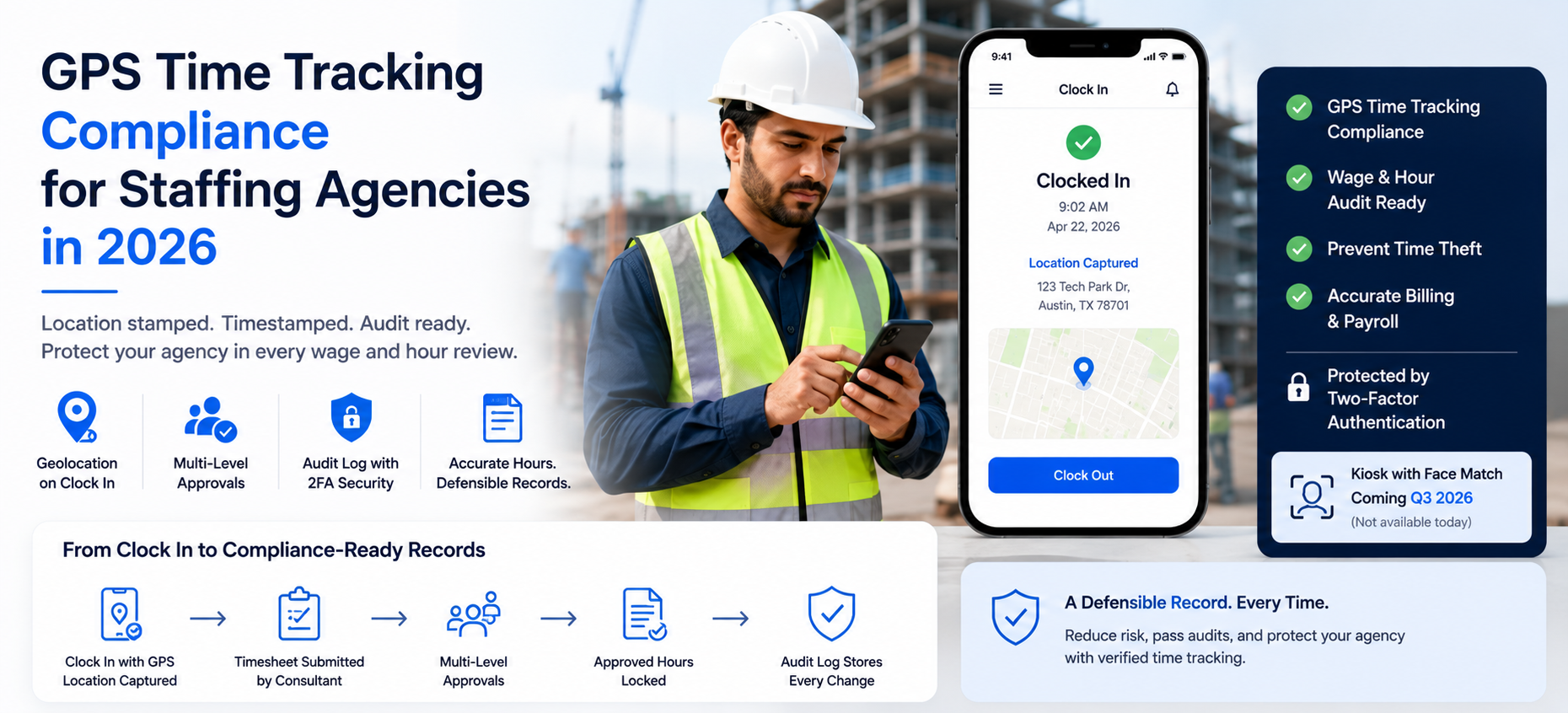
Quick answer: GPS time tracking compliance gives staffing agencies a location stamped, timestamped record of work that holds up in a wage and hour review. Velorona records geolocation on clock in, routes hours through multi level approval, and stores every change in an audit log protected by two factor authentication. Note that kiosk attendance with photo and face match is a Velorona roadmap item targeted for Q3 2026, not a live feature today.
Why Is Accurate Time Capture the Foundation of GPS Time Tracking Compliance?
For staffing agencies, accurate time capture is legal security. When you track hours using manual or honor system logs, you leave the agency exposed to three risks.
First, wage and hour disputes are hard to defend without a verifiable trail. Second, geographic complexity grows when workers span cities or states with different rules. Third, audit vulnerability rises when records can be altered. The U.S. Department of Labor sets clear recordkeeping expectations under the Fair Labor Standards Act.
How a Clock In App Supports GPS Time Tracking Compliance
A clock in app captures geolocation at check in. That gives the agency a record that a worker logged hours at the assigned site during the logged time. This data supports both tax auditors and labor reviews, and it is far stronger than a self reported paper log.
What Verified Controls Does Velorona Offer Today?
Velorona reduces compliance risk with controls that are live now, not promised. Geolocation on clock in records where each shift started. Multi level approval routes each timesheet to the right approver, so hours are reviewed before they reach billing or payroll.
The audit log captures every submission, edit, approval, and rejection with a timestamp, protected by two factor authentication. Configured pay rules apply the correct rate per assignment, so overtime logic is consistent rather than recalled from memory. Together, these controls produce a defensible record. A wage claim that once took days to reconstruct resolves in minutes from the audit log.
Manual Logging vs Verified Digital Tracking
| Compliance factor | Manual spreadsheets | Velorona (verified, live today) |
|---|---|---|
| Audit defense | Weak, easy to alter | Strong, timestamped and location stamped |
| Approval | Informal | Multi level approval workflow |
| Record integrity | Self reported | Audit log with two factor authentication |
| Location verification | None | Geolocation captured on clock in |
| Rate application | Manual, error prone | Configured pay rules per assignment |
What Does Velorona Not Claim About Compliance?
Honesty about scope matters for compliance content. Velorona does not perform automatic tax filing, real time tax adjustment, or any guarantee of total compliance. Compliance depends on your policies, your counsel, and the applicable jurisdictions.
Kiosk attendance with photo and face match is targeted for Q3 2026. It is not available today. Because biometric capture carries privacy obligations, the Federal Trade Commission has warned businesses to handle biometric information carefully. If a vendor claims live AI facial recognition, ask for a demonstration in your environment before buying.
How Does Verified Tracking Help During an Audit?
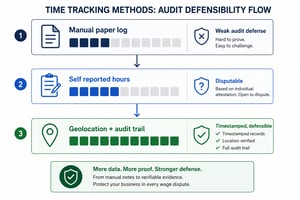
A digital trail gives every clock in a timestamp and a geolocation point. Standardized records replace fragmented paper files with a searchable database. The same approved hours then flow into invoices and subvendor reconciliation, so billing and pay rest on the same verified record. For related reading, see how to stop time theft with modern clock in out software and payroll accuracy for staffing firms.
Frequently Asked Questions
Is GPS tracking legal for employee timekeeping?
Generally yes, when used for legitimate business purposes such as verifying hours, with transparency and consent in the handbook or contract. Check your jurisdiction.
Does Velorona have facial recognition today?
No. Kiosk attendance with photo and face match is targeted for Q3 2026. Today’s controls are geolocation on clock in, multi level approval, and the audit log.
Does Velorona calculate or file taxes automatically?
No. It produces Payroll Details and feeds verified hours to your payroll process. It does not file taxes or adjust withholdings in real time.
How does it help with remote workers?
It captures geolocation on clock in and keeps a timestamped record, so you can bill clients accurately while maintaining a defensible log.
Book a personalized demo at velorona.com/demo.