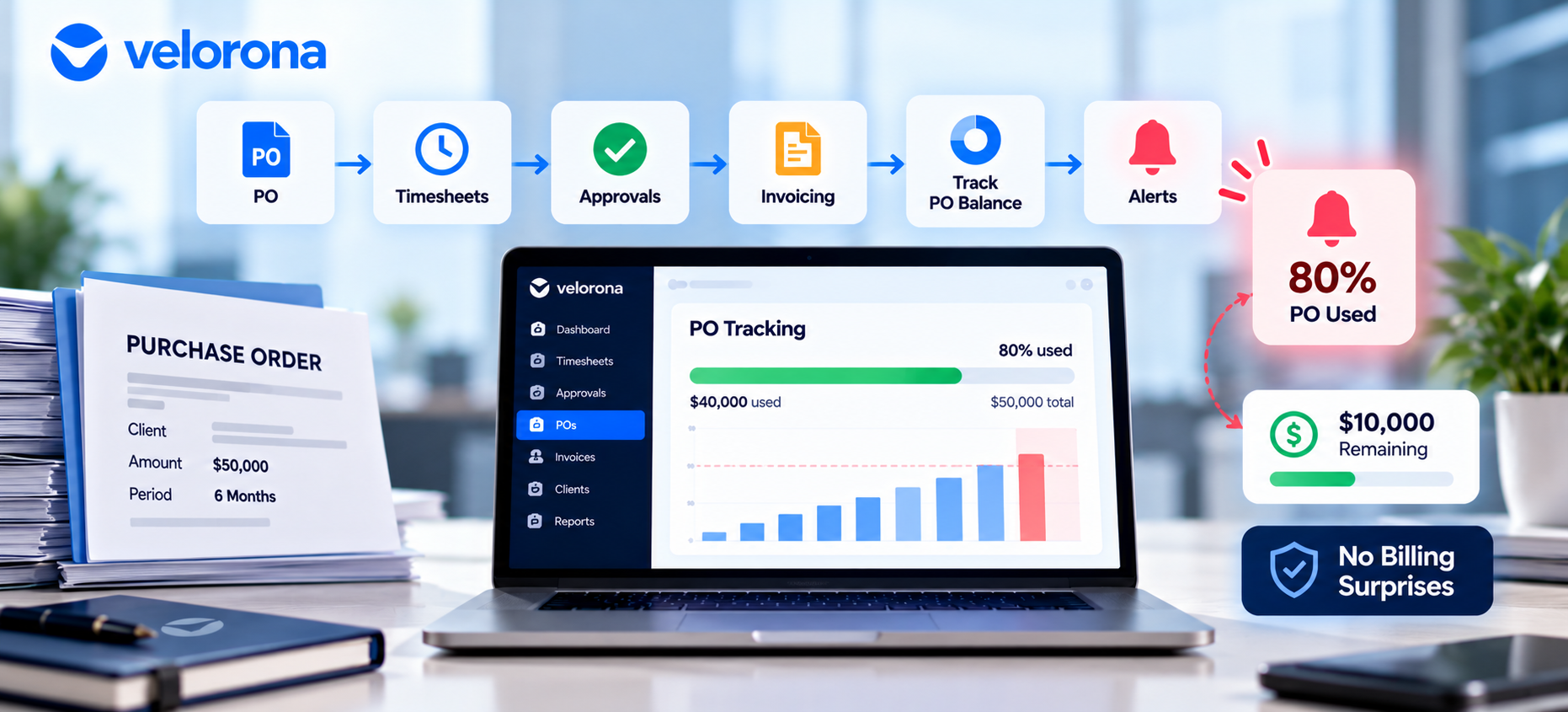
Billing surprises happen when a staffing firm invoices a client for more than the client’s purchase order allows, or when the client can’t easily verify how the billed amount was calculated. Digital PO tracking prevents this by monitoring approved hours and invoice activity against the PO balance, then alerting the team before the approved budget is exhausted.
The invoice that starts a fight
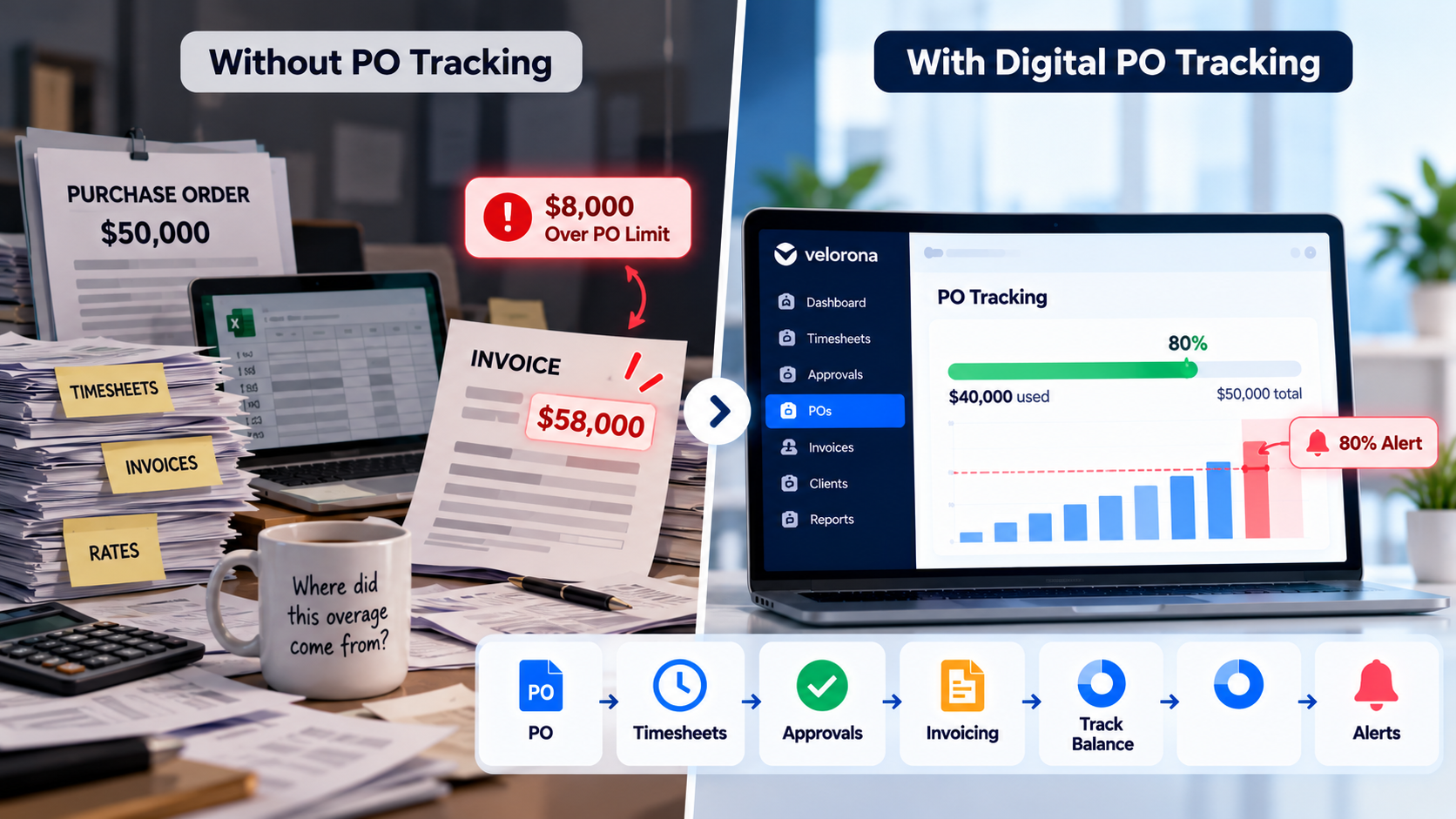
Imagine a client approving a $50,000 purchase order for a six-month staffing engagement. Three consultants log hours against it every week, but nobody monitors the running balance closely.
By month five, the staffing firm sends an invoice that is $8,000 above the approved PO amount.
Now the client’s finance team is asking questions. The account manager is scrambling to explain the overage. The controller is pulling timesheets from multiple spreadsheets to determine where the difference came from. The client, who approved a specific budget and expected billing to remain within it, starts questioning the reliability of the entire process.
The problem is not only the $8,000. It is the surprise.
A disputed invoice can slow payment while the client reviews the charges. It can create extra work for the controller and account manager. It can also make future renewal conversations more difficult because the client now wants additional assurance that billing will remain under control.
For staffing firms managing multiple consultants, sub-vendors, and manual timesheet approvals, this risk increases as the number of billing inputs grows.
Why PO overages happen
The root problem is usually visibility, not a lack of effort.
Many staffing firms manage purchase orders in spreadsheets or separate documents. Timesheets may be approved weekly, invoices may be generated monthly, and the PO balance may be updated only when someone remembers to check it.
That creates a gap between the moment work is performed and the moment the firm realizes that the approved budget is nearly exhausted.
The risk becomes greater when:
- Several consultants bill against the same PO.
- Different billing rates apply to different consultants.
- Sub-vendors submit invoices separately.
- Timesheets and invoices are managed in different systems.
- Approvals are handled through email.
- The client changes the scope or extends the engagement without immediately updating the PO.
A PO that looks healthy in week three can be nearly exhausted by week ten if hours, rates, and invoices are not monitored together.
How digital PO tracking works
Digital PO tracking connects the purchase order to the timesheet and invoicing workflow instead of storing it in a separate spreadsheet.
The process typically works as follows:
- The PO amount is entered into the system and linked to the client and engagement.
- Approved consultant hours are recorded against the relevant assignment.
- The system calculates invoice activity against the remaining PO balance.
- Alerts are triggered when spending reaches a defined threshold, such as 80% of the PO.
- The staffing firm can discuss an extension, scope change, staffing adjustment, or new PO before the existing budget is exhausted.
- Invoice and approval records provide a clearer audit trail for both the staffing firm and the client.
The goal is to move from “we discovered the overage after the invoice was rejected” to “we saw that the PO was approaching its limit and started the budget conversation early.”
An 80% alert does not prevent an overage by itself. It creates enough visibility and lead time for someone to take action.
 What this changes for staffing firms
Fewer avoidable invoice disputes
When invoices are created from approved hours and billing activity can be reviewed against the PO, there is less room for confusion about how the amount was calculated.
This does not eliminate every dispute. Clients may still challenge rates, hours, expenses, scope, or approval decisions. However, a connected record makes those questions easier to investigate.
Earlier budget conversations
A warning at 80% gives the account manager and client time to decide what happens next:
- Extend the existing PO.
- Issue a new PO.
- Reduce or pause staffing.
- Change the engagement scope.
- Approve a revised billing arrangement.
The important point is timing. The conversation happens while the firm and client still have options, rather than after an invoice has already exceeded the approved amount.
Less manual reconciliation
A controller should not have to combine timesheets, rate sheets, sub-vendor invoices, and PO spreadsheets manually every month to determine whether billing is accurate.
A connected workflow can reduce repetitive reconciliation by linking approved hours to invoice creation and monitoring the available PO balance.
The exact time savings will vary by firm, billing volume, number of consultants, and level of process standardization.
More predictable payment processing
Invoices that contain accurate approved hours and clear supporting records are generally easier for a client’s finance team to review.
Digital delivery and invoice-status tracking can also help clarify whether an invoice was sent, viewed, reviewed, or approved. This reduces uncertainty when someone asks whether the invoice reached the client.
Faster payment is not guaranteed, however. Client payment terms, procurement rules, approval delays, and AP procedures also affect how quickly an invoice is paid.
Stronger renewal discussions
Consistent billing does not replace a good delivery experience, but it can remove one source of friction from the client relationship.
When clients are not repeatedly surprised by overages or missing invoice information, renewal discussions can focus more on staffing performance, business outcomes, and future needs.
Bringing Velorona into the workflow
Velorona’s invoicing workflow includes PO balance tracking and alerts at 80% consumption. This helps staffing firms identify potential overages before the approved budget is exhausted.
The platform generates invoices from approved consultant hours and supports matching sub-vendor invoices against approved hours so that mismatches can be identified before payment.
Velorona also delivers invoices through a client portal and email, with visibility into invoice delivery and status. This creates a clearer record when a client questions whether an invoice was received, reviewed, or approved.
For a staffing firm managing C2C engagements, the benefit is connecting several steps that are often handled separately:
- Consultant time approval.
- PO consumption monitoring.
- Invoice generation.
- Client delivery.
- Sub-vendor invoice review.
- Payment and approval tracking.
That connected process can make billing easier to audit and help the firm identify problems earlier.
The improvement also comes from the broader automated billing workflow, not PO tracking alone.
What digital PO tracking does not replace
Digital tracking supports billing control, but it does not replace financial judgment or client communication.
A system can alert the team that a PO is approaching its limit. It cannot decide whether the client should approve more budget, whether the scope has changed, or whether a consultant’s hours are commercially justified.
Staffing firms still need clear procedures for:
- Approving timesheets.
- Setting billing rates.
- Handling rate changes.
- Reviewing expenses.
- Managing scope changes.
- Requesting PO extensions.
- Resolving disputed hours.
- Confirming sub-vendor invoices.
The technology makes those processes more visible and consistent. It does not remove the need to manage them.
The real cost of staying manual
Spreadsheet-based PO tracking may appear inexpensive, but the cost often appears elsewhere:
- Controller hours spent reconciling billing after the fact.
- Account-manager time spent explaining unexpected charges.
- Payment delays while clients investigate invoices.
- Duplicate or inconsistent records.
- Sub-vendor discrepancies discovered too late.
- Renewal conversations that begin with questions about billing reliability.
If your firm has experienced even one unexpected PO overage this year, treat it as a process signal rather than only an isolated mistake.
Ask:
- When is the PO balance currently updated?
- Who receives the warning when the budget is nearly consumed?
- Can approved hours be traced directly to the invoice?
- Are sub-vendor invoices compared with approved consultant hours?
- Can the team verify when an invoice was sent, viewed, or approved?
- How much time does the controller spend investigating billing discrepancies?
The objective is simple: identify the risk while there is still time to act, not several days after the invoice has already surprised the client.
Final takeaway
Digital PO tracking helps staffing firms replace after-the-fact billing investigations with earlier visibility. By connecting approved hours, invoice activity, PO thresholds, client delivery, and sub-vendor review, it can reduce preventable surprises and support more predictable billing conversations.
For firms managing multiple consultants or C2C sub-vendor relationships, the practical value is not simply automation. It is knowing how much of the approved budget has been used, what remains, and when the client needs to be involved, before a billing issue becomes a relationship issue.
Frequently asked questions
What is digital PO tracking for staffing firms?
Digital PO tracking connects a client’s purchase order balance directly to approved timesheets and invoices, so the remaining budget updates automatically as hours are logged, instead of being tracked separately in a spreadsheet.
What does an 80% PO alert do?
An 80% PO alert notifies the account manager and relevant team members once billed activity reaches 80% of the approved purchase order amount, giving time to discuss a PO extension, scope change, or staffing adjustment before the budget is exhausted.
Does digital PO tracking guarantee faster payment?
No. It supports faster payment by reducing invoice disputes and improving visibility, but actual payment speed still depends on the client’s payment terms, procurement rules, and internal approval process.
Does PO tracking replace the need for client communication?
No. PO tracking surfaces the warning that a budget is nearly consumed, but staffing firms still need clear processes for approving hours, handling rate changes, and discussing scope or budget changes with the client.