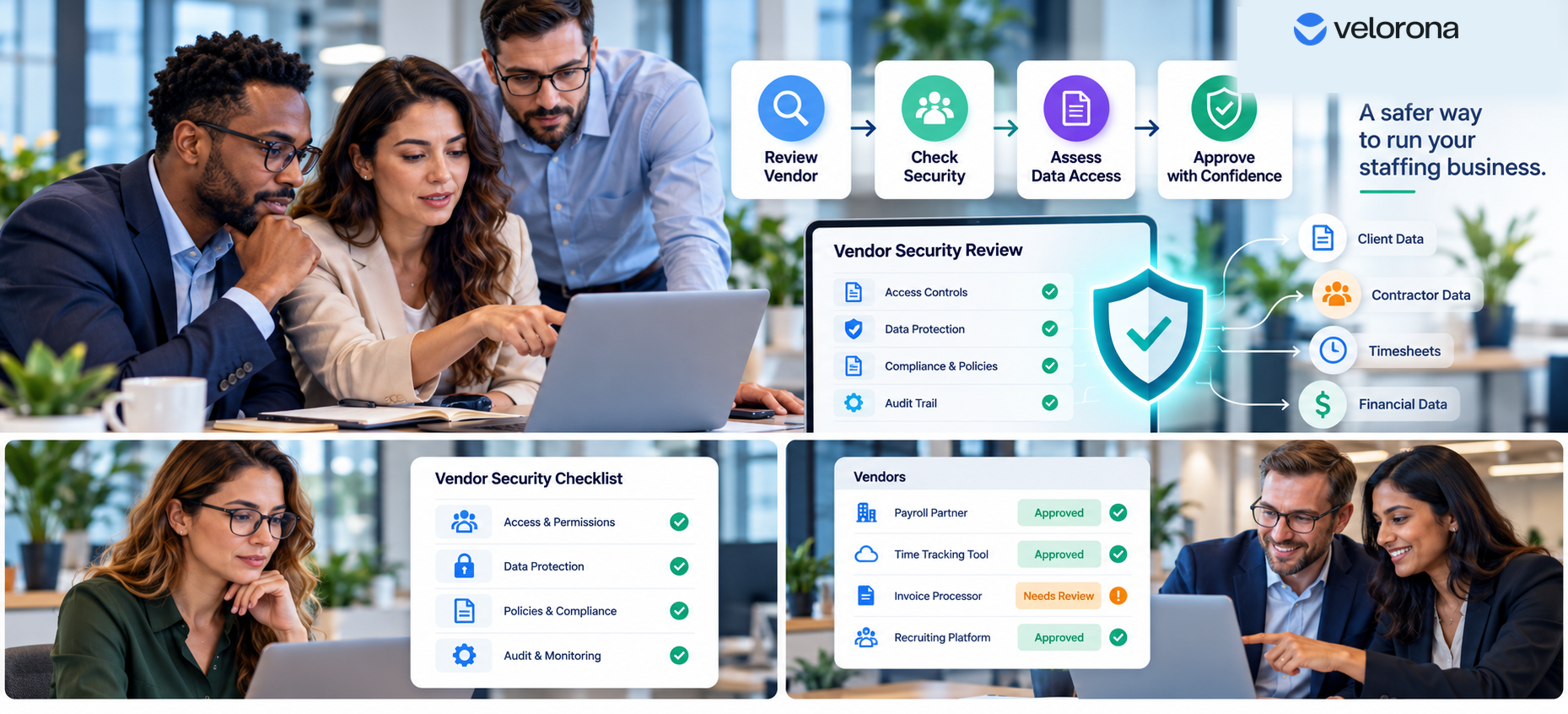
Why a Security Questionnaire Almost Cost Him a $200K Contract
Larger clients increasingly run vendor security reviews before signing asking about audit logs, access controls, and two-factor authentication, even for staffing partners. A firm that can’t answer clearly and quickly looks riskier than one that can, regardless of how good its placements are. This is the vendor security review gap most staffing firms don’t know they have until a deal stalls because of it.
The deal was close to done. Rates were agreed. Consultants were identified. The timeline was set.
Then the client’s procurement team sent over a vendor security questionnaire. It was the same one they sent to every vendor handling any part of their operations. It didn’t matter whether that vendor was a software company or a staffing partner.
The questions weren’t complicated on their face. Do you use two-factor authentication for system access? Is there an audit log of who accessed what, and when? How is consultant timesheet and payment data protected?
However, the honest answers weren’t reassuring. Approvals happened over email. Data lived in spreadsheets shared over Google Drive. Access control amounted to “whoever has the link.” There was no real answer to “who accessed this data and when” beyond checking email send times.
The client’s security team flagged the vendor as higher-risk. It wasn’t disqualified outright. However, the review got delayed six weeks for follow-up. During that window, a competing firm with a cleaner answer to the same questionnaire got a serious look instead.
Why Would a Staffing Firm Face a Security Review at All?
This is a relatively recent but accelerating shift. Larger clients the kind consolidating vendor relationships and running formal procurement processes increasingly treat any vendor handling sensitive data as a security consideration, not just a service consideration.
A staffing firm holds exactly this kind of data: names, rates, hours, and payment information for every consultant placed. Consultant personal information, billing records, and payment details all carry the same weight in a security review as a software vendor’s customer data would.
What Makes This Different From a Standard Vendor Check
Most staffing firms expect procurement to check rates, references, and placement history. Security reviews check something else entirely. They check whether the systems behind those placements protect the data flowing through them. A firm can have excellent consultants and a clean placement record and still fail this specific check, because the check isn’t about the people it’s about the infrastructure.
How Do Weak Security Answers Compare to Strong Ones?
The following table shows the specific gap between an answer that stalls a review and one that clears it:
| Vendor Security Concern | Weak Answer | Strong Answer |
|---|---|---|
| Access control | “Whoever has the shared link” | Role-based access, individually authenticated |
| Two-factor authentication | Not in use | Standard on all accounts |
| Audit trail | “We can check email if needed” | Timestamped log of every access and action |
| Data storage | Spreadsheets, shared drives | Structured system with defined access controls |
| Response time to questionnaire | Requires internal scramble first | Answered directly, with evidence, on the same call |
A firm that answers these questions clearly, quickly, and with actual evidence not a promise to “look into it” clears this step in days. A firm that can’t clears it in weeks, if at all. In a competitive process, weeks are often the deciding factor.
What Actually Changed the Outcome for This Firm?
The firm didn’t rebuild its entire operation to pass a security review. It adopted a back-office system that had two-factor authentication and audit logging built in as standard. Nothing needed construction from scratch under deadline pressure.
A few months later, a different prospective client sent a similar questionnaire. This time, the answers were straightforward. Yes, 2FA is standard. Yes, every approval and access is logged with a timestamp. Here’s what that log looks like.
The Cost of Stalling on a Security Review
Per Velorona’s analysis of staffing firm sales cycles, vendor security reviews that stall on unclear or negative answers commonly add weeks to a sales cycle not days. That’s enough time, in a competitive process, for a client to seriously consider or default to an alternative vendor with a cleaner answer.
The American Staffing Association notes that operational reliability increasingly factors into how clients evaluate staffing partners, alongside placement quality and rate. A security review is one of the clearest, most measurable versions of that evaluation because the answer is either yes or no, with evidence.
Is This Only Relevant for Very Large Clients?
It’s most visible with larger, more process-driven clients. However, the underlying trend keeps spreading downward as security awareness becomes standard practice across companies of many sizes.
The Connection to Winning Deals on Visibility
This connects to the same pattern covered in The Staffing Firms Winning RFPs Aren’t Winning on Price. In both cases, the deciding factor isn’t rate or consultant quality. It’s whether the firm’s operational infrastructure inspires confidence or raises questions during evaluation.
The Same Audit Trail, Two Different Uses
The audit log that resolves an internal wage dispute quickly is the same audit log that answers a client’s security questionnaire confidently. We cover the internal dispute side in Staffing Firm Audit Trail: Resolve Wage Disputes in Minutes, Not Weeks. One system serves both purposes, because the underlying need is the same: a verifiable, timestamped record of who did what and when.
Why Does a Security Questionnaire Reveal More Than Just Software Choices?
A security questionnaire response reflects the entire back-office process, not just which tool a firm happens to use. Consider what each honest answer actually reveals:
“Approvals happen over email” reveals that timesheet and invoice approvals lack a documented, timestamped trail. That’s the same gap that makes wage disputes take weeks instead of minutes.
“Data lives in shared spreadsheets” reveals that consultant and billing data has no access control beyond a shared link. Anyone with that link can view sensitive payment information, regardless of whether they should.
“We can check email if needed” reveals that there’s no real audit trail just a manual reconstruction process that happens after the fact, if someone remembers to look.
Each of these answers signals the same underlying issue: informal processes with no documentation. A security review simply makes that issue visible to a client before the relationship even starts.
What Should a Firm Prepare Before the Next Security Questionnaire Arrives?
Four questions worth answering honestly, before the questionnaire lands:
Can you state clearly, with evidence, whether two-factor authentication is standard across your systems? Not “we should probably turn that on” an actual yes, with the ability to show it.
Is there an actual audit log not a promise to check email for who accessed sensitive data and when? This needs to exist before the question gets asked, not get built in response to it.
Is consultant and billing data stored in a system with defined access controls, or in shared spreadsheets and drives? “Whoever has the link” is not an access control. It’s the absence of one.
Could you answer a security questionnaire in the same call, or would it require a scramble afterward? The scramble itself is often what costs the weeks — not the underlying gap, but the time spent trying to construct an answer under deadline pressure.
If the honest answer to more than one of these is uncertain, it’s worth addressing before a deal is on the line and a competitor is one clean answer away from winning it instead.
How Does This Connect to the Rest of the Back Office?
A vendor security review isn’t a standalone hurdle. It’s a visible symptom of the same gaps that show up elsewhere:
Timesheet and invoice approvals need the same audit trail that a security review asks about. When every approval action gets timestamped and tied to a verified individual through 2FA, the answer to “is there an audit log” becomes an immediate yes.
Sub-vendor and client data needs the same structured storage a security reviewer expects. When sub-vendor rates, W-9s, and agreements live in a vendor hub with defined access controls rather than a shared drive the answer to “how is this data protected” has actual substance behind it.
Client-facing operations need the same verifiable trail. A client portal that logs every invoice delivery, view, and approval demonstrates the same operational maturity a security reviewer is checking for and doubles as the visibility that wins RFPs in the first place.
What Should You Honestly Expect and What Isn’t Ready Yet?
Velorona handles timesheets with multi-level approval and time locking, sub-vendor invoicing with bidirectional reconciliation via the vendor hub, client portal auto-delivery with read receipts, multi-currency invoicing (USD/INR with FX lock), expense tracking, time-off, schedules, payroll details, bulk timesheet approval, and audit logs with 2FA on every approval action.
The Team plan costs $10/month per user ($7/month on annual billing), with no setup fees and no implementation cost. Firms typically go live in 5 to 14 days. Full plan details sit on the pricing page.
What Isn’t Available Today
However, Velorona does not do the following today. QuickBooks Online integration targets Q3 2026; until then, use CSV export for clean matched data. Stripe Connect for online invoice payment also targets Q3 2026. SSO is currently in development. Public API and Zapier integration target Q3 2026. Payroll execution via Gusto Embedded targets Q4 2026. 1099-NEC auto-generation targets Q4 2026 as well. The FAQ page covers additional details.
One month free trial. No credit card required.
FAQ: Vendor Security Reviews for Staffing Firms
Do all clients run security reviews on staffing vendors?
Not all. However, the practice is increasingly common among larger, more process-driven clients. It’s also becoming more common overall as security awareness spreads across company sizes.
What’s the minimum a firm should have in place to answer confidently?
Two-factor authentication as standard. A genuine audit log of system access and approvals. Structured, not spreadsheet-based, storage of sensitive consultant and billing data. These three form the baseline most reviews ask about directly.
How much time can a weak security answer add to a sales cycle?
Based on the pattern described here, commonly several weeks. That’s enough time, in a competitive process, for a client to seriously evaluate or default to an alternative.
Is this the same audit trail relevant to wage disputes?
Yes. The same timestamped record of approvals and access serves both purposes resolving internal disputes quickly and answering external security questionnaires confidently. We cover the wage dispute use case in Staffing Firm Audit Trail: Resolve Wage Disputes in Minutes, Not Weeks.
Does adopting a more secure system guarantee passing every review?
No. Reviews vary by client and can include requirements beyond what any single vendor addresses. However, a clear, evidence-backed answer to the standard questions removes the most common reason reviews stall.
How quickly can a firm get 2FA and audit logging in place?
Firms typically go live with Velorona in 5 to 14 days, with no setup fees. The 2FA and audit trail are standard from day one not a separate configuration project to build before the next questionnaire arrives.
Don’t Wait for the Questionnaire to Find the Gap
A vendor security review doesn’t ask anything unusual. It asks whether a firm’s back office matches the same operational standard a software company would need to meet. Most staffing firms discover the gap only when a deal stalls because of it and by then, a competitor with a cleaner answer is already ahead in the process.
Book a demo of Velorona and see the audit log and access controls your firm can point to the next time a security questionnaire lands on your desk. Not ready for a full demo? Claim 2 Months 100% FREE Premium Plan instead no credit card required, live in 5 to 14 days.
Related reading:
- The Staffing Firms Winning RFPs Aren’t Winning on Price
- Staffing Firm Audit Trail: Resolve Wage Disputes in Minutes, Not Weeks
- How One Staffing Sales Call Closed on the Demo Alone
- How Sub-Vendor Invoice Errors Cost Your Staffing Firm $12,000 to $25,000 Every Year
- Your Client Said They Never Got the Invoice. Again.
- The Complete Guide to Staffing Agency Back Office Software