Multi-Tier Sub-Vendor Management: How to Win 3-Party IT Staffing Placements
Most staffing back-office tools assume a simple two-party relationship: a client and a vendor. Real IT staffing deals often run through a sub-vendor chain three parties deep client, staffing firm, sub-vendor, sometimes a sub-sub-vendor and tools built for the simple case break down the moment a placement enters that kind of sub-vendor chain. Firms that can manage a sub-vendor chain natively win placements competitors have to turn away.
Why Do Most Tools Break Down on a Sub-Vendor Chain?
The request came in through an existing client’s procurement team: they needed a specialized consultant, fast, and their preferred vendor a mid-size staffing firm didn’t have anyone available with the specific skill set. That firm knew a sub-vendor who did. And that sub-vendor, in turn, sourced the actual consultant through a smaller specialty shop they worked with regularly.
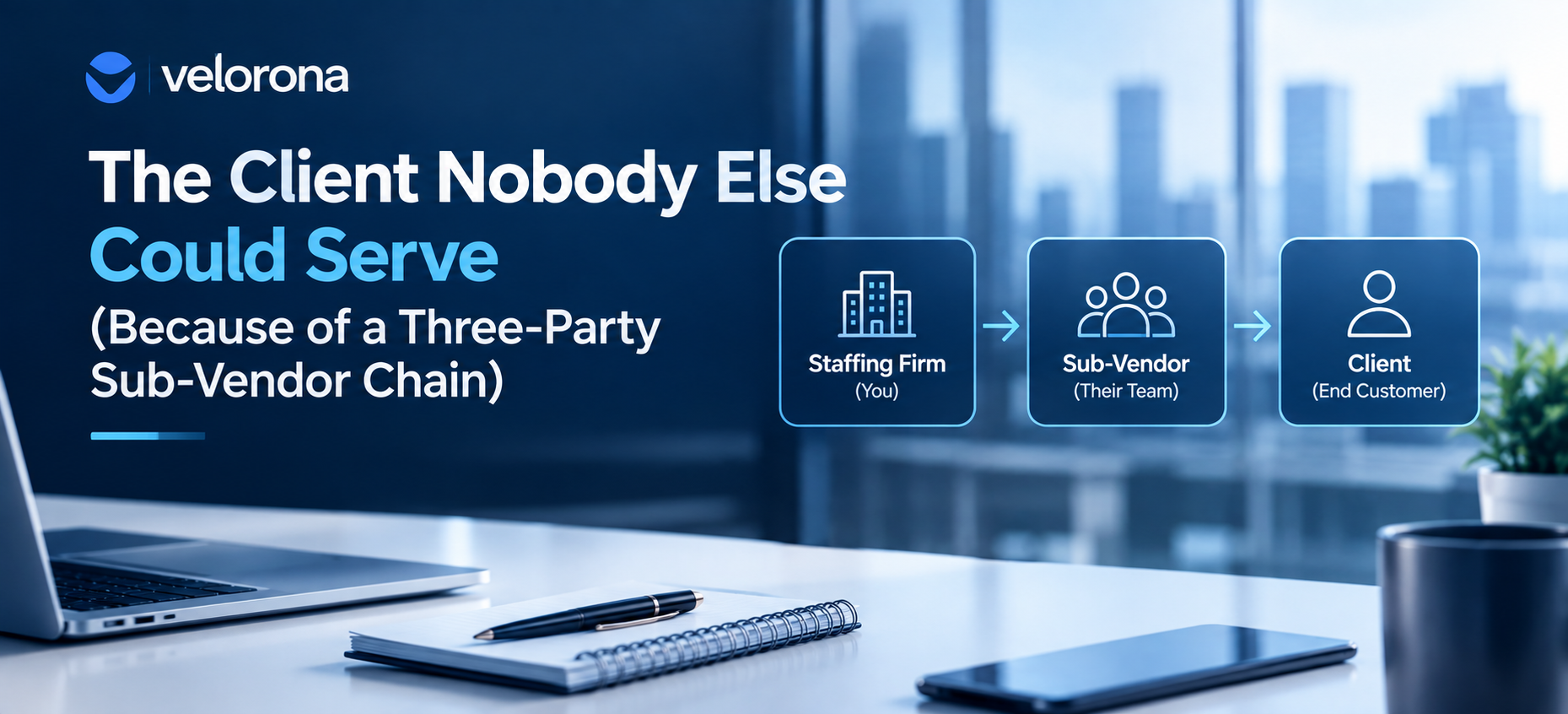
So the chain looked like this: end-client, paying the staffing firm; staffing firm, paying the sub-vendor; sub-vendor, paying the sub-sub-vendor, who actually employed the consultant. Three parties deep, not two.
The staffing firm’s existing back-office tool had no way to represent this. It was built around a single vendor relationship one invoice out, one invoice in. The moment a second layer of sub-contracting entered the picture, someone had to track the second layer manually, in a spreadsheet, alongside the system that was supposed to be handling exactly this.
Why Do Most Tools Only Handle Two Parties?
Most staffing and back-office software and virtually all general-purpose invoicing tools are built around a straightforward assumption: a client pays a vendor, the vendor does the work or subcontracts it informally, end of chain. That assumption holds for a large share of placements. It breaks down specifically in IT staffing, where sourcing a specialized consultant quickly often means going through a sub-vendor’s own network, which itself may include another layer of sub-contracting.
| Two-Party Assumption | Multi-Tier Native Support | |
| Client → Firm invoicing | Handled | Handled |
| Firm → Sub-vendor invoicing | Handled | Handled |
| Sub-vendor → Sub-sub-vendor invoicing | Manual, outside the system | Handled natively |
| Reconciliation across all tiers | Requires manual cross-referencing | Automated at every tier |
| Margin visibility across the full chain | Requires assembling data from multiple sources | Visible end to end |
When the second tier lives outside the system, two things get harder simultaneously: reconciliation (checking that hours billed at each tier actually match what was worked) and margin visibility (knowing what’s actually being retained after paying through two layers of sub-vendors, not one).
What Happened When This Firm Could Handle the Chain Natively?
The firm took the placement something they wouldn’t have been able to do cleanly six months earlier, when a three-party chain would have meant building a manual tracking process outside their existing tools just for this one client relationship.
Every tier logged hours and invoices in the same system: the sub-sub-vendor’s consultant submitted time, the sub-sub-vendor invoiced the sub-vendor, the sub-vendor invoiced the staffing firm, and the staffing firm invoiced the end-client all reconciled automatically at each step, all visible in one place. The end-client never saw any of this complexity. They saw a single, reliable invoice and a consultant who showed up and did the work.
Original data point: For firms without native multi-tier support, placements requiring a second sub-vendor layer are commonly declined or handled through an ad hoc manual process outside the primary system meaning the placement either doesn’t happen, or happens with meaningfully higher reconciliation risk than a standard two-party arrangement.
Why Does This Become a “Win More Clients” Story, Not Just an Operations Story?
Clients with recurring, complex sourcing needs — the ones consolidating vendor relationships, the ones asking for specialized skill sets on short notice are exactly the clients worth winning and keeping. A firm that has to say “we can’t take that one, it’s too complicated to track” is turning away precisely the kind of placement that pays well and builds a deeper relationship, specifically because it was hard for a less-equipped competitor to fill.
This connects to the same visibility dynamic covered in the story about staffing firms winning RFPs on operational capability rather than price the ability to handle a complex chain cleanly is itself a form of operational visibility a client notices, even if they never see the mechanics directly.
What Should a Firm Check Before Assuming Its Tools Can Handle This?
- Can a sub-vendor’s own sub-vendor submit and get paid through the same system, or does that require a workaround outside it?
- Is margin visible across the full chain, or only at the first tier (client to firm)?
- Does reconciliation happen automatically at every tier, or only at the first one?
- If a client asked about a placement three tiers deep, could the firm answer confidently and quickly?
FAQ: Multi-Tier Sub-Vendor Support
How common are three-party (or deeper) sub-vendor chains in IT staffing? Common enough that it’s a recurring pattern rather than a rare edge case, particularly for specialized or urgent placements where a firm’s direct network doesn’t have the specific skill set immediately available.
Does handling multiple tiers native change how invoicing works for the end-client? No the end-client relationship stays simple regardless of how many tiers exist behind it. The complexity is fully absorbed by the system, not passed along to the client.
What happens to margin visibility across a longer chain? With native multi-tier support, margin at each tier and the combined margin across the full chain is visible in the same place, rather than requiring separate reconciliation for each layer.
Is this only relevant for very large staffing firms? No, it comes up for firms of many sizes whenever a specific placement requires sourcing through a sub-vendor’s own network rather than a firm’s direct consultant pool.
How is this different from standard sub-vendor invoice reconciliation? Standard reconciliation typically assumes one layer (firm to sub-vendor). Multi-tier support extends the same reconciliation logic to additional layers beneath that, which most tools don’t account for at all.
Sources & Further Reading
- The Staffing Firms Winning RFPs Aren’t Winning on Price
- The $18,000 Leak He Didn’t Know About Until He Looked
Book a demo of Velorona and see how a three-party (or deeper) sub-vendor chain gets reconciled automatically, not manually.