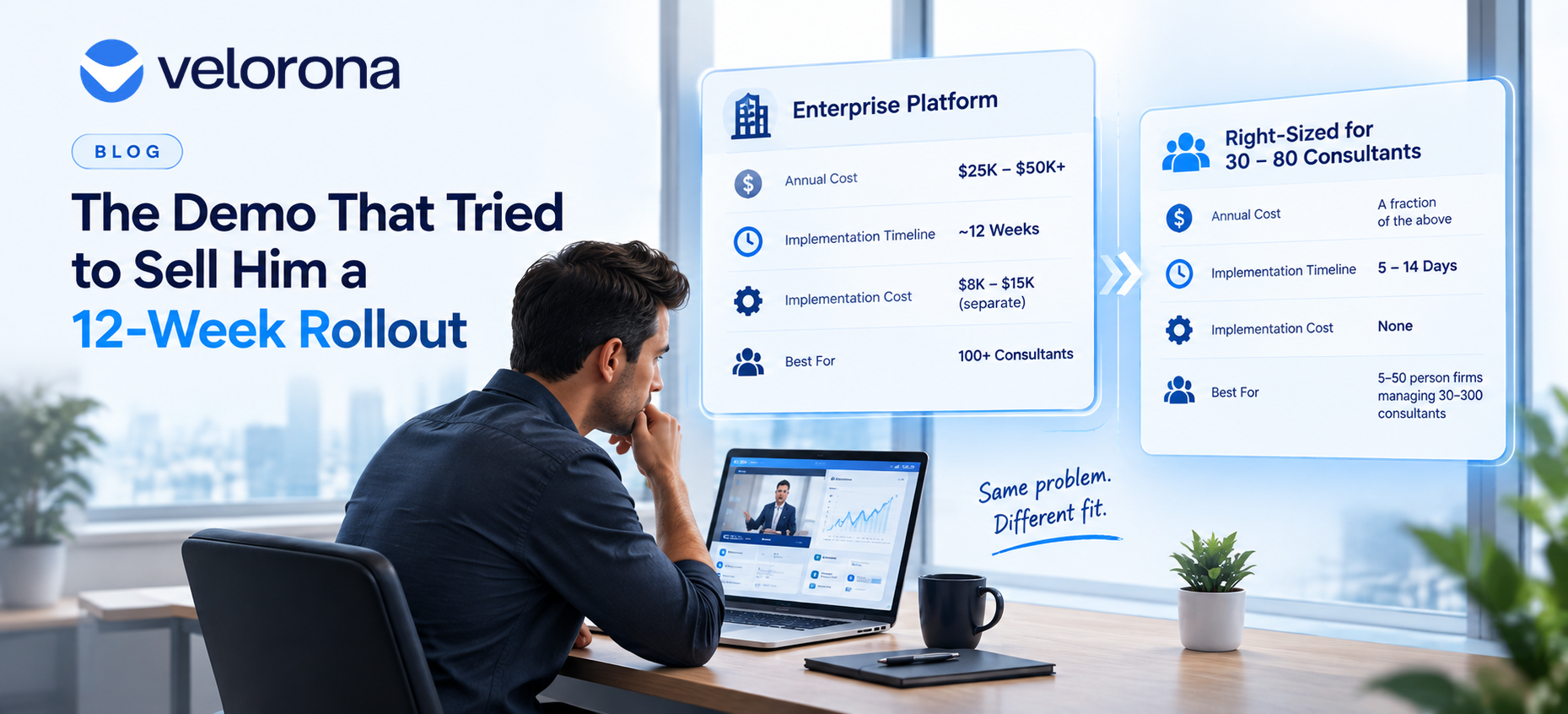
The Demo That Tried to Sell Him a 12-Week Rollout
Enterprise staffing platforms are built for firms running 100+ consultants, priced accordingly, and implemented on a matching timeline. A 40-consultant firm evaluating them isn’t wrong to want the visibility they offer but the price and rollout time are built for a business three times its size, not the one actually asking.
Why Did an Enterprise Demo Feel Wrong for a 40-Consultant Firm?
The problem was real: spreadsheets weren’t cutting it anymore, and the owner had heard good things about one of the established enterprise staffing platforms the kind of name that shows up whenever anyone asks what “real” staffing software looks like. He booked a demo, expecting to see whether it fit.
The sales rep walked through the platform for forty-five minutes, and it was genuinely impressive deep reporting, extensive configuration, integrations with almost anything. Then came pricing: a number well into five figures annually, plus a separate implementation fee. Then came timeline: a 12-week onboarding process involving a dedicated project manager, several rounds of configuration calls, and a phased rollout across departments.
He asked, half-joking, whether there was a faster or lighter version for a firm his size. The answer, politely, was no this was the platform, built for firms with the complexity and headcount to justify it. His 40 consultants and 8-person internal team weren’t really the target customer, even though nobody had said that directly until he asked.
Why Are Enterprise Staffing Platforms Priced and Built the Way They Are?
Platforms in this category are generally built for firms running 100 or more consultants, where the complexity of the operation multiple offices, dozens of internal staff, deep integration needs genuinely justifies both the price and the implementation effort. The twelve-week rollout isn’t padding; it reflects real configuration work for an operation with that much complexity to model.
| Enterprise Platform | Right-Sized for 30-80 Consultants | |
| Typical annual cost | $25,000-$50,000+ | A small fraction of that |
| Implementation timeline | ~12 weeks | 5-14 days |
| Implementation cost | Often $8,000-$15,000 separately | None |
| Built for | 100+ consultant operations | 5-50 employee firms managing 30–300 consultants |
The mismatch isn’t that enterprise platforms are bad. It’s that a firm significantly smaller than their target customer ends up paying for configuration depth and support infrastructure it doesn’t need yet, on a timeline built for a much larger rollout than its own operation requires.
What Does the Same Underlying Need Look Like at a Smaller Scale?
The core need reconciled invoicing, sub-vendor tracking, margin visibility doesn’t disappear at 40 consultants. It’s just as real as it is at 150. What differs is the amount of organizational complexity around it: fewer departments to coordinate, fewer integration points, a much shorter path from “we need this” to “this is live.”
Original data point: Firms in the 30-80 consultant range that evaluate enterprise staffing platforms commonly report the same reaction described here the platform solves the right problem, but the price and rollout timeline are calibrated for an operation two to three times their current size.
A tool built specifically for this smaller range can address the same core needs reconciliation, sub-vendor tracking, client visibility without requiring the twelve-week onboarding process or the five-figure commitment that comes with configuring for much larger operations.
Why Does Choosing the Right-Sized Tool Matter for Growth, Not Just Cost?
The twelve-week implementation isn’t just an inconvenience during that entire window, the firm is still running on the same spreadsheets and email that created the problem in the first place. A tool that’s live in 5-14 days starts solving the reconciliation and visibility problem almost immediately, while the enterprise alternative is still in configuration calls.
This connects to the pattern covered in the story about the ceiling every staffing firm hits around 50–60 consultants the firms that get through that growth stage cleanly are the ones that adopt structure quickly, not the ones stuck waiting out a long enterprise rollout while the underlying problem keeps compounding.
What Should a Firm Ask Before Committing to an Enterprise Platform?
- Does the pricing and implementation timeline match the firm’s actual current size, or the vendor’s typical (larger) customer?
- Is there a lighter option that solves the same core problem reconciliation, sub-vendor tracking, client visibility without the enterprise configuration overhead?
- What does the firm’s operation look like during the implementation window, and is that an acceptable amount of time to keep running the current, already-strained process?
- Is the firm evaluating this platform because it’s genuinely the right fit, or because it’s the most well-known name in the category?
FAQ: Choosing Between Enterprise and Right-Sized Staffing Software
Are enterprise staffing platforms bad tools? No they’re well-built for the operations they’re designed around, generally 100+ consultant firms with the organizational complexity to match. The mismatch is about fit, not quality.
At what size does an enterprise platform typically make more sense? Commonly once a firm is operating well past 100 consultants, with enough internal departments and integration needs that the platform’s depth and implementation process actually map to real organizational complexity.
Does a faster implementation mean a less capable tool? Not necessarily a shorter implementation timeline often reflects a tool built for less organizational complexity to configure around, not a tool with fewer core capabilities for the problem it’s solving.
How should a smaller firm evaluate whether it’s being sold the wrong tier of software? If a sales conversation involves multi-week configuration calls, a dedicated project manager, and pricing well into five figures for a firm under 80 consultants, it’s worth asking directly whether a lighter-weight option exists for the same core need.
Is it common to outgrow a right-sized tool and need to move to an enterprise platform later? It can happen as a firm scales well past 100 consultants and organizational complexity grows accordingly but that’s a different, later decision point than the one facing a 30-80 consultant firm today.
Sources & Further Reading
Start your free trial of Velorona live in 5-14 days, no implementation fee, no twelve-week rollout.