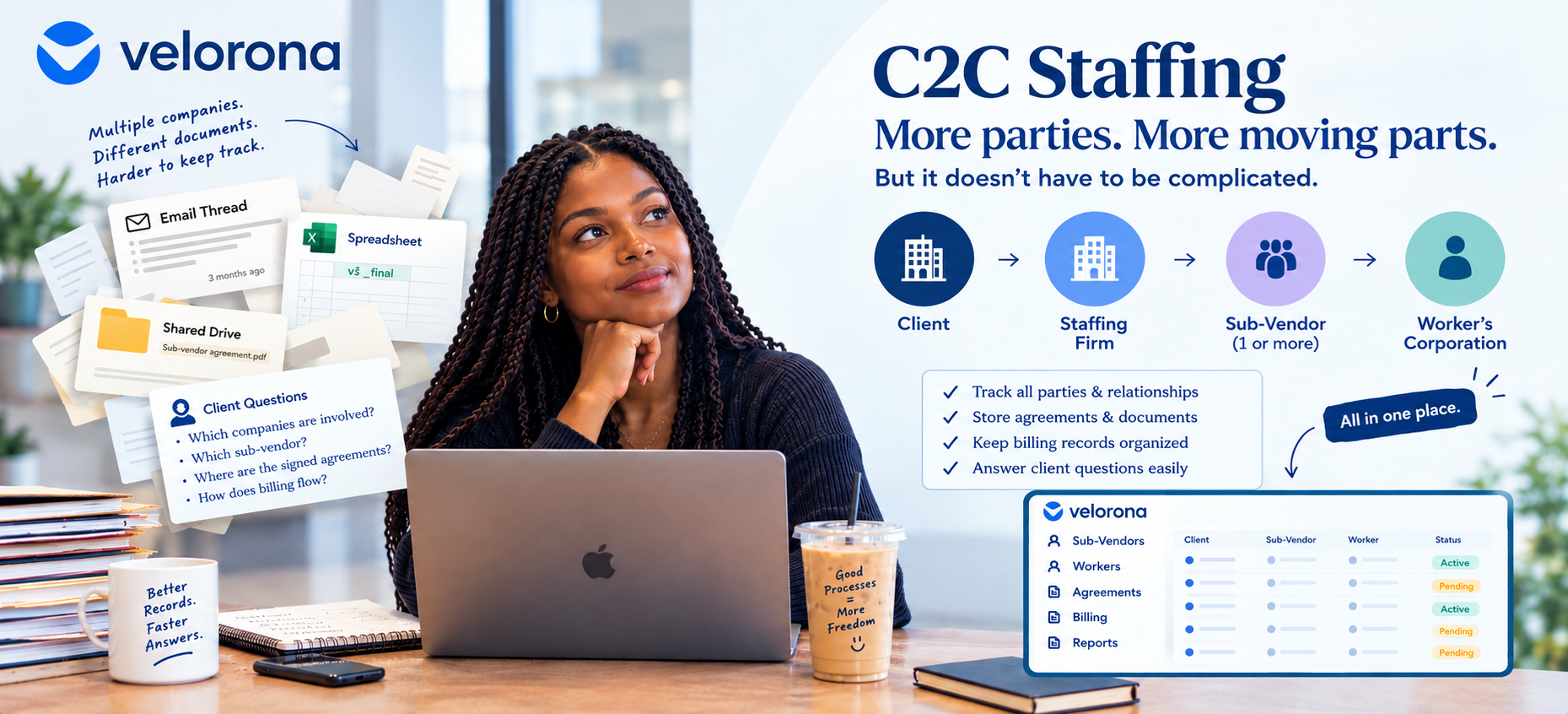
C2C Staffing: How Digital Sub-Vendor Visibility Works
A client’s compliance contact emails with a few questions: Which companies are involved in this engagement? Which sub-vendor is this consultant working under? Where are the signed agreements? Can you confirm how billing flows between the parties?
You know the answers exist. They’re just not in one place. The sub-vendor agreement is in a shared drive. The worker’s assignment details are in an email thread from three months ago. The current billing arrangement is in someone’s head, or buried in a spreadsheet tab labeled “v3_final.”
None of this means anything is wrong. It just means answering a straightforward question takes longer than it should, and that it depends on whoever happens to remember where things are filed.
This is the core challenge in C2C (Corporate-to-Corporate) staffing arrangements: as more companies get involved, keeping track of who’s who and where the records live gets harder. This article looks at why that happens, what clients typically want to understand about a C2C relationship, and how staffing firms can organize their own records well enough to answer those questions without a scavenger hunt.
What Is C2C Staffing?
Instead of a staffing firm employing the worker as a W-2 employee, the worker operates through their own corporation (or an LLC/S-corp). That corporation then contracts with another business sometimes the staffing firm directly, sometimes a sub-vendor in between.
A simple version looks like this:
Client → Staffing Firm → Worker’s Corporation
A more layered version introduces one or more sub-vendors companies that sit between the staffing firm and the worker, often because they sourced the worker, hold a relationship with that worker’s corporation, or have their own contractual arrangement with the staffing firm:
Client → Staffing Firm → Sub-Vendor → Worker’s Corporation
In practice, some engagements add a second or third sub-vendor layer. Others have none at all. The number of parties, the contractual structure, and who invoices whom can vary significantly from one engagement to the next there’s no single standard arrangement, and the right structure depends on the specific deal, the client’s requirements, and applicable rules in that state or industry.
Each additional company in the chain adds a relationship to track: a contract, a point of contact, a billing rate, and documentation that needs to stay current. That coordination is manageable with one or two sub-vendors. It gets noticeably harder as a firm takes on more C2C engagements across more clients.
The number of parties, the contractual structure, and who invoices whom can vary significantly from one engagement to the next. There’s no single standard arrangement. The right structure depends on the specific deal, the client’s requirements, and applicable rules in that state or industry.
Why C2C and Sub-Vendor Management Can Become Complicated
Any single C2C placement is manageable on its own. The complication shows up at scale, when a firm is running dozens of these arrangements across different clients, sub-vendors, and workers at once. A few places this tends to show up:
- Keeping track of the companies involved. A firm working with 15 sub-vendors across 20 clients has a lot of entities to keep straight. That includes which sub-vendor supplies which client, under what terms, and who the point of contact is at each one.
- Linking workers to the right sub-vendor. When a worker’s placement changes, or a sub-vendor relationship ends and a new one starts, the connection between “this worker” and “this sub-vendor” needs to be updated everywhere it’s recorded not just in one file.
- Maintaining the relevant agreements. MSAs, NDAs, W-9s, certificates of insurance each sub-vendor relationship usually comes with its own set of documents, and those documents can expire or need renewal.
- Keeping billing records organized. If a sub-vendor invoice doesn’t match the hours the worker actually logged, someone has to notice, and noticing is harder when hours and invoices live in separate systems.
- Knowing which company is tied to a given transaction. A payment, a rate change, or a dispute needs to be traced back to the right entity in the chain not always obvious after the fact.
- Retrieving information when clients ask. A question that should take two minutes to answer can take an afternoon if the answer requires checking three inboxes and a shared drive.
- Coordinating changes across records. A new rate, a new point of contact, or a new sub-vendor on an existing engagement often needs to be updated in more than one place a spreadsheet, a contract, a billing system and it’s easy for one of those updates to get missed.
None of these problems are unusual. They’re the ordinary cost of running C2C arrangements through spreadsheets, email, and whatever system happens to be open at the time.
What Clients May Want to Understand About a C2C Relationship
Not every client asks detailed questions about the parties behind a C2C placement. But clients with more formal vendor-management programs, or stricter internal compliance requirements, often do. This is particularly common in regulated industries or at larger organizations with their own audit obligations.
Questions that tend to come up include:
- Which companies are involved in this engagement, from the client down to the worker?
- Which sub-vendor is associated with this specific worker?
- Can you produce the relevant documentation agreements, W-9s, certificates of insurance — on request?
- How are billing records organized, and can they be traced to the right entity?
- Can you explain, in plain terms, the relationship between the staffing firm, the sub-vendor, and the worker?
A staffing firm doesn’t need a perfect answer to every possible question a client could ask. But being able to answer the common ones clearly without a multi-day scramble tends to make vendor evaluations and ongoing client relationships go more smoothly.
It’s also worth being clear about what this doesn’t mean. Having organized digital records is not the same as being in legal or regulatory compliance, and a clean dashboard doesn’t substitute for proper contracts, correct worker classification, or legal review. Digital organization supports recordkeeping and makes information easier to produce; it doesn’t replace the underlying legal and compliance work.
Spreadsheets vs. Digital C2C Visibility
| Activity | Disconnected or Manual Process | Connected Digital Process |
| Tracking sub-vendors | Information may be spread across different files | Relevant records may be organized in one workflow |
| Finding worker relationships | Team members may need to check multiple records | Worker and sub-vendor relationships may be easier to retrieve |
| Locating documentation | Staff may need to search email and folders | Records may be easier to find when properly maintained |
| Answering client questions | Answers may require coordination across teams | Relevant information may be easier to present |
| Managing changes | Updates may need to be repeated in multiple places | Connected records may reduce duplicate work, depending on the system |
A few caveats worth keeping in mind: moving to a connected system doesn’t fix bad data on its own if the underlying records are incomplete or out of date, a digital system just makes that more visible. Permissions matter too; the right people need access to the right records, and no more. And not every platform supports every capability in the table above, so it’s worth checking what a given system actually does before assuming it solves all of these at once.
How to Make Your C2C Process Easier to Explain
You don’t need new software to start improving this. A few practical steps can make a real difference on their own, and they also make any future move to a connected system faster:
Five Steps You Can Start Today
- Maintain an up-to-date list of every staffing company and sub-vendor you work with, including who they are, what they’re contracted for, and who your point of contact is.
- Record which worker or engagement is associated with each relationship, so a question like “which sub-vendor supplies this consultant” has one clear, current answer.
- Keep the relevant agreements and supporting documentation organized, MSAs, NDAs, W-9s, certificates of insurance in a place more than one person can find, not just in the original signer’s inbox.
- Establish clear responsibility for updating records. Someone specific should own keeping this current; “everyone” usually means no one does it consistently.
- Make sure authorized team members can retrieve what they need without depending on one person being available or remembering where things are.
- Review the process periodically, especially as you add new clients, take on new sub-vendors, or an engagement’s structure changes a system that worked at 10 sub-vendors can quietly stop working at 40.
Where a Connected System Helps
The steps above work with spreadsheets. They work faster and hold up better in a system built around C2C and sub-vendor workflows, which is the problem Velorona is built to handle for small and mid-sized US staffing firms.
In practice, that means:
- A sub-vendor portal where sub-vendors approve their own consultants’ hours instead of you chasing them
- Document storage for MSAs, NDAs, W-9s, and certificates of insurance, attached to the right sub-vendor record
- Support for multi-tier arrangements where a sub-vendor has its own sub-vendor
- Margin and billing reporting by client, consultant, or sub-vendor that’s current, not rebuilt from scratch each quarter
If you want to see what this looks like with your own sub-vendor setup, a 20-minute walkthrough is a low-friction way to find out.
FAQ
What does C2C mean in staffing? C2C stands for Corp-to-Corp. It’s an arrangement where a worker is engaged through their own corporation (rather than as a direct W-2 employee), and that corporation contracts with a staffing firm or sub-vendor.
What is a sub-vendor in staffing? A sub-vendor is a company that sits between the staffing firm and the worker in a C2C chain often because it sourced the worker or has its own contract with the staffing firm. An engagement can have one sub-vendor, several, or none at all.
How many companies are typically involved in a C2C arrangement? It varies. A simple arrangement might involve just the client, the staffing firm, and the worker’s corporation. More layered arrangements add one or more sub-vendors. There’s no fixed standard, so it’s worth confirming the actual structure on each engagement.
Does having digital records guarantee compliance?
No. Organized digital records make information easier to find and present, but they don’t replace proper contracts, correct worker classification, or legal review. Compliance depends on the underlying agreements and applicable law, not just where records are stored.
Related Reading
- The Complete Guide to C2C Invoicing for Staffing Firms
- How to Calculate Margin Per Consultant
- Sub-Vendor Management: Features Overview
- 1099-NEC Prep Checklist for Staffing Firms