AI Recruitment

AI Recruitment Reality vs Hype: What Actually Works in 2026?

Staffing firms using AI recruitment tools are twice as likely to have grown revenue last year. That statistic gets cited often — and it is real — but it obscures a more important question: which firms, using which tools, in which parts of their operation?

By 2026, 67% of staffing and recruiting firms have purchased an AI solution, built one internally, or are actively experimenting with generative AI. That is no longer the leading edge; it is the baseline. And yet 42% of companies abandoned most of their AI projects in 2025, up from 17% the year before. Adoption is rising and failure rates are rising alongside it, which means the industry is buying more tools than it knows how to use.

This article separates what AI recruitment tools genuinely deliver from what gets oversold. It covers the use cases with proven, measurable returns; the pitfalls that consistently derail implementations; how to maximize ROI; and where a platform like Velorona fits for firms whose operational chaos lives in the back office rather than the front-end hiring workflow.

AI in Recruitment 2026: What’s Real and What’s Not

Adoption is Broad. Results Are Not.

The 67% adoption rate signals a genuine shift in how recruitment operations are run. Enterprise firms lead with 79% reporting active AI implementation strategies, and mid-market firms are closing the gap faster than at any point in the past three years.

What the headline number hides is the variance. Firms that implemented AI against clearly defined workflow problems — screening volume too high, scheduling too slow, candidate communication too inconsistent — report measurable returns. Firms that implemented AI because competitors were doing it largely report that the tool is in use but the operation has not materially changed. AI adoption saves recruiters up to 17 hours weekly when deployed against the right tasks, but that average is pulled up by purposeful deployment and pulled down by AI running alongside the manual processes it was supposed to replace.

The Four Operational Profiles That Shape What You Actually Need

Before evaluating any AI recruitment tool, it is worth being clear about where your firm’s friction actually lives. Four operational profiles cover the majority of staffing firms:

  • Spreadsheet-only firms: Timesheets in Excel, invoices built manually, payroll reconciled by hand. The problem is not front-end hiring — it is that every downstream process is error-prone and unauditable.
  • Tools and spreadsheets combined: A scheduling or ATS tool handles part of the workflow, but manual data transfer bridges the gap to invoicing or payroll. The seam between systems is where errors live.
  • Siloed tools for each function: Separate platforms for scheduling, timesheets, invoicing, and payroll. Each hand-off is a manual step and a potential error.
  • Existing platform with gaps: A back-office platform is in place but lacks sub-vendor C2C invoice management, a client review portal, or multi-company access under a single login.

AI recruitment tools address the front-end hiring workflow. They do not fix the back-office operational problems the second, third, and fourth profiles face. Understanding which problem your firm actually has determines which category of tool actually helps.

From Pilots to Full Integration

The most significant shift in AI staffing since 2024 is the move from isolated pilots to integrated deployment across the full recruitment lifecycle. The firms making that transition successfully identified which workflow to connect first — not by deploying everything simultaneously and hoping it cohered.

What Actually Works: Proven AI Use Cases in Staffing

Beyond the hype, AI recruitment tools deliver concrete, measurable results in a handful of specific use cases. These are the workflows where the before-and-after comparison is cleanest and the numbers are defensible.

Resume Screening: Up to 75% Time Reduction

Manual resume screening consumes approximately 23 hours per hire. AI screening tools process thousands of applications in minutes, rank candidates by fit, and surface qualified people before a human recruiter sees a single resume. The time reduction — up to 75% in well-implemented deployments — is real. So is the compliance risk: AI screening that cannot explain its rejections is a liability under the EU AI Act and NYC Local Law 144. The tools that deliver returns without legal exposure have transparent scoring, bias audit capabilities, and human review built into the rejection workflow.

Candidate Matching: Skill Inference and Fit Scoring

Advanced matching algorithms now move past keyword matching. They extract semantic meaning from resumes, infer skills a candidate has demonstrated but not explicitly listed, and combine skill overlap, career progression, industry similarity, and recency into a fit score. The result is a shorter candidate list more likely to contain the right people. For firms with large internal talent databases not being fully activated, this is where AI changes the output of the recruiting function most directly. Up to 50% of placements can come from existing talent pools when matching surfaces those candidates effectively.

Interview Scheduling: From Days to Minutes

Recruiters spend between 30 and 120 minutes scheduling a single interview manually. AI scheduling tools integrate with calendar systems, identify available slots across all parties, offer candidates self-scheduling, and handle rescheduling without human intervention. For firms where scheduling is a measurable bottleneck, this is one of the cleanest ROI calculations in the AI recruitment toolkit.

AI Messaging: Personalized Outreach at Scale

Personalized candidate outreach increases application rates by 50% compared to generic job board posts. AI messaging tools generate tailored communication at a scale no human team can match. The strongest use case is re-engagement — reaching back into existing talent databases to surface candidates who applied previously but were not placed. This directly reduces dependence on external job board spend, which 40% of staffing leaders cite as a top operational challenge.

AI Assistants: Automating Admin and Follow-Ups

AI assistants handle the administrative layer of recruiting: transcribing interviews, flagging key signals, prompting interviewers for structured feedback, and following up with candidates automatically. The value is cumulative — no single saved task transforms the operation, but across hundreds of candidates and dozens of active roles, the time returned to recruiters is significant.

Read More: Navigating the Real Impact of AI on the Staffing Industry

Where the Hype Falls Short: Common Pitfalls

42% of companies abandoned most of their AI projects in 2025, up from 17% the previous year. Over 80% of AI projects fail outright — twice the failure rate of other IT initiatives. The reasons are consistent and avoidable.

Over-Automation: The Candidate Experience Breaks

Speed is a competitive advantage in recruiting until it becomes a liability. Automated systems that reject candidates without explanation or respond to nuanced questions with scripted answers create brand damage that is hard to reverse. If your system rejects a candidate and your recruiter cannot explain why, that candidate will post a review. Build human review checkpoints into rejection workflows and give candidates a path to a real person when the automated process breaks down.

Compliance Gaps: EU AI Act, EEOC, NYC Local Law 144

The compliance landscape around AI in hiring moved faster in 2024 and 2025 than most firms anticipated. The EU AI Act classifies any AI used in hiring decisions as high-risk, triggering mandatory transparency requirements, bias audits, human oversight obligations, and documentation standards. Fines reach €35 million or 7% of global annual revenue, whichever is higher. NYC Local Law 144 requires annual bias audits for AI hiring tools used on New York City candidates and is being used as a legislative template elsewhere. Compliance must be an evaluation criterion from the start, not an afterthought.

Data Quality: The Foundation Everything Else Requires

Poor data quality is where AI recruitment projects die most quietly. Bad data costs U.S. businesses $3.1 trillion annually. 47% of newly created data records contain critical errors. Gartner reports 60% of AI projects stall because the underlying data is inconsistent, incomplete, or structured in ways the model cannot interpret reliably. For staffing firms, this typically means ATS records built over years by different recruiters with different tagging conventions. A matching algorithm running on inconsistent data surfaces inconsistent results.

Shiny Object Syndrome: Tools Without Workflow Fit

The most expensive AI mistake staffing firms make is selecting tools based on what the demo showed rather than what the workflow needs. A tool that automates a step that was not the bottleneck does not accelerate anything. Pilot paralysis is the typical outcome: the tool works in isolation but never reaches production because integration challenges were left unresolved at evaluation. Start with a specific, measurable problem and evaluate tools against that — not against a feature checklist.

How to Maximize ROI from AI Recruitment Tools

Organizations that plan AI adoption carefully experience up to 340% ROI within 18 months. Those that do not are making up the 80% failure statistic. The difference is methodology, not budget or tool quality.

Establish Baseline Metrics Before You Start

The firms with the clearest ROI stories documented their operation before they changed it. Time-to-fill, cost-per-hire, screening hours per placement, candidate drop-off by stage — whichever metrics are relevant to the problem being solved need a pre-implementation benchmark. Without that baseline, improvement is anecdotal. With it, the return is a data point that guides what to optimize next. 61% of talent acquisition leaders believe AI can improve how they measure quality of hire — but only if the measurement framework exists before deployment.

Change Management: Training, Champions, Feedback Loops

48% of employees report they would use AI tools more frequently with proper training. Successful adoption involves identifying internal champions who engage deeply with the tool early and become the go-to resource for colleagues. Training must be role-specific: recruiters need to interpret confidence scores and know when to override; ops managers need to understand workflow configuration; admins need full configuration scope. Regular feedback loops — structured sessions where users report what the tool handles well and where it breaks down — produce the configuration refinements that move an implementation from functional to high-performing.

Integration Strategy: Connect the Workflow, Not Just the Data

Unified systems that connect ATS data with downstream operational processes reduce manual data entry by up to 70%. True integration means an action in one part of the system automatically triggers the next step without human intervention. A tool that shares data through a nightly export is not integrated. A tool requiring a human to trigger data transfer is not automated — it is a manual process with a nicer interface. Every manual bridge that remains is a place where errors accumulate and time is lost.

Where Velorona Fits: Back-Office Operations, Not Front-End Sourcing

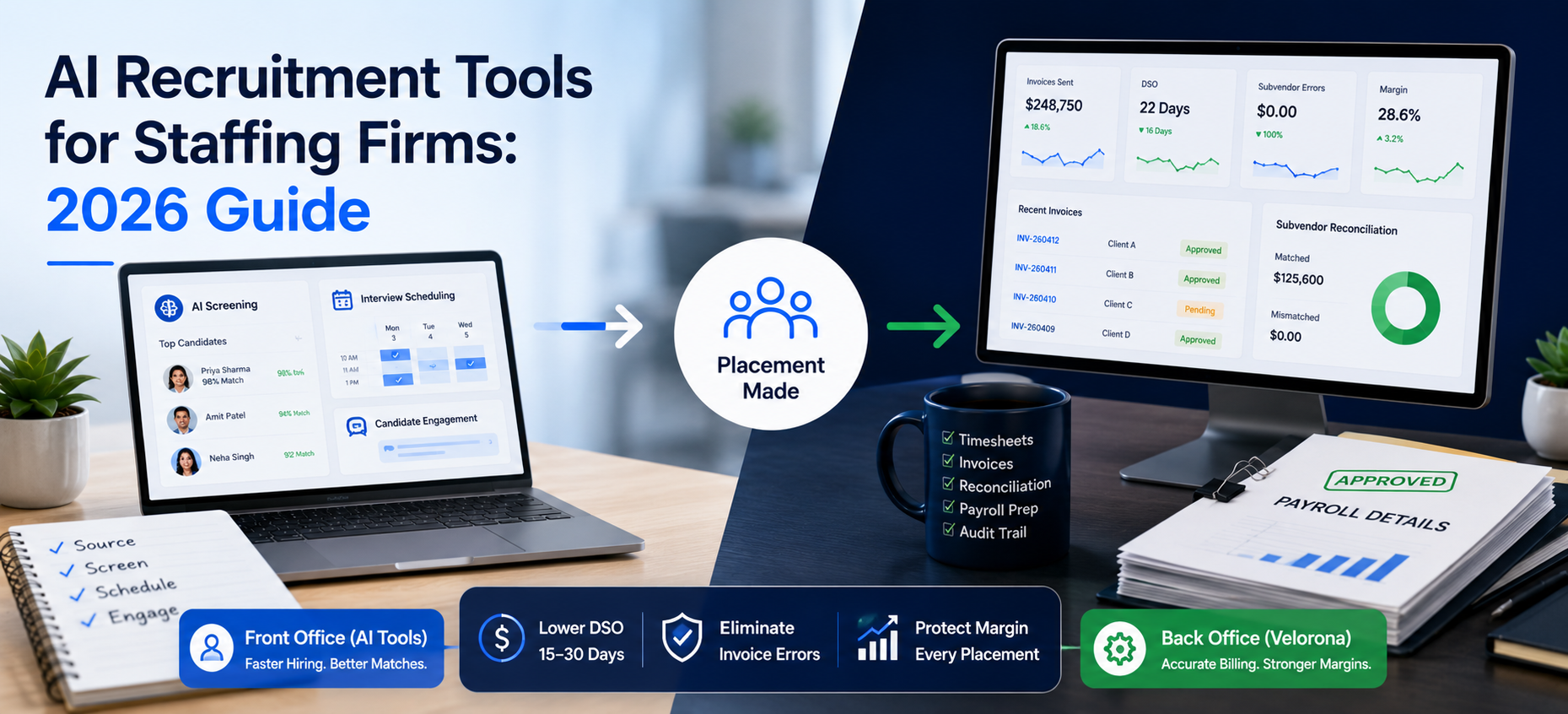
AI recruitment tools address the front-end hiring workflow: sourcing, screening, scheduling, candidate communication. What they do not address is what happens after placement — timesheet management, invoice generation, sub-vendor billing, expense tracking, and payroll. For staffing firms where the operational chaos lives in the back office, Velorona is built for that problem specifically.

The platform connects schedule creation to timesheet submission to automatic invoice generation to payroll, without manual data transfer between stages. Clients review and accept invoices through a shared portal rather than email threads. Sub-vendor C2C invoices run on a parallel cycle from the same approved timesheet. Multiple company entities are accessible under a single login. A firm whose invoices are wrong because approved hours are manually transferred into a billing spreadsheet does not need better candidate matching — it needs the timesheet and the invoice to be connected. That is a different category of solution.

Conclusion

The recruitment landscape in 2026 has moved past whether to use AI. The question is which AI, for which workflows, and whether the implementation is connected enough to the actual operation to produce measurable results.

The proven use cases — resume screening, candidate matching, interview scheduling, personalized outreach, administrative automation — deliver real returns when deployed against the specific workflows where they fit. The pitfalls — over-automation, compliance gaps, data quality failures, shiny object syndrome — are consistent and preventable with the right evaluation criteria and implementation methodology.

For staffing firms where the front-end hiring workflow is the bottleneck, purpose-built AI recruitment tools are the right investment. For firms where the bottleneck is the back office — billing errors, disconnected timesheets, manual sub-vendor reconciliation, invoices built by hand every cycle — the solution is operational connectivity. Velorona addresses that second category specifically: the staffing firm whose recruiters are placing candidates but whose operations team is still manually bridging the gap between approved hours and a finalized invoice.

Frequently Asked Questions

Q1. How has AI adoption in recruitment changed in recent years?

By 2026, 67% of firms have implemented AI recruitment tools, with enterprise organizations at 79% adoption. The shift is from isolated pilots to integrated deployment across the full recruitment lifecycle. The failure rate has risen alongside adoption — the industry is implementing more broadly but not always more effectively.

Q2. What are the most effective AI use cases in recruitment right now?

Resume screening delivers up to 75% reduction in screening time. Candidate matching with skill inference surfaces qualified candidates from existing databases that would otherwise go unactivated. Interview scheduling reduces coordination time from hours to minutes. Personalized AI messaging increases application rates by up to 50% and re-engages past candidates effectively. AI assistants that handle transcription, follow-up, and feedback prompting free recruiter time for higher-value work.

Q3. What are the most common reasons AI recruitment implementations fail?

Poor data quality is the most common technical cause — Gartner reports 60% of AI projects stall because data is inconsistent or incomplete. Over-automation that removes human judgment from rejection decisions creates compliance risk and candidate experience damage. Workflow misfit — selecting tools based on features rather than whether they address the actual bottleneck — produces tools that work in demos but stall before production. Compliance gaps under the EU AI Act and NYC Local Law 144 create legal exposure that surfaces after implementation has scaled.

Q4. How should staffing firms approach compliance when evaluating AI hiring tools?

Compliance should be an evaluation criterion from the start. The EU AI Act requires transparency in scoring decisions, bias audit documentation, human oversight protocols, and record-keeping for any AI used in hiring. NYC Local Law 144 requires annual bias audits for tools used on New York City candidates. Tools that cannot produce audit records, that lack bias testing, or that automate rejections without human review are compliance liabilities regardless of their performance metrics.

Q5. What is the difference between AI recruitment tools and a back-office platform like Velorona?

AI recruitment tools handle the front-end hiring workflow: sourcing candidates, screening resumes, scheduling interviews, and automating candidate communication. Velorona handles back-office operations: timesheet submission and approval, automatic invoice generation from approved hours, sub-vendor C2C invoice management, client-facing invoice review, expense tracking, and payroll. These are distinct problems. A firm that buys a front-end AI tool to solve a back-office billing problem will find the billing problem remains.

Q6. How can staffing firms maximize ROI from their AI investments?

Start with a documented baseline for the specific metric the tool is supposed to improve. Run a controlled pilot of four to twelve weeks before full deployment. Build role-specific training rather than generic platform orientation. Create internal champions who understand the tool deeply and support colleagues. Establish regular feedback loops that surface configuration improvements based on real usage patterns rather than vendor recommendations.