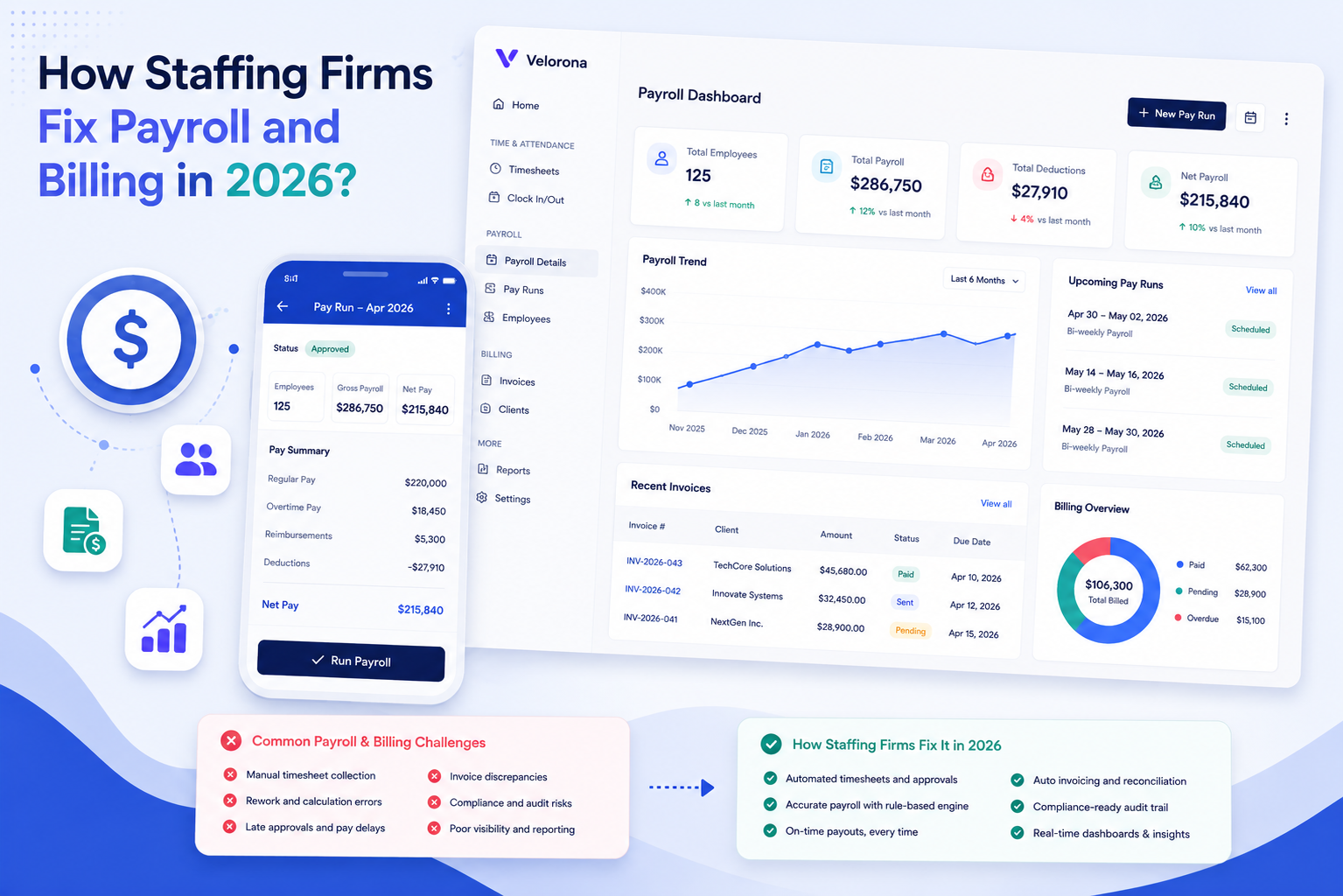
How Staffing Firms Fix Payroll and Billing in 2026?
The Back-Office Automation Guide for IT Staffing Operators
Payroll and billing break at staffing firms because data moves through too many manual handoffs — from approved hours to invoices, from timesheets to payroll, from sub-vendor invoices to payment approval. For firms managing W-2, 1099, and C2C workers across multiple clients, the fix is staffing back-office automation: connecting every step in one system so every downstream figure traces back to the same approved timesheet — and no manual transfer exists between them.
In 2026, the gap between firms that have solved this and firms that haven’t is widening — and it’s showing up in margins, client relationships, and staff turnover. This guide breaks down the four operational types, the 2026 market requirements, and what fixing billing and payroll software for staffing firms actually looks like in practice.
At a Glance: Four Firm Types, Four Failure Points, Four Fixes
Find your firm below. Each row maps to a full section.
| Firm Type | Failure Point | SEO Theme | Fix |
| Excel-first firm | Formula breaks, key person leaves, no audit trail | staffing back-office automation | Replace manual templates with automated timesheet-to-invoice workflow |
| Tools + spreadsheets | Manual data transfers between apps; $291 average error remediation cost | timesheet to invoice workflow | Connect time tracking directly to invoicing — no export/re-entry |
| Siloed tools firm | 5 logins, 5 data sets; real-time margin visibility impossible | margin visibility staffing firm | Consolidate onto one platform with shared records |
| Platform — hitting ceiling | C2C sub-vendor invoicing requires workarounds at scale | C2C billing automation | Bidirectional sub-vendor invoice reconciliation in the same system |
Each failure point is explained in detail below — with what it costs, why it happens, and what the fix looks like in practice.
Why Does Staffing Billing Break at Scale? The Numbers Behind the Problem
The scale of payroll errors in the U.S. surprises even industry professionals. For staffing firms, these numbers compound — you’re not managing one payroll, you’re managing dozens of pay schedules, multiple employment types (W-2, hourly, C2C), variable bill rates per client, and invoice cycles that may not align with pay cycles.
Key data points:
54% of U.S. workers are affected by payroll problems every year — G2 / Workforce Institute
70% of American workers say a one-week pay delay would cause financial difficulty — American Payroll Association
50% of employees start actively job-hunting after just two payroll errors — Kronos / UKG
51% of small businesses still use spreadsheets for payroll processing — G2 Research
53% of companies have incurred compliance penalties in the last five years — G2 Research
53% of staffing firms have made payroll and billing automation their #1 priority — ahead of AI recruiting — Bullhorn
That last statistic from Bullhorn’s annual industry research is telling. When staffing operations leaders are asked what they’re automating first, the answer isn’t AI recruiting or ATS platforms — it’s the back office: timesheet collection, invoice generation, and pay runs.
Four Ways IT Staffing Firms Currently Manage Payroll and Billing
Staffing firms tend to fall into one of four operational categories. Each has a different failure point — and a different path to fixing it.
Type 1: The Excel-First Firm — Why Staffing Billing Breaks Here
This is more common than most people admit. Timesheets come in by email or PDF. Invoices are built from a template. Pay calculations run on formulas someone wrote years ago. 51% of organisations still use spreadsheets and manual processes for payrollG2 / ADP).
The failure mode isn’t always obvious until it happens:
- A key person leaves and takes institutional knowledge with them
- A formula breaks and nobody catches it for two pay cycles
- A client questions an invoice and there’s no clean audit trail linking timesheet to bill
Scenario: A 35-consultant IT staffing firm runs invoices out of Excel. Their ops manager of four years resigns in March. By mid-April, two clients have received incorrect invoices — one underbilled by $3,200, one overbilled by $1,800. The new hire spends six weeks reconstructing the formula logic before the billing cycle stabilises.
The underappreciated risk: this approach doesn’t scale. Adding five new consultants doesn’t add five minutes of admin — it adds five email chains, five timesheet files, five manual invoice calculations. Overhead grows linearly with headcount.
Type 2: The Tools-Plus-Spreadsheets Firm — The $291-Per-Error Transfer Problem
This firm has made some investments. There’s a time tracking tool. Maybe a basic invoicing app. But the tools don’t connect, so spreadsheets live between them — as a translation layer, a buffer, a place where data gets reformatted before it can move to the next step.
The practical result: a payroll admin spends part of every week manually pulling approved hours from one system, reformatting them, and entering them into another. Each transfer is a chance for a mistake — and each mistake costs an average of $291 to remediate when it involves a payroll error that reaches an employee.
Scenario: A payroll admin at a 50-consultant firm spends every Monday morning exporting timesheet data, reformatting it in Excel, and importing it into their invoicing tool. One Monday, a column header mismatch causes 12 hours to be dropped from a client invoice. The client receives an underbill. The correction takes three days and two emails to resolve — and the client questions the firm’s accuracy on the next call.
This is also where reconciliation becomes painful. When a client disputes an invoice, the admin has to cross-reference three different systems to verify the hours. That takes time they don’t have, and it erodes client trust even if the original numbers were right.
Type 3: The Siloed-Tools Firm — Five Logins, No Margin Visibility
This firm invested in purpose-built software but bought separately for each function: a scheduling tool, a timesheet tool, a standalone billing platform, a payroll processor. Five logins. Five data sets. Five places to look when something goes wrong.
94% of business leaders worldwide want payroll software integrated across all HR systems — ADP / SSR
Getting a clear picture of margin visibility per client — or labour cost versus revenue in real time — requires pulling from multiple systems and building the view manually in a spreadsheet. Which brings you back to Type 1.
Scenario: A firm’s founder wants to know their gross margin on their top three clients before a quarterly review. Her finance manager needs two days and a four-tab spreadsheet to produce the answer. By the time the analysis exists, one of the clients has already renewed at the old rate.
Type 4: Already on a Platform — But Hitting the C2C Ceiling
Some firms have already consolidated. Spreadsheets are mostly gone. But they’re hitting constraints: the invoicing isn’t flexible enough for certain billing arrangements, or Corp-to-Corp sub-vendor invoicing requires a workaround that’s becoming a problem at scale.
These firms aren’t starting over — they’re evaluating whether the platform they chose a few years ago still fits the business they’re running now. The key question: does this system handle the staffing billing cycle end-to-end, or is it a general payroll tool that happens to serve staffing firms?
Scenario: A firm on a general payroll platform manages 20 C2C contractors. Every billing cycle requires a manual spreadsheet step to reconcile what sub-vendors invoiced against what hours were approved — the platform doesn’t handle incoming sub-vendor invoices at all. At $500K sub-vendor spend, this gap costs the firm an estimated $12–25K per year in undetected overbilling.
What the 2026 Staffing Market Demands from Back-Office Software
The staffing sector is projected to reach $183 billion in 2026, growing modestly at ~2% after several years of sharper swings (SIA). Tighter margins mean firms can’t make up for operational inefficiency with volume growth the way they could in 2021–2022.
Against this backdrop, here is what billing and payroll software for staffing firms actually needs to do in 2026:
| Requirement | Why it matters in 2026 | Velorona feature |
| Time capture to invoice — no manual transfer | Weekly billing cycles + 67% of workers paid weekly means the error window is narrow | See feature → |
| Client-facing invoice review portal (not email) | Clients expect transparent shared workflow; email invoices create DSO drag | See feature → |
| Sub-vendor and C2C billing in the same system | C2C arrangements require both outgoing client invoices and incoming sub-vendor invoices | See feature → |
| Payroll tied to the same records as billing | Separate systems force manual reconciliation every pay cycle | See feature → |
| Approval workflow with full audit trail | Rising compliance risk (CA 2025 law changes) requires verifiable approval timestamps | See feature → |
Why Does Staffing Billing Break at Scale? The Root Cause in One Diagram
Every failure type above shares the same root: data moving through manual handoffs. The fix is removing those handoffs entirely.
The fix is not adding a better spreadsheet. It is connecting the data at the source — the approach behind every feature in Velorona’s IT staffing platform.
What Fixing Staffing Back-Office Automation Actually Looks Like
The firms that have gotten this right share four operational patterns. None involve AI recruiting or ATS platforms — the back-office fixes are quieter but more impactful on cash flow and client retention.
1. How Do Staffing Firms Reduce Invoice Errors? Approved Hours Flow Automatically
When a time entry is approved, the hours should flow directly into the invoice generation process — no copy-paste, no reformatting, no re-entry. This single change eliminates the most common source of billing errors.
Companies using payroll automation report 33% greater effectiveness and 31% fewer payroll errors compared to manual processes. For a staffing firm billing dozens of clients weekly, even a 31% error reduction represents a significant reduction in correction cycles, client disputes, and late payments.
2. Why Does Email-Based Invoicing Hurt Cash Flow? Client Portal Review
An invoice sent as a PDF attachment can sit unread, get lost in a thread, or generate a back-and-forth that extends the payment timeline by days or weeks — directly inflating DSO. With a $183 billion market, even marginal improvements in days sales outstanding add up.
When clients review, accept, or reject invoices directly in a client invoice portal — with timesheet records available for verification — disputes get resolved faster, accepted invoices trigger automatic due dates, and the whole cycle is shorter.
3. Sub-Vendor Invoice Reconciliation: The $12–25K Annual Leak
This is the piece most platforms miss. Staffing firms using C2C contractors have two invoice flows running simultaneously: billing clients for the work, and receiving invoices from sub-vendors for the same work.
Velorona’s bidirectional sub-vendor invoice reconciliation handles both directions simultaneously. Outgoing client invoices generate automatically from approved timesheet hours. Incoming sub-vendor invoices are auto-matched against those same approved hours before payment. Mismatches — where a sub-vendor invoiced for 40 hours and the consultant worked 36 — are flagged in a review queue before money leaves the account.
For a staffing firm with $500K in sub-vendor spend, this typically catches $12–25K per year in errors that manual eyeballing misses. That figure is the margin recovery in year one.
4. Payroll Tied to the Same Records as Billing — No Separate Reconciliation
When payroll data lives separately from billing data, you eventually get the question: why doesn’t this payroll figure match this invoice? The answer usually involves digging through two systems. The fix: payroll configuration in the same system as time tracking and invoicing, so data traces back to one approved source record.
73% of companies report higher total payroll expenses year-over-year — accurate records are critical for cost management — WTW / SSR
Where Velorona Fits: Back-Office Software Built for the Staffing Billing Cycle
Velorona is billing software for staffing — not a general payroll platform adapted for staffing. It was designed specifically around the staffing billing cycle: time tracking → approval → invoice → client review → payment, with sub-vendor invoicing handled on the same platform as client billing.
Time Tracking: Timesheets and Timelogs
Velorona supports both structured weekly timesheets and real-time clock-in/clock-out timelogs — with both available on web and mobile. For field-based workers, timelogs include geolocation capture. Both formats go through an approval workflow before they’re eligible for invoicing.
Automatic Invoice Generation from Approved Hours
Once a client is configured with an invoicing schedule, a bill rate, and payment terms, invoices generate automatically from approved time entries — sent to clients for review in the platform, not by email. Clients accept or reject. Accepted invoices auto-finalise with due dates set per payment terms.
Sub-Vendor and C2C Billing in One System
Velorona handles both sides of C2C billing automation: automatic client invoicing from approved hours, and incoming sub-vendor invoice matching against those same records. This is the only platform under $15K ACV that handles both directions simultaneously.
Expense Management Without a Separate Tool
Employees submit expenses in the same platform they use for timesheets. Admins review, approve, and track against the employee record. Nothing moves through email. No separate expense tool to reconcile at month-end.
Payroll Details Tied to the Same Employee Records
Pay group, pay period, processing days, and payment schedules are configured per employee in Velorona’s payroll module. Payroll details are visible to employees in the platform alongside their time records. Admins filter by pay period and mark payroll as paid — all without leaving the system that also holds time data and invoice records.
Multi-Company Support Under One Login
For staffing firms managing multiple entities or client verticals, Velorona allows switching between companies without logging out. The team and people module keeps the active company always visible — a straightforward feature that saves meaningful time for anyone managing more than one entity.
Who Gets the Most Value — and Who Doesn’t
Honest fit assessment matters more than overselling:
| Firm Profile | Fit | Note |
| Moving off spreadsheets | ✅ Best fit | Fastest, most significant improvement — immediate jump to automated billing |
| Tools-plus-spreadsheets workflow | ✅ Strong fit | Consolidation value is real; removes all manual inter-tool transfers |
| Siloed tools, no shared data | ✅ Strong fit | Especially if tools require manual data export between them |
| Already on a platform, hitting ceiling | ⚠️ Evaluate fit | Assess client review workflow and sub-vendor invoicing specifically |
| Deep legacy ERP integration needed | ❌ Not the right fit | Velorona is built for staffing ops, not general enterprise configuration |
Frequently Asked Questions
How do staffing firms reduce invoice errors from sub-vendors?
The most effective method is bidirectional sub-vendor invoice reconciliation: every incoming sub-vendor invoice is auto-matched against approved consultant hours before payment is released. Mismatches are flagged in a review queue. At $500K sub-vendor spend, this typically catches $12–25K per year in overbilling. See Velorona’s sub-vendor feature →
Why does staffing billing break at scale?
The root cause is always manual handoffs between disconnected systems — timesheets in email, invoices in QuickBooks, sub-vendor costs in a separate spreadsheet, payroll in another tool. Each handoff introduces error risk, latency, and lost visibility. The fix is removing those handoffs by connecting data at the source. See how Velorona connects the staffing billing cycle →
How does Velorona handle C2C and Corp-to-Corp billing?
Velorona handles both the outgoing invoice to the client (auto-generated from approved hours) and the incoming invoice from the C2C sub-vendor (auto-matched against those same approved hours). Both sides are managed in one system, eliminating the manual spreadsheet reconciliation step that most firms run outside their platform.
Does Velorona have a client invoice portal?
Yes. Invoices are delivered to a client-facing review portal — not email. Clients can review, accept, or reject invoices with access to the underlying timesheet records. Accepted invoices auto-finalise with due dates. This eliminates the ‘I never received it’ dispute and typically reduces DSO by 15–30 days within the first quarter.
Does Velorona integrate with QuickBooks?
Velorona exports to QuickBooks via CSV today. Native QuickBooks Online integration is arriving Q3 2026. The CSV export covers the data transfer until the native connection is live. Contact us with integration questions →
What does Velorona not do?
Velorona is not an ATS. It does not source candidates, manage job orders, or track the recruiting pipeline. It is back-office software for staffing firms — timesheets, invoicing, sub-vendor billing, payroll details. If you need an ATS, CEIPAL and Bullhorn cover the front office. Velorona handles what comes after the placement.
How quickly can a staffing firm go live on Velorona?
Live in 5–14 days. No setup fees. No implementation cost. Historical data imports via CSV. See pricing → or book a demo →
The Honest Bottom Line
The staffing industry’s front office has seen enormous investment in AI recruiting, candidate matching, and ATS platforms. The back office — invoice reconciliation, timesheet-to-payroll connectivity, sub-vendor billing, client portal delivery — has lagged behind.
That lag is measurable:
- 51% of firms still using spreadsheets (G2)
- 53% having incurred compliance penalties in the last five years (G2)
- $12–25K per year in sub-vendor invoice errors most firms never catch
- $291 average cost to remediate each payroll error that reaches an employee
The fix is connecting the data at the source. Approved hours flow to invoices automatically. Sub-vendor invoices are matched before payment. Client invoices are delivered to a portal, not an inbox. Payroll details are populated from the same record as the invoice. One system, one approved timesheet, every downstream figure consistent.
That is what Velorona does. It is not an ATS, not an AI recruiting tool, not a general payroll platform. It is back-office software for IT staffing firms — from timesheet approval to client invoice to sub-vendor reconciliation to payroll details — built specifically for firms managing 30–300 consultants.
See how Velorona handles staffing payroll and billing
If your firm is still managing timesheets, invoices, and payroll across disconnected tools or spreadsheets, Velorona is built to replace that entire workflow.
Book a demo | See pricing | Request a quote
Live in 5–14 days. No setup fee. No implementation cost.