Why Payroll and Billing Still Break at Staffing Firms in 2026 — and What Actually Fixes It
The U.S. staffing industry is a $183 billion market heading into 2026. Over 26,000 staffing companies operate across roughly 49,000 offices. They collectively connect around 11 million temporary and contract workers with jobs every year.
That’s an enormous operational engine. And underneath all of it — underneath every placement, every contractor, every client contract — is a back-office problem that most staffing firms haven’t fully solved: getting the right people paid accurately and on time, while simultaneously billing clients correctly, and doing it without building a small army of payroll admins to hold the whole thing together.
This is not a new problem. But in 2026, the gap between firms that have solved it and firms that haven’t is getting wider — and it’s starting to show up in margins, in client relationships, and in staff turnover.
The Numbers Behind the Problem
Let’s start with what the data actually shows: the scale of payroll errors in the U.S. is surprising even to industry professionals.
| 54% | of U.S. workers — that’s 82 million people — are affected by payroll problems every year | G2 / Workforce Institute |
| 70% | of American workers say a one-week pay delay would cause them financial difficulty | American Payroll Assoc. |
| 50% | of employees start actively job hunting after just two payroll errors | Kronos / UKG |
| 51% | of small businesses still use spreadsheets for payroll processing | G2 Research |
| 53% | of companies have incurred compliance penalties in the last five years | G2 Research |
For staffing firms, these numbers compound. You’re not managing a single payroll for one employer — you’re managing dozens of pay schedules, multiple employment types (W2, hourly, seasonal, Corp-to-Corp), variable bill rates per client, and invoice cycles that may not align with pay cycles. The margin for error is thin, and the consequences of getting it wrong — losing a contractor, triggering a compliance penalty, or damaging a client relationship over a disputed invoice — are immediate.
| Payroll and billing is the #1 task that staffing firms are automating — ahead of screening, onboarding, and candidate sourcing. 53% of firms have already made it a priority. (Bullhorn) |
That statistic from Bullhorn’s annual industry research is telling. When staffing operations leaders are asked what they’re automating first, the answer isn’t AI recruiting or automated hiring systems — it’s the unglamorous back office: timesheet collection, invoice generation, and pay runs.
The front-office tools have gotten a lot of attention. AI recruiting, automated hiring systems, ATS platforms with sourcing and matching capabilities — that ecosystem has matured quickly. The back office is catching up, but many firms are still running on a combination of tools that weren’t designed to work together.
Four Ways Staffing Firms Currently Manage Payroll and Billing
Based on what’s actually happening in the market — not theory — staffing firms tend to fall into one of four operational categories when it comes to payroll and billing. Each has a different failure point.
The Excel-first firm
This is more common than most people admit. Timesheets come in by email or PDF. Invoices are built from a template. Pay calculations run on formulas that someone wrote years ago.
The failure mode here isn’t always obvious until it happens. Things run fine until a key person leaves and takes the institutional knowledge with them. Or until a formula breaks and nobody catches it for two pay cycles. Or until a client questions an invoice and the firm realizes there’s no clean audit trail linking the timesheet to the bill.
| 51% | of organizations still use spreadsheets and manual processes for payroll | G2 / ADP |
The other underappreciated risk: this approach doesn’t scale. Adding five new contractors doesn’t add five minutes of admin work — it adds five separate email chains, five timesheet files, five manual invoice calculations. The overhead grows linearly with headcount.
The tools-plus-spreadsheets firm
This firm has made some investments. There’s a time tracking tool. Maybe a basic invoicing app. But the tools don’t connect, so spreadsheets live in between them — as a translation layer, as a buffer, as a place where data gets reformatted before it can move to the next step.
The practical result: a payroll admin spends part of every week manually pulling approved hours from one system, reformatting them, and entering them into another. Each transfer is a chance for a mistake. And each mistake costs an average of $291 to remediate when it involves a payroll error that reaches an employee.
This is also where reconciliation becomes painful. When a client disputes an invoice, the admin has to cross-reference three different systems to verify the hours. That takes time they don’t have, and it erodes client trust even if the original numbers were right.
The siloed-tools firm
This firm went the other direction and invested in purpose-built software — but bought separately for each function. A scheduling tool here. A timesheet tool there. A standalone billing platform. A payroll processor with its own portal.
Five logins. Five data sets. Five places to look when something goes wrong. The tools are individually good, but the firm is paying the integration tax — hours spent exporting data, reformatting, importing, reconciling discrepancies between systems that see the same worker differently.
| 94% | of business leaders worldwide say they want payroll software integrated across all HR systems | ADP / SSR |
The siloed approach also makes reporting harder. Getting a clear picture of gross margin per client, or labor cost versus revenue in real time, requires pulling from multiple systems and building the view manually in a spreadsheet. Which brings you back to the first problem.
The firm already on a platform — but hitting the ceiling
Some firms have already consolidated. They’re on a staffing platform of some kind. The spreadsheets are mostly gone. But they’ve started running into constraints: the invoicing isn’t flexible enough for certain client billing arrangements, the client-facing review process is clunky, or Corp-to-Corp sub-vendor invoicing requires a workaround that’s becoming a problem at scale.
These firms aren’t starting over — they’re evaluating whether the platform they chose a few years ago still fits the business they’re running now. The evaluation criteria are specific: does this system actually handle the staffing billing cycle end-to-end, or is it a general payroll tool that happens to serve staffing firms?
What the 2026 Staffing Market Demands from Back-Office Software
The staffing sector is projected to reach $183 billion in 2026, growing modestly at around 2% after several years of sharper swings. That normalization means margins are tighter. Firms can’t make up for operational inefficiency with volume growth the way they could in 2021 and 2022.
At the same time, the workforce itself is changing in ways that add complexity:
- 67% of U.S. staffing workers are paid weekly — the most demanding pay cadence from an admin perspective (SIA)
- Corp-to-Corp arrangements are growing as more contractors prefer the 1099/C2C structure over W2 employment
- Client expectations around invoice transparency have risen sharply — buyers want to see the work behind the bill, not just a line item
- Regulatory risk is increasing, with California’s 2025 employment law changes raising the stakes on misclassification, overtime accuracy, and wage-and-hour compliance across the industry
Against this backdrop, what does back-office software actually need to do for a staffing firm in 2026? The answer isn’t complicated, but it is specific:
| Requirement | Why it matters in 2026 |
| Time capture to invoice — no manual transfer | Each manual step adds latency and error risk. With weekly billing cycles and 67% of workers paid weekly, the window for mistakes is narrow. |
| Client-facing invoice review (not email) | Clients increasingly expect a shared, transparent workflow — not a PDF attachment and a follow-up call two weeks later. |
| Sub-vendor and C2C billing in the same system | C2C arrangements require tracking both outgoing invoices (to clients) and incoming invoices (from sub-vendors). Most systems handle one side. Few handle both. |
| Payroll tied to the same records as billing | When payroll data and billing data live in separate systems, reconciliation becomes a recurring manual task. Every discrepancy requires investigation. |
| Approval workflow that creates an audit trail | With compliance risk rising, staffing firms need to be able to show exactly who approved what hours and when — before invoicing happened. |
These aren’t advanced requirements. They’re table stakes — and yet a surprising number of firms in 2026 are still not meeting them, either because they’re running on spreadsheets, or because the tools they’ve bought don’t actually connect.
What Fixing the Back Office Actually Looks Like
The firms that have gotten this right share a few operational patterns. None of them are about AI recruiting or automated hiring systems — those are front-office wins. The back-office fixes are quieter but arguably more impactful on cash flow and client retention.
Approved hours automatically populate invoices
This single change eliminates the most common source of billing errors: the manual transfer of timesheet data into an invoice. When a time entry is approved, the hours should flow directly into the invoice generation process — no copy-paste, no reformatting, no re-entry.
The math on why this matters: companies using payroll automation report 33% greater effectiveness and 31% fewer payroll errors compared to manual processes. For a staffing firm billing dozens of clients on a weekly or biweekly schedule, even a 31% error reduction represents a significant reduction in correction cycles, client disputes, and late payments.
Clients review and accept invoices on a shared platform
One of the less-discussed costs of the email-based invoice process is the delay it creates. An invoice sent as a PDF attachment can sit unread, get lost in a thread, or generate a back-and-forth that extends the payment timeline by days or weeks. With a $183 billion market, even marginal improvements in days sales outstanding (DSO) add up.
When clients can review, accept, or reject invoices directly in a platform — with the timesheet records available for verification — disputes get resolved faster, accepted invoices trigger automatic due dates based on payment terms, and the whole cycle is shorter.
Sub-vendor invoicing handled in the same system as client invoicing
This is the piece that most platforms miss. Staffing firms that use Corp-to-Corp contractors have two invoice flows running simultaneously: they’re billing clients for the work, and they’re receiving invoices from sub-vendors for the same work. If these are managed in separate systems, reconciliation is a recurring manual task and disputes are hard to resolve quickly.
A unified system — where incoming sub-vendor invoices and outgoing client invoices are both tracked, both tied to the same time records, and both reviewable on one screen — is the structural fix. It’s not glamorous. It saves hours every billing cycle.
Payroll details tied to the same records, not calculated separately
When payroll data lives separately from billing data, you eventually get the question: why doesn’t this payroll figure match this invoice? The answer usually involves digging through two systems to find the discrepancy. The fix is having payroll configured in the same system as time tracking and invoicing, so the data traces back to the same source.
| 73% | of companies report higher total payroll expenses than the previous year — accurate records are critical for managing cost | WTW / SSR |
For a staffing firm managing dozens of employees across multiple clients, this isn’t an abstract benefit — it’s the difference between a payroll admin who spends half their day reconciling discrepancies versus one who can focus on exceptions and edge cases.
Where Velorona Fits
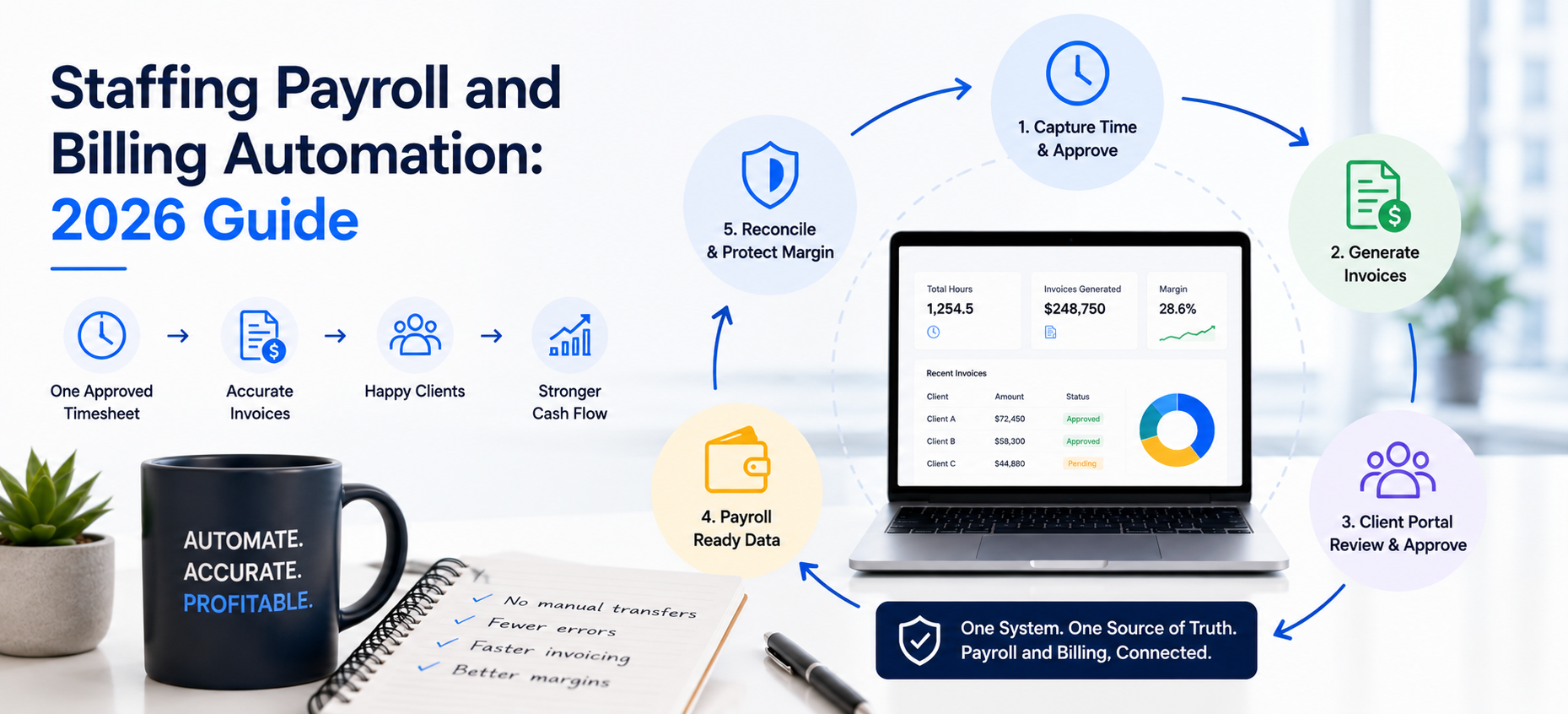
Velorona is billing software for staffing built specifically around the operational shape described above. It’s not a general payroll platform adapted for staffing — it was designed from the beginning around the staffing billing cycle: time tracking → approval → invoice → client review → payment, with sub-vendor invoicing handled on the same platform as client billing.
A few things worth noting about what it actually does, based on the platform documentation:
Time tracking covers both timesheets and timelogs
Velorona supports both structured weekly timesheets and real-time clock-in/clock-out timelogs — with both available on web and mobile. For staffing firms with field-based workers, timelogs include geolocation capture, which creates a verifiable record tied to each time entry. Both formats go through an approval workflow before they’re eligible for invoicing.
Automatic invoice generation from approved hours
Once a client is configured with an invoicing schedule (weekly, biweekly, semi-monthly, or monthly), a bill rate, and payment terms, invoices generate automatically from approved time entries. They’re sent to clients for review within the platform — not by email attachment. Clients can accept or reject. Accepted invoices auto-finalize, and the due date is set based on the payment terms configured at the client level.
Manual invoicing is also available — by employee, by client, or as a general one-off invoice — for situations that don’t fit the automated schedule.
Sub-vendor and Corp-to-Corp billing on the same platform
This is the piece that matters for firms with C2C contractors. Velorona handles both sides: automatic invoicing to clients based on approved hours, and automatic invoicing from sub-vendors using the same time records. Incoming invoices from sub-vendors are reviewed and accepted or rejected in the same system. For a payroll admin reconciling both sides of a C2C arrangement, everything is in one place.
Expense management without a separate tool
Employees submit expenses in the same platform they use for timesheets. Admins review and approve. Once approved, expenses can be marked as paid and tracked against the employee record. Nothing moves through email. No separate expense tool to reconcile at month-end.
Payroll configuration tied to the same employee records
Pay group, pay period, processing days, and payment schedules are configured per employee in Velorona. Payroll details are visible to employees in the platform alongside their time records. Admins can view payroll by employee, filter by pay period, and mark payroll as paid — all without leaving the system that also holds the time data and invoice records.
Multi-company support under one login
For staffing firms that manage multiple entities, brands, or client verticals under separate company structures, Velorona allows switching between companies without logging out. The active company is always visible. This is a straightforward operational feature that saves meaningful time for anyone managing more than one entity.
Who Gets the Most Value — and Who Doesn’t
Being honest about fit matters more than overselling. Here’s the realistic breakdown:
| Firms moving off spreadsheets or off a tools-plus-spreadsheets workflow will see the fastest and most significant improvement. The jump from manual invoice creation to automated billing tied to approved timesheets is immediate. |
Firms with siloed tools will also benefit substantially — particularly if those tools don’t currently share data and require manual transfers between systems. The consolidation value is real.
Firms already on a platform should evaluate specifically whether Velorona’s client review workflow and sub-vendor invoicing fit their operations better than what they have. If those are pain points, it’s worth a direct comparison.
Firms that need deep integration with legacy ERP systems or highly customized enterprise payroll configurations will want to evaluate carefully. Velorona is built for staffing operations — it’s not a general enterprise platform, and it doesn’t try to be.
The Honest Bottom Line
The staffing industry’s front-office has seen enormous investment in ai recruiting, candidate matching, and automated hiring systems over the last several years. The back-office — payroll billing software, invoice automation, sub-vendor management — has lagged behind.
That lag is measurable. 51% of firms still using spreadsheets. 53% having incurred compliance penalties in the last five years. 70% of workers saying a one-week pay delay causes financial hardship. These aren’t hypothetical risks — they’re operational costs that compound month over month.
The firms that close this gap in 2026 will do it the same way any operational improvement happens: by replacing disconnected, manual processes with a system that actually connects the dots. Time data → approval → invoice → client review → payment. One record, one system, one place to look when a question comes up.
That’s the fix. It’s not flashy. It works.
| See how Velorona handles staffing payroll and billing If your firm is still managing timesheets, invoices, and payroll across disconnected tools or spreadsheets, Velorona is built to replace that entire workflow. Book a demo at velorona.com. |